


The US formally seized two shipping containers housing training workstations made by a South African flight academy.
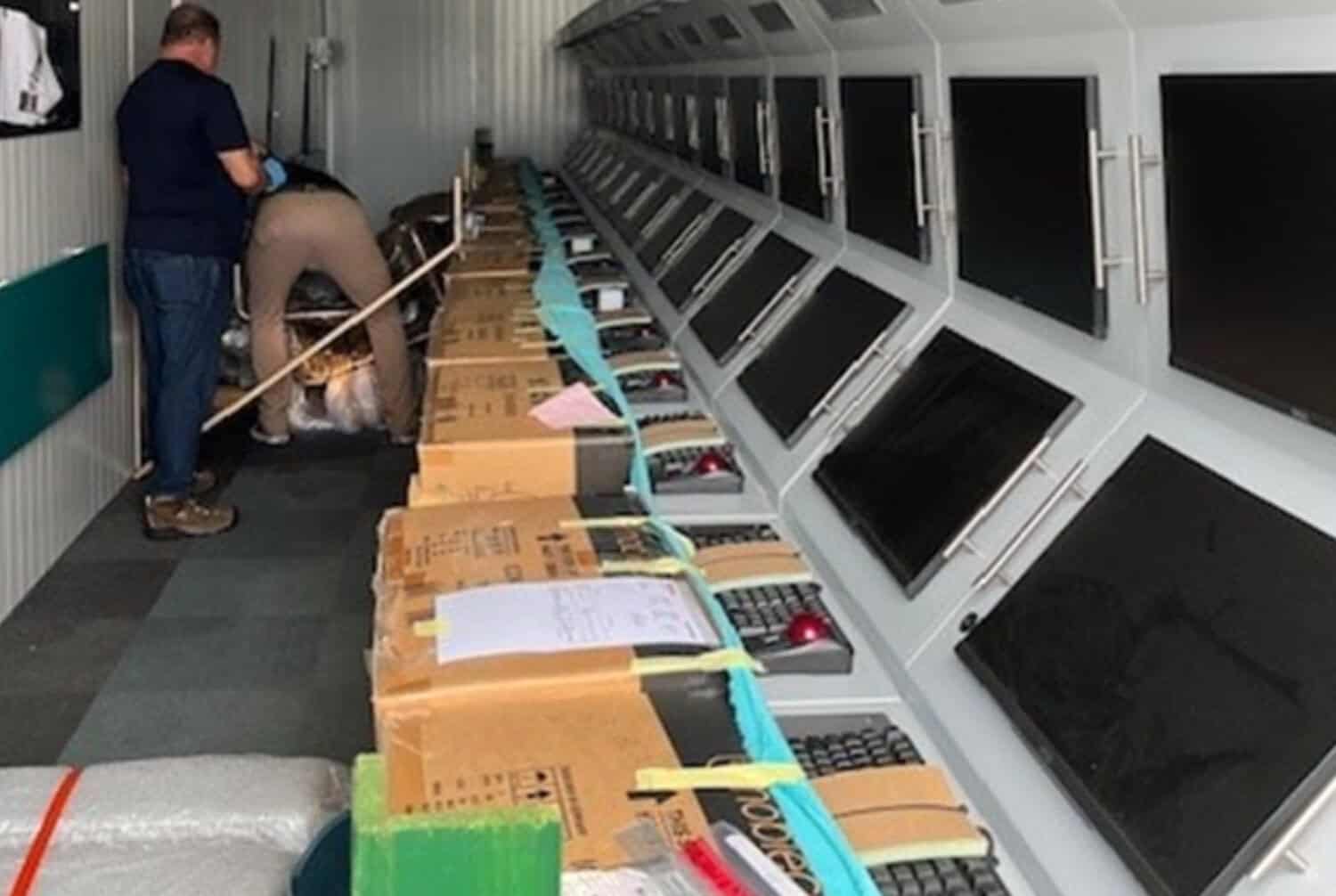
The contents of the containers confiscated by US officials. Picture: US Department of Justice


The US Department of Justice has accused a South African training academy of masking its operations to smuggle information to the Chinese military.
US officials on Thursday confirmed that documentation had been filed to seize two mission crew trainers — mobile simulators — produced by Test Flying Academy of South Africa (TFASA).
The flight simulator and training consoles were housed in shipping containers and were initially seized in Singapore in November 2024 while on a Chinese-owned ship en route to China.
TFASA denied any wrongdoing, releasing the results of a 2025 independent investigation into the confiscation.
TFASA ‘masquerades’ as civilian entity
US officials claim the mobile classrooms were intended to assist China’s People’s Liberation Army (PLA) with airborne anti-submarine training using protected US technologies.
“The TFASA illegally exported US military flight simulator technology and recruited former Nato pilots for the purpose of training China’s military, jeopardising US national security and placing the lives of American service members at risk,” said Roman Rozhavsk, FBI Counterintelligence and Espionage assistant director.
“TFASA masquerades as a civilian flight-training academy, when in fact, it is a significant enabler of the Chinese air and naval forces and a pipeline for transferring Nato aviation expertise, operational knowledge and restricted technology directly to the People’s Liberation Army,” said John Eisenberg, US assistant attorney general for national security.
Court documents allege that TFASA’s supply of the simulators was codenamed Project Elgar and was aimed at training PLA pilots to identify US submarines in the Pacific.
US officials claim the training simulators were based on a product manufactured by Boeing which serves as the US’ primary operations platform for its patrol aircraft.
“The software used a basic flight simulator programme designed and marketed by a US company, which TFASA software engineers then enhanced using technical data relating to Western anti-submarine warfare aircraft,” the US justice department’s statement reads.
‘No evidence of illegal software’
TFASA rejected the US claims, saying that it had acted lawfully and that no Nato expertise, US military technology or technical data was being transferred.
The independent investigation’s report — released without identifying the party that conducted the investigation — states that no advanced systems or flight simulation equipment were present in the containers.
“Each mobile learning unit consists solely of individual workstations, each featuring a desk with a monitor cutout and a commercial off-the-shelf Windows PC,” the report reads.
The report adds that “project-specific software” was removed before shipment and that the only software on the computers were licensed Windows products and commercial Lockheed Martin 3D training programmes.
“There is no evidence of illegal software use or export violations. The current software claims appear to stem from an overreach based on unauthorised access to historic backup data, not from the actual condition or contents of the shipped containers,” the report concluded.
As per the report, the Chinese company shipping the containers had redirected inquiries into the matter and had not provided adequate feedback.
“The lack of transparency and coordination strongly suggests that the matter is being managed under a broader geopolitical directive, rather than through standard legal or commercial processes,” the report said.
‘Threatening US national security’
TFASA said that they were aware that their supply of the training devices had the potential to attract “heightened international attention and differing policy views”.
It added that the shipment was sent “lawfully and in good faith” under the belief that prior vetting was substantive enough to withstand scrutiny from authorities.
“TFASA has at all times acted transparently and without any intent to conceal the nature or purpose of the equipment,” TFASA said.
US officials added that this was not the first instance of TFASA allegedly assisting the PLA, saying that TFASA was in 2023 added to a list of entities using Nato resources to act against US interests.
“TFASA was founded in 2003 with the support of the South African government to facilitate cooperation with China
“This interdiction is a product of the US government’s coordinated effort to stop the PLA and its enablers from further threatening US national security,” the US justice department said.
NOW READ: ‘SA can’t lecture world on justice while cosying up to Iran,’ US Embassy slams Pretoria
Support Local Journalism
Add The Citizen as a Preferred Source on Google and follow us on Google News to see more of our trusted reporting in Google News and Top Stories.

