
A portion of genius at King Shaka International Airport
Khaleesi is one of the working hawks at the Airport, helping keep the airspace free of other birds that could pose a danger to aircraft.
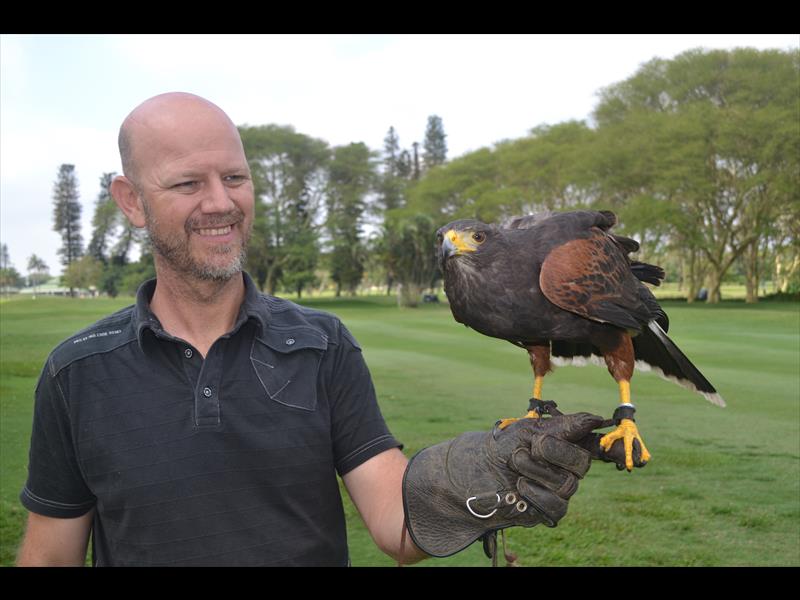
The poet William Blake once said every bird of prey was a little portion of genius, and when you meet Stephen Lourens’ four-year-old Harris Hawk, Khaleesi, you can understand why.
Khaleesi is one of the working hawks at King Shaka International Airport, helping keep the airspace free of other birds that could pose a danger to aircraft.
Birds of prey have become one of the most popular tools for this task, but that is not all her job entails. Khaleesi travels up and down KZN scaring geese off golf courses, keeping pigeons and other pest birds away from factories and and warehouses and keeping wild birds – possibly infected by bird flu – away from chicken farms and more.
“We are using nature to fight nature,” said Lourens, who has four Harris Hawks – two male and two female – in his business, Dirt Hawkers.
Lourens has been working professionally with birds of prey for 19 years and was a hobbyist before that. He told the Courier the object of their work was not to kill other birds, but rather to scare them away.
“As a predator, a hawk owns its space and it does not take too long before other birds start keeping clear of what they perceive as a dangerous area.”
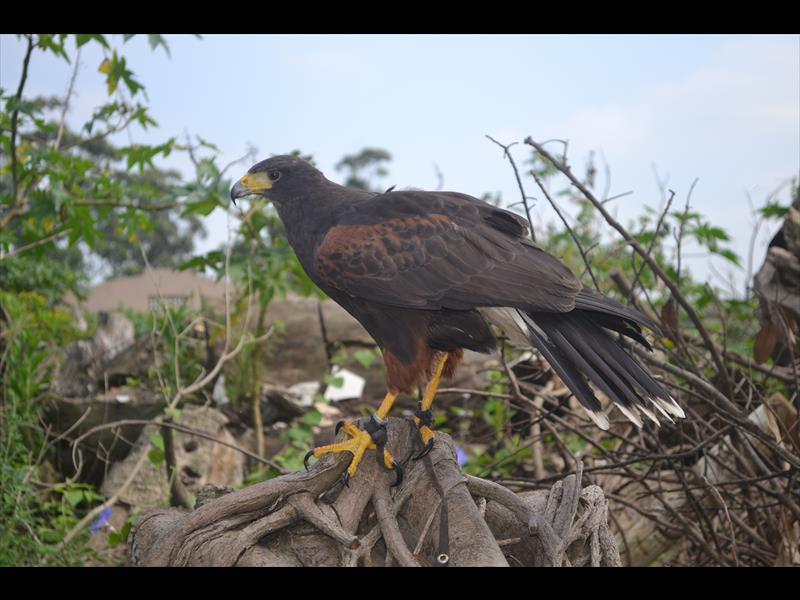
Of course, Khaleesi and her colleagues are wild creatures so occasionally they will make a kill, which is why Lourens flies them “fat”. The birds are already fed when they go out so it is less likely they will go for a kill.
According to Lourens most birds have a memory span of around three days, so he and his hawks make frequent visits to reinforce the fear.
A father of two himself, Lourens explained that his relationship with Khaleesi and the other birds is very much a trust based one.
“If she does not perceive our relationship as a positive thing for her, she will decide she can keep herself fed and could just fly away.”
Which is one of the reasons that, when feeding the hawks, Lourens never lets them see him taking the food away.
He has to hold the meat in a clenched fist and slowly tug it out the bottom with the other hand, then quickly hide it so the birds do not think he is withholding.
Naturally the birds are all fitted with trackers, but he prefers not to have to rely on these. The trackers are also a requirement given that the Harris Hawks, though locally bred, hail from South America.
A lot of work goes into monitoring the Hawks’ health: they are weighed twice a day, receive a small anti-bacterial dose every three days (pigeon flesh can be nasty stuff) and are dewormed every three months among a host of other precautions.
In the wild, Harris Hawks hunt cooperatively. Working together in small groups, the alpha female will find a spot in a tree while the rest of the hawks flush prey out in her direction. This “team spirit” is one of the reasons Harris Hawks work so well with humans.
>> Ready to say ‘I Do’ on the Dolphin Coast? Meet the team ready to advise, help and deliver on your big day.
>> Visit our Education feature for a collection of all the best schools, tutoring systems, and even some colleges and training facilities on the North Coast.

Do you want to receive news alerts via WhatsApp? Send us a WhatsApp message (not an sms) with your name and surname to 061 718 4438.
Please read our WhatsApp broadcast list disclaimer.
Join us on BBM at 59015786
Join the conversation on Facebook, Twitter and Instagram
Stay in the loop with The North Coast Courier on Facebook, X, Instagram & YouTube for the latest news.
Mobile users can join our WhatsApp Broadcast Service here, or if you’re on desktop, scan the QR code below.