

Beware the march of the deadly S.lupi worm, warn Ballito vets
The worm infestation first became a matter of concern more than 2 years ago, but an increasing number of cases have been identified ever since according to Ballito Vet Hospital's Dr Kevin Stevens and Dr Louis Gouws.

A parasitic worm that raises the risk of oesophageal cancer and spirocercosis in dogs Spirocerca lupi (S.lupi), continues to be a major threat to pets on the North Coast.
The worm infestation first became a matter of concern more than 2 years ago, but an increasing number of cases have been identified ever since according to Ballito Vet Hospital’s Dr Kevin Stevens and Dr Louis Gouws.
“We are still seeing cases virtually every week. As much as we try and warn people bringing in their pets, there still seems to be a lack of education on the dangers of this disease,” said Gouws.
The worm can be ingested in multiple different ways by an inquisitive dog left to its own devices.
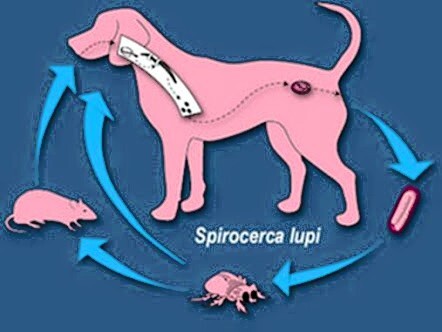
The lifecycle of an S.lupi worm is complicated and has to involve multiple hosts before reaching its final destination within your family pet.
Initially, in its first larval stage, the worm is ingested by dung beetles present in and around open spaces where animals defecate.
Once it reaches the beetle as a host, the worm will be in its third larval stage. At this point, S.lupi will likely move on through direct ingestion by lizards, birds or dogs.
Your dog is in danger at this point and the worm will spend weeks travelling through your pet’s arteries, eventually reaching its chest cavity and later the oesophagus.
It can cause an immediate aneurysm or be asymptomatic, later laying eggs and causing cancer. This process can take more than two years.
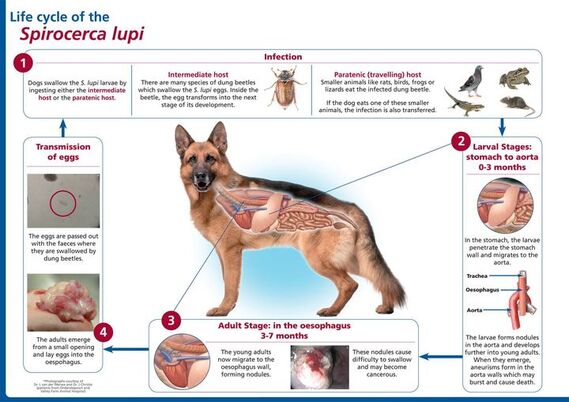
Photo: Fourways Vet Hospital – Facebook.
“It is difficult to identify and the only way to be certain is to do an endoscopy of the oesophagus, after which doramectin injection treatment will be recommended,” said Stevens.
“The best way to avoid your pet becoming infected is to regularly visit your vet for vaccinations and deworming. There are two deworming treatments that have been shown to be effective against S.lupi, Milbemax and Milpro.
“Your dog is at a much lower risk if you bring it for deworming every 3 to 4 months.”
If you notice any signs of change in your pet, including losing weight, retching or coughing, then it is crucial you take them to your local vet for an examination.
Aside from deworming, a good way to limit exposure is to remove animal faeces from your garden on a daily basis.
For breaking news follow The North Coast Courier on Facebook, Twitter, Instagram and YouTube.
Join our Telegram Broadcast Service at: https://t.me/joinchat/yJULuN8NaCs5OGM0
Join our WhatsApp Broadcast Service: Simply add 082 792 9405 (North Coast Courier) as a contact to your phone, and WhatsApp your name and surname to the same number to be added.
Stay in the loop with The North Coast Courier on Facebook, X, Instagram & YouTube for the latest news.
Mobile users can join our WhatsApp Broadcast Service here, or if you’re on desktop, scan the QR code below.