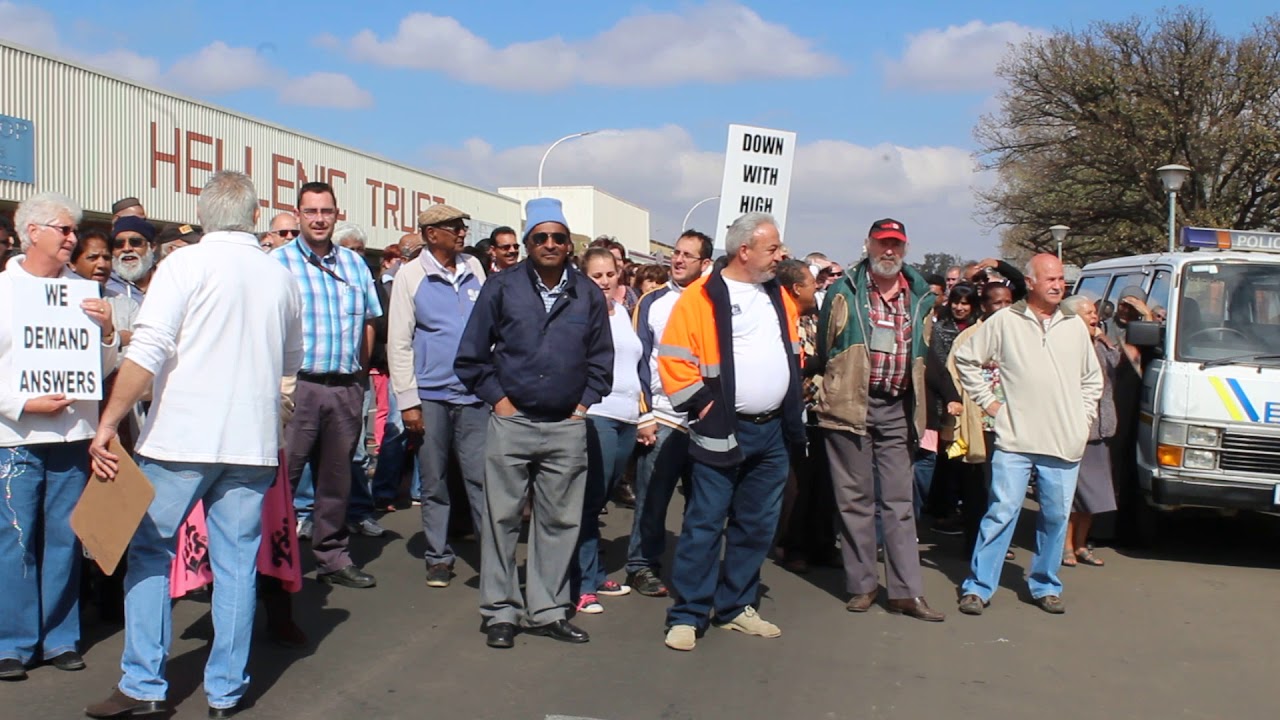
At a press briefing last Thursday, the municipality responded to almost all of the 13 points raised in the protest memorandum from the August 25 march.
Mayor, Makhosini Nkosi led this report back:
Q1 – Although there is no change in the structure of households, i.e. the same number of people living in the house using the same amount of water and electricity, utility bills fluctuate on a monthly basis by up to R1 00 per month. Why does this occur?
Response – Cllr Nkosi pointed out the understanding of the sentiments was that the municipality had already implemented the 6.2 per cent increase indicated in the Newcastle Advertiser – he said this was not correct.
At that time, he said, no tariff changes were effected and increases on municipal bills were not a result of the 2017/2018 tariffs.
Cllr Nkosi explained the billing system worked in arrears, which meant meter readings from July would have only reflected on the August account.
“It is our submission, our belief from the exercises we’ve conducted, to conclude that increased municipal bills are a direct result of increased consumption of electricity by households; nothing else.”
According to so-called historic trends, Cllr Nkosi said increased consumption reflected from May to August every year when cold weather kicked in.
To display this, he revealed what the municipality paid to Eskom in terms of electricity consumption.
In July 2016, an amount of R58 328 215 was paid to the utility, compared to R32-million in December 2016.
From January this year (R35 673 110), the amount increased in June and July to more than R55-million.
“If you compare January to July, it’s in agreement with what we’ve said. The municipality doesn’t determine how much we are charged for consumption.”
Q2 – Meters are read monthly, however a month can run anywhere from 23 days to 31 days. When the monthly reading is extended by a few days, the electricity charges are pushed up into the higher block tariff. Why are meters not read on a permanent 25 day basis.
Response – Cllr Nkosi explained the normal reading period was between 29 and 32 days, meaning the date between the previous month and current month was 31/32 days.
He said the reason was the meter reading process could only begin two days after processing of the monthly levies.
Route lists were printed the day after the levy process, with the meter reading process beginning the next day.
Cllr Nkosi added levies were processed on a predetermined date; the municipality cannot process levies on any day of the month.
“There may be instances of estimations but it hardly happens.”
If a consumer received a bill which indicated estimations, Cllr Nkosi encouraged them to come forward.
He said there was no reason not to believe officials, but also stated that if what a politician said was proven wrong, it had to be brought to the attention of authorities.
However, he said dealing with more than 50 000 households meant mistakes were bound to happen.
Q3 – Our understanding is that Nersa ruled to cap electricity increases at 1.88%. However this percentage increase is only reflected in block 1 of the tariffs. Why are the tariffs of blocks 2, 3 and 4 not subject to the 1.88% increase?
Response – This issue was raised as a result of a misunderstanding, according to Cllr Nkosi.
At the time of receiving the memorandum, he said the issue of the 1.88 per cent increase had not come into the picture, and wasn’t effected.
He explained Nersa did not cap increases but made recommendations.
This meant the decision at which level to pitch increases stood with the municipality and council, and 1.88 per cent was ultimately agreed upon.
“We realised people have difficulties and know it’s hard out there, people have economic hardships.”
Nersa had since confirmed the 1.88 per cent increase across the board, and Cllr Nkosi said there was no truth to increases beyond that.
Q4 – We also believe that neither the Executive Committee nor Council have approved the tariffs currently being applied. If this is so, then the Municipality is in non-compliance with the Nersa ruling. Is this true, and if so, has the person/persons responsible for submitting the increased tariffs directly to Nersa without Council’s approval been disciplined?
Response – Cllr Nkosi stated the question was ‘very much confused to start with’.
“It says Exco has not approved tariffs which were applied but there were no tariffs that were being applied at the time.”
He went on to the issue of non-compliance, but said there was no Nersa ruling even in terms of the application.
He also believed the 6.2 per cent applied for had not come into play because no increases were effected, and said the question was misguided.
Cllr Nkosi said the last part of the question showed him the person who had compiled the memorandum had some information which wasn’t correct, and got mixed up.
While it was correct the 1.88 per cent was approved and an official had submitted an application of 6.2 per cent to Nersa, it was never effected on ratepayers.
“Whether the person was disciplined or not is an administrative issue and we cannot preempt or even direct that they must be disciplined. The Municipal Manager must investigate the matter and take appropriate steps.”
Q5 – We have been told of water and/or electricity meters that are buried under compacted ground, which leads to the question – are meters being read on a regular basis (especially when RDG is indicated on the account of such inaccessible meters)?
Response – “We are saying ‘yes’, meters are being read on regular basis.”
Although the municipality may be faced with situations where it needed to average, Cllr Nkosi said this was only under extraordinary circumstances like inclement weather or more than two workers being sick.
In addition, the municipality had agreed to capacitate general workers to read meters in a pinch.
“Most of the time you hear people expressing themselves about an issue as if it’s fact, but when we say to them ‘show us the proof’, they renege on their story.”
Cllr Nkosi said it was simple – if a resident knew of a meter which was buried, they were obligated to bring the matter to municipal attention.
He called this two-fold.
Firstly, he would then want administration to explain how the reading was done, and secondly was to correct the problem.
“To keep complaining of a buried meter doesn’t help anyone. The municipality is here to solve problems and we mustn’t raise issues for the sake of raising issues to make noise.”
Q6 – It is our understanding that the block tariff was brought into use during the period when electricity from Eskom was in short supply, to encourage consumers to use less electricity. However, Eskom now has an excess of electricity so why is the block tariff system still in use. Is it simply an easy way to obtain revenue from consumers?
Q7 – The block tariff system should be abolished. A suggestion put forward was that the tariffs applicable to block 1 – 4 be averaged and that average figure be used to bill consumers. Is this possible.
Response – In terms of the block tariff being an easy revenue maker, Cllr Nkosi said it was certainly not the case.
He agreed it was correct that Eskom had encouraged less use of electricity, but explained the municipality had asked Nersa to do away with the block tariff.
However, Nersa first requested a study on electricity costs.
Once this was done, the municipality would submit a request and the study findings for consideration.
“It is our intention to do away with the block tariff, but it isn’t something which can change overnight.”
Q8 – Consumers require proof that their meters have been read, e.g. a printed slip in the postbox stating that the meters were read on a particular date, giving the meter reading filled in by the reader that was taken on a particular day.
Response – Cllr Nkosi said he had no problem with the suggestion, yet it brought in the issue of smart metering.
In terms of costing however, it was claimed sending letters (at R18 each) to more than 55 000 accounts would result in incurring huge expenses.
He said it was critical to seek solutions less burdensome on municipal finances, but held onto hope that smart meters would be considered in future.
Q9 – The applicable fee for checking a faulty water/electricity meter is costly. The average consumer cannot afford this fee. It is proposed that all consumers be entitled to one free electricity meter and one free water meter check per year.
Response – Cllr Nkosi said norms and standards had to be considered, because offering checks once a year would lead to people asking ‘why not twice a year?’
He also stated this would prove too costly to the municipality.
Claiming reading all meters for faults would cost millions of Rand, it opened up opportunities for abuse of money, corruption and cronyism.
A large-scale meter checking was conducted some years earlier and reportedly cost in the region of R30-million.
“You could incur millions in expenses and find only 2 000 out of 30-45 000 meters are faulty.”
Residents who believed their meters needed testing were urged to come forward to the municipality, but were also cautioned of a proviso.
If a meter is found to be faulty, the municipality bears the cost.
However, if a meter is checked and found to be in working condition, the ratepayer would then carry the costs.
Q10 – The drought is over, our dams are full. Is the drought water tariff still being applied? If so, why?
Response – Cllr Nkosi said questions like this confirmed a need to sit around a table.
He wondered why one would embark on a protest to ask such a simple question.
Despite this, he explained the drought tariff was regulated by the Department of Water Affairs and was imposed upon municipalities.
“We are waiting for DWA to say it can be done away with; we’ve written to them because it’s the department’s mandate. We are awaiting their response and will advise ratepayers accordingly.”
Q11 – Is there a difference between a high season and a low season tariff? If not, why is the notice in the Newcastle Advertiser dated 30 June 2017 indicating a low season tariff?
Response – none given.
Q12 – The consumers of Newcastle West cannot be held responsible for the shortfall of money in the Newcastle Municipality’s coffers, especially as we have been led to believe that the shortfall is partially due to non-payment by 80% of Newcastle East households, who suffer NO penalty and no loss of services when no payment is received.
Response – Cllr Nkosi said the statement was true in saying those consumers who could afford to pay should be made to do so.
In a recent Finance Portfolio meeting, officials were informed of the restriction of 441 households who were audited and identified as non-indigent (they were working and could afford payment).
He believed one way of turning finances around was by increasing revenue through this type of collection.
Q13 – We are led to understand that 120 housing units in kwaMathakuza have been using electricity for the past four years and are not being billed for usage, as no meters have been installed. Why were electricity meters not installed and who is subsidizing[sic] the cost of electricity to these consumers?
Response – To provide perspective, Cllr Nkosi explained when a decision was taken to demolish and rebuild the settlement, officials realised they needed to provide accommodation to the occupants.
A temporary hostel shelter was then erected for the 120 people.
Cllr Nkosi said at that time, residents were meant to be in the hostel for less than a month at a time: they were to move out, the house would be demolished and rebuilt, and the residents would move into the new home.
It was also stated it would be impractical to install meters in the hostel.
Cllr Nkosi said there were complications during the rebuilding process, when the de facto owners saw the new homes and decided to move back in.
This left residents paying rent with no place to live.
Instead of the hostel being demolished, the residents simply moved into the temporary shelter instead.
“Last year it was brought to our attention and I went there in person.”
At the time, there were insufficient meters for installation, and the quota was only filled out this month.
The Ward Councillor provided documents for residents to use in applying for meters, providing them a grace period of at most two months.
“Those who do not apply will be cut off. We are now awaiting construction of 200 new houses for the hostel residents to relocate; we are dealing with the issue and the memorandum has put more pressure on us to expedite the matter.”