Dundee’s battlefield tourism industry shows signs of ‘small recovery’
I think the interest in these sites is still there in the UK, but the challenges to tourism over the next few years go deeper, with the state of South Africa's economy and the infrastructure on the ropes, and the world being in an economic downturn."
After nearly three years of being in the doldrums, the local tourism industry is slowly awakening.
The Covid-19 pandemic and associated lockdown killed battlefields tourism – like it did most industries – putting many accommodation establishments out of business. Local tour guides also found themselves with empty booking diaries as tours dried up.
Some, like Johann Hamman, turned their hands to woodwork just to keep food on the table. “We also survived (and are still surviving) thanks to my wife Michelle’s yarn, pottery and studio work, which generates online sales. For two years – March 2020 to December 2021 – I had no tours. It was a grim time. I had my first tour, a family from Cape Town, in January this year and since then there have been several more from the UK and elsewhere. But the business is just a fraction of what it was pre-Covid,” Hamman said, adding that he has had ‘many enquiries’ and remains hopeful that the tours will flow in.
“Many people don’t understand that tourism has such a wide effect on our small economy – previously it was estimated that tourism added over R100 million to the economy. From linen shops (sheets, etc, for B&Bs), hardware stores (for those renovating their accommodation establishments), grocery stores, garages, coffee shops, restaurants, etc, not to mention the people who are employed either directly or indirectly in the tourism sector.”
He added that battlefields tourism is a ‘niche market’ and does not have the general appeal of the Kruger Park, winelands, the Berg or the beach.
“What we really need are tours that encompass the general appeal market and the battlefields. A military tour is an eclectic experience which I like to describe as a work of art. Every guide has a different style and every site we visit has its own appeal.”
However, Hamman expressed his concern over the ‘general degradation of Dundee, with filth, potholes and a general breakdown in law and order destroying the small town vibrancy we once had’.
“The municipality must implement the by-laws we always hear about. Out-of-control parties in Coronation Park killed a nearby B&B some years ago. The town will be just another scruffy dorp unless we start getting serious about attracting people here, keen to spend their rands.”
Many tourist- and hospitality-associated businesses have come to rely on local travellers and school groups to keep their tills ticking over.
And while there have been some sporadic Belgian and Dutch tour groups passing through Dundee, none of them stay over in the town, choosing rather to lunch at Talana before going on to the Drakensberg.

UK tour guide back after four-year break
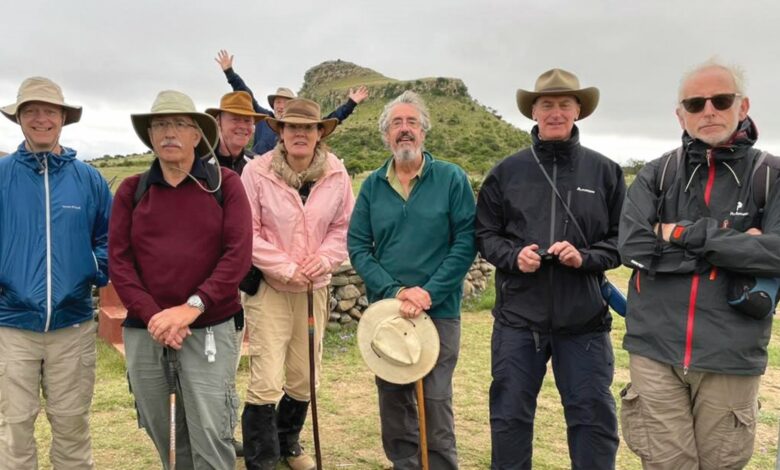
Ian Knight, the renowned UK-based military historian and tour guide, last week made his first visit to the area in four years with a group of English tourists (including two now based in California), a Belgian and a Canadian. Knight’s focus is on the Anglo-Zulu War of 1879 and he stayed several nights in the area with his group.
“I was generally impressed with both iSandlwana and Rorke’s Drift, both of which seem well kept, despite presumably a lack of visitors during Covid, although some of the access roads have suffered a bit,” Knight told the Courier.
“Other sites elsewhere haven’t fared so well – the monuments at Nyezane outside Eshowe, for example, were very overgrown and the Anglo-Zulu War graves in Eshowe have suffered from a grass-fire sweeping through.”
However, his biggest disappointment was seeing the extent of the damage to the small ossuary outside St Vincent’s at iSandlwana (where bones of the Zulu dead were once buried), which had been gutted by a fire.
It is not clear as to how the fire started. “It was also sad to hear that some of the small enterprises, like the tea shop at iSandlwana, hadn’t survived lockdown. I think all the sites would benefit from more people coming through, but I suspect it’ll be a while before the numbers return, not least because of the downturn in the world’s economies.
“I hope to bring out some more groups next year, but we’ll see,” Knight added. Asked about the continued level of interest in battlefields tourism in the UK, Knight commented that, “I think the interest in these sites is still there in the UK, but the challenges to tourism over the next few years go deeper, with the state of South Africa’s economy and the infrastructure on the ropes, and the world being in an economic downturn.
“I have three tours pencilled in for next year, but we’ll just have to see if they go ahead.”
Poor signage a challenge
Veteran guide and author Pat Rundgren concurred that ‘things have certainly improved over the last three months so far as battlefield touring is concerned’.
“That’s not saying too much, as anything is an improvement on zero. Plus the guys coming out now are mostly those who booked pre-Covid. I’m currently working at half capacity, but again, that’s a whole lot better than zero capacity. December is always a quiet period for UK tourists. January should be better. The Blood River/Ncome commemoration should be a biggie this year.
“As usual, though, the Department of Arts & Culture have still to wake up to the possibility of an Isandlwana re-enactment in January next year. On the downside, the roads are shot. Signage is now almost non-existent.
“And most of the facilities on the battlefields – coffee shops, curio shops, crafts, etc – have been killed by Covid-19.”