

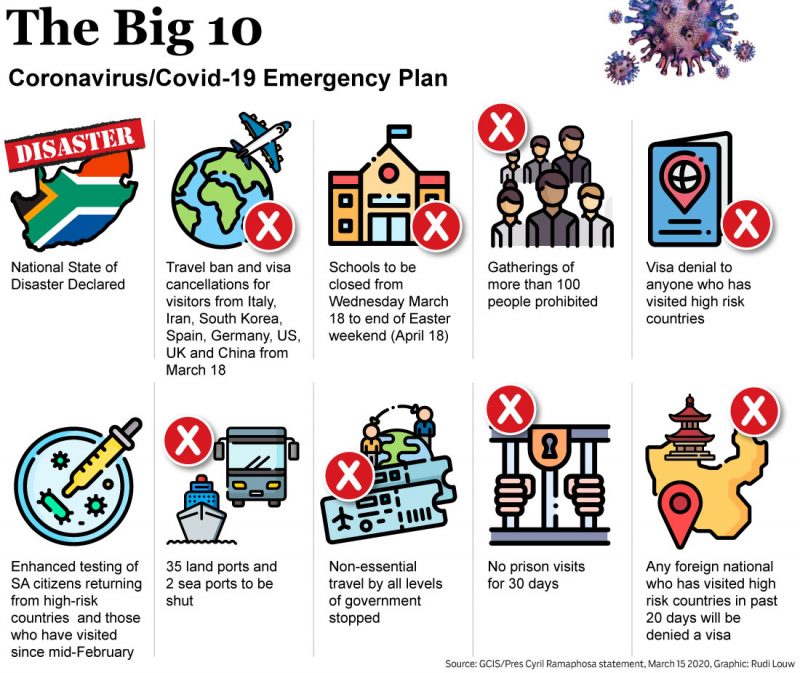
The pandemic of Coronavirus, COVID-19, in South Africa has been declared a national state of disaster by President Cyril Ramaphosa, on Sunday, 15 March. Several people have been in a panic over the spread of the virus, especially since there are 62 confirmed cases in the country to date.
Let’s take a look at what Coronaviruses are.
World Health Organisation states that “Coronaviruses (CoV) are a large family of viruses that cause illness ranging from the common cold to more severe diseases such as Middle East Respiratory Syndrome (MERS-CoV) and Severe Acute Respiratory Syndrome (SARS-CoV).”
According to The Telegraph, MERS-CoV and SARS-CoV outbreaks were severe diseases because between the two diseases, they’ve killed at least 1, 500 people since 2002.
Coronaviruses are zoonotic, which means they are transferred from animals to people. If a person is infected, the virus can be transmitted from person-to-person.
The Telegraph states that the outbreak of COVID-19 could be from a wet market in Wuhan, China as the outbreak of SARS-CoV was also from a wet market. Wet markets are markets that sell perishable goods like seafood (fish, prawns, etc.) and meat. However, the source has not yet been identified. Dr. Hazel Mufhandu, a Virologist at NWU-Mahikeng Campus, confirms and says the exact origin of the COVID-19 outbreak is still being investigated.
The COVID-19 is a new strain that was discovered in 2019, it was previously not found in humans.
The symptoms of coronavirus in humans may be a runny nose, sore throat, coughing, fever or severe cases of difficulty breathing.
Protective measures from the World Health Organisation (WHO), on how to avoid the Coronavirus:
- Wash your hands regularly and thoroughly, with an alcohol-based substance or with soap and water.
- Maintain social distance – distance yourself at least 1 metre from people when they cough or sneeze.
- Avoid touching your eyes, nose, and mouth – hands can be easily contaminated as they touch different and many surfaces, so they can pick up viruses.
- Ensure that you and others practice good respiratory hygiene – cover your hand and nose when you cough or sneeze, with a bent elbow or a tissue (immediately dispose of once you’re done).
- Seek medical attention if you experience a fever, coughing and have difficulties breathing.
WHO further advices the public to stay informed with the latest developments about Coronavirus and to follow the advice provided by healthcare providers.
Sources:
Advice for public. (n.d.). Retrieved from https://www.who.int/emergencies/diseases/novel-coronavirus-2019/advice-for-public
Gulland, S. N. A. (2020, March 16). What is coronavirus, how did it start and could the outbreak grow bigger? Retrieved from https://www.telegraph.co.uk/news/2020/03/16/what-coronavirus-how-start-outbreak-pandemic-covid-19/
(n.d.). Retrieved from https://www.businessinsider.co.za/wuhan-coronavirus-chinese-wet-market-photos-2020-1?r=US&IR=T