J.B. Marks celebrates World TB Day
On 24 March every year, the nation and the entire world commemorate World TB Day. As a result, the month of March is dedicated to raising TB awareness.
On 24 March every year, the nation and the entire world commemorate World TB Day. As a result, the month of March is dedicated to raising TB awareness.
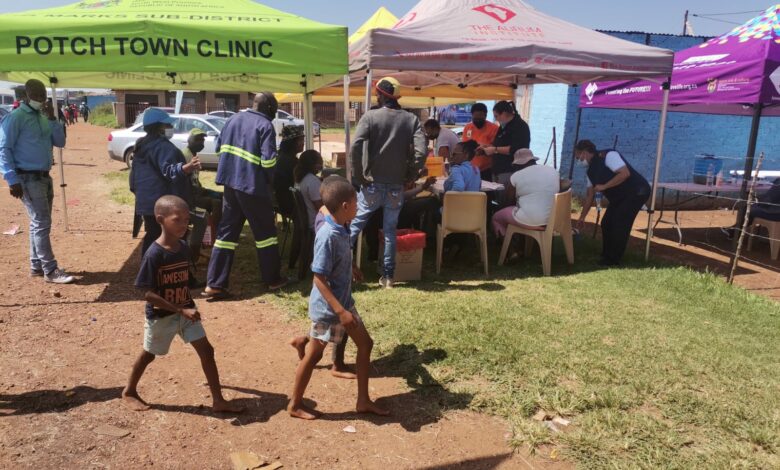
As part of the build-up to the main event at Tswelelang Sports Grounds in the Dr Kenneth Kaunda District. J.B. Marks’s Sub-District Health embarked on a mobilisation and screening campaign for TB and other chronic conditions. The outreach programme served as a one-stop shop, also providing Covid-19 vaccinations and other services from 22 to 23 March.
The province believes there is an urgent need to find, initiate and retain TB clients on treatment and regain those who have been lost-to-follow-up, hence the call for mutual accountability between leaders and ordinary South Africans.
On Tuesday, 22 March, the build-up event started with direct service delivery and creating awareness in the Marikana settlement near Promosa, screening for chronic conditions and TB, in particular.
“It is amazing how many people turned up for medical check-ups and immunisation, including the opportunity to vaccinate,” Tebogo Lekgethwane, the spokesperson for the North West Department of Health said.
On Wednesday,23 March, the campaign and direct services moved to Zakhele Settlement in Ext. 7, including the taxi rank. The MEC for Health, Madoda Sambatha, led the event.
“The main event is at the Tswelelang Sports Grounds, Ext. 13 of Maquassie Hills at 09:00,” Lekgethwane said.
The province’s TB treatment success rate is mainly affected by loss-to-follow-up as patients move from an area without reporting it. That is why the province has em-barked on the 90-90-90 strategy, aiming for:
* 90 per cent of all people to be screened for TB
*90 per cent of those diagnosed with TB to be treated and retained on treatment and
*90 per cent of those on treatment to be treated successfully.
Under the theme, “Invest to end TB. Save lives”, the provincial government seeks to join the national effort of rallying all stakeholders and broader society to make meaningful contributions towards the fight against TB. The theme is an earnest call to all South Africans to rally behind national efforts to end TB.
“We can agree that the advent of Covid-19 disrupted TB services and derailed TB programmes, just like it affected many other sectors and programmes. However, we must quickly get back on track with targeted programmes towards meeting the TB targets in the National Strategic Plan for HIV, TB and STIs from 2017 to 2022” said Sambatha.
Globally, tuberculosis (TB) is still a major cause of ill-health and death, with an estimated 10 million people falling ill with TB in 2018. South Africa is one of the 14 countries worldwide with a high burden of both multi-drug resistant TB and drug-sensitive TB. Nine of these countries are in Africa and five in Asia. In South Africa, Bojanala and Dr Kenneth Kaunda are among the 11 high-burden districts. Men have a higher rate of infection than women, especially in the 35 to 44 age group (27 per cent).
North West has a total population of 4,027,160, Bojanala District has 1,7 million residents, followed by Ngaka Modiri Molema District with 889,108. Dr Kenneth Kaunda has a population of 742,821 and Dr Ruth Segomotsi Mompati District has the smallest population, with 459,358.
Bojanala and Dr Kenneth Kaunda districts include the mining towns of Rustenburg and Klerksdorp, Orkney, Stillfontein and Hartbeesfontein, resulting in the unique socio-economic challenges of informal settlements in and around them. These areas also see the emergence of HIV, STI and TB.
The province has collaborated with stakeholders like traditional healers, traditional leaders, faith-based organisations and community organisations to tackle HIV/Aids and TB.
The tuberculosis burden in North West (both susceptible and drug-resistant) is estimated at 5,187. The highest burden districts are Bojanala and Dr Kenneth Kaunda, as job opportunities, mainly at the mines, attract more people.
The number of TB patients treated successfully is lower than those initiated on treatment, due to high lost-to-follow-up (defaulters) and death. TB patients who are not retained in care increase the number of missing TB cases and TB mortality and pose the risk of developing drug-resistant TB and infecting community members. Treating drug-resistant TB is more expensive and drugs have more severe side effects.
“We need to intensify community awareness of and health education on TB and the importance of seeking assistance early. Those confirmed to have active TB disease should be initiated on treatment as soon as possible and remain in care until they have completed their treatment,” Sambatha said.