‘Musina – most dangerous place to live in’
The state of decay characterising the border town of Musina, an ever present fear of crime harboured by local residents, their agitation with corruption-related activities allegedly prompted by the overwhelming presence of a reportedly outnumbering foreigner contingent and the impact on resources and infrastructure are ample telltale signs of a ticking time-bomb awaiting detonation. Monday’s …
The state of decay characterising the border town of Musina, an ever present fear of crime harboured by local residents, their agitation with corruption-related activities allegedly prompted by the overwhelming presence of a reportedly outnumbering foreigner contingent and the impact on resources and infrastructure are ample telltale signs of a ticking time-bomb awaiting detonation.
Monday’s announcement of Cabinet’s approval of the designation of the Musina-Makhado Special Economic Zone (SEZ) raises the question whether conditions in this nucleus that is characterised by infrastructure already under pressure, incessant influx of migrants from elsewhere in Africa and the rest of the world, an accompanying crime situation and the continuous presence of the element of corruption are conducive to accommodating such an arrangement.

The many puncture holes in the heart of what ordinarily seems to be a bustling hub for cross-border trade and a transport thoroughfare into upper Africa, count among the factors at play that characterise survival in what is being loosely termed “the most dangerous place to live in” by a former resident who expresses relief at having been able to relocate elsewhere. Law lecturer at the University of Venda, Cynthia Nkabele doesn’t beat about the bush when describing Musina as South Africa’s most dangerous place. With reference to her thesis for an LLM degree submitted in January 2014, she refers to a very disheartening situation defining life for many. Having lived and worked there in the Home Affairs asylum office for six years before relocating to Thohoyandou in February this year, she speaks with authority on issues impacting on the lives of ordinary South African citizens who are being subjected to the prevalence of ills such as crime, human trafficking, corruption, bribery, illegal trade, killer gangs and greedy land barons. (Interview to be published in next week’s edition)
In terms of service delivery and controlling the situation the local municipality under African National Congress (ANC) rule is seen wanting. Moreover the factors at play have created fertile canvassing ground for opposition parties prior to 3 August. Electioneering posters fixed to every possible surface – from the barks of baobabs to border walls in town – promise a better future.
During a visit to Musina last Thursday, Polokwane Observer interacted with local residents who expressed alarm over a host of concerns. Signs of decay alternated with hints of renewal in the form of the introduction of the odd retail hub.

Trading hours
By that time most shops were back to normal trading hours while a handful were not open yet after unrest on the Zimbabwe side of the border threatened to spill over to Musina. Accompanied to the Central Business District (CBD), photographs were obtained of gravel roads partially stripped of tar due to incessant traffic caused by heavy vehicles, dumping sites strewn with litter and unsafe water sources. The sight of a camera was evidently not welcome in a place generally known for harbouring undocumented migrants. In some parts informal traders converged on the threshold of formal business, many offering duplicates of affordable clothing similar to adjacent shops.
Rwanda
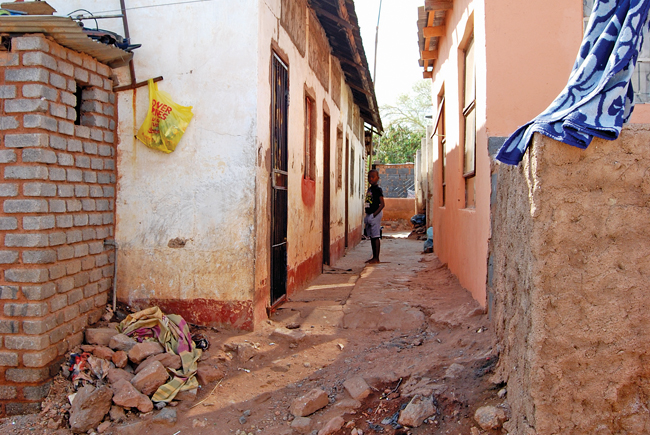
The settlement of Rwanda off the CBD, apparently known for crime in broad daylight, serves as living quarters for scores of families left without any other alternative, congested living conditions were pointed out. Here every inch is inhabited and narrow passages snake in between buildings. Ironically most of the structures are fitted with satellite dishes. Outside latrines are the order of the day, laundry is hung on the driveway to dry, spaza shops compete with ordinary dwellings, an adjacent waterway carries the appearance of a rubbish dump and a former change house serves as a crèche.
“SA’s own Nigeria”
A visit to Nancefield took a turn at an old hostel in Patrick Mphephu Street where concern was raised about families, some up to nine at a time, sharing a room at a cost of an estimated R200 per month. The premises was seen to be snake-infested and a hazard to especially unaccompanied young children playing among neglected structures, soliciting the remark of “South Africa’s own Nigeria” from a source. A resident who claimed to be gathering information to be handed to the Hawks for investigation, presented various receipts for rental allegedly collected from occupants by a woman whose identity is being withheld. Oddly one of the slips contained the stamp of a company based in Polokwane. According to him houses on the premises were being occupied without the occupants having title deeds, but simply paying for water and electricity. He said the majority of people staying there were Zimbabweans who have permanently relocated to South Africa and suspected of paying thousands to a municipal official.

Land ownership
Land ownership remains an issue of discontent, as locals lament the fact that foreigners manage to fork out foreign currency for places to stay or rented spaces they in turn charge an arm and a leg for. A heartrending scene unfolded when meeting a 34-year-old disabled mother, Lydia Ngovhese, who shares a shack of an estimated 4 m² with her daughters aged 14, nine and four years and the last born a few months old, is left to their own devices while living in squalor. Her two oldest daughters are also disabled, she indicated.
Foreign presence
Sources raised alarm about foreigners from Zimbabwe, Somalia, Nigeria, Ghana, Cameroon, Ethiopia, Chinese, India, Bangladesh and Pakistan seemingly outnumbering locals. Referring to times of xenophobic friction in the past, a South African woman relayed the words of a Zimbabwean citizen who warned that “if we can strike we will kill all of you”. Hence they have learnt to identify any foreigner by enquiring in Afrikaans about their well-being and to be shown where they lived, another woman quipped. With the influx of foreigners came the worry about safety and the fear of being killed, robbed or raped, said another source. Apparently the fear factor contributed to people avoiding the streets between 23:00 and 05:00.
Border post
It was off to the border post next where trucks were lined up for hundreds of metres after being cleared for the border crossing. The place was alive with activity with street sellers pointed out to be openly trading in black market currency exchange or fresh produce against the backdrop of shacks lining the pavements. Upon further enquiry the presence of the guma-gumas (translated into “thieves”) – gangs made up of mostly unemployed but wealthy Zimbabweans who allegedly engage in illegal activities – was highlighted.
Last stop on the itinerary was Mapungubwe Heritage Site. Whereas some roads in town have long discarded their tar status the condition of the road was eq ually shocking, considering the fact that the attraction lures visitors from across the world.
Municipal response
Musina Local Municipality spokesperson Wilson Dzebu responded to a question related to service delivery by saying it was not true that the municipality was delivering substandard services. “What criteria did you use to conclude that the service is substandard? Yes, we might be having some challenges, but we are doing our best to address those challenges while delivering efficient services to our people.” He added that their workers were doing their best to make sure that the town was clean at all times. They had skilled civil staff who made sure that waterways were safe at all times, he assured. To a question on foreign presence in town he quoted the latest Census figures by saying that Musina was having “approximately 60 000 people, but the number has since tripled due to the influx of foreign nationals”. Lastly, on the SEZ he said the town was 100% ready and that government was providing full support.

Provincial government
Provincial Government spokesperson Phuti Seloba said the intended SEZ would be a proper model of integrated development with large job creation impact. Intended for introduction within the next few months, the monetary implications of such an undertaking have not been quantified as yet, he mentioned. Whereas a SEZ for Tubatse was still in conceptualisation phase, public consultations on the Musina-Makhado SEZ have been taking place the past two months, he indicated. Responding to a question whether Musina would be able to sustain the arrangement considering the standard of services in town, he said prior to activity taking off within the zone the current infrastructure would be upgraded to meet the new challenges and delivery of mostly basic services be strengthened.
Story and photos: YOLANDE NEL
>>observer.yolande@gmail.com
Featured photo: A scene from a congested Rwanda.