
Province to gear itself for growth – Leda boss
Ben Mphahlele, Managing Director of the Limpopo Economic Development Agency (Leda) at a recent Black Industrialist symposium held at Meropa Casino & Entertainment World called on an audience comprising possible local developers and industrialists to get ready and organised as roll-out of infrastructure growth and the Special Economic Zone (SEZ) in Musina will begin next …
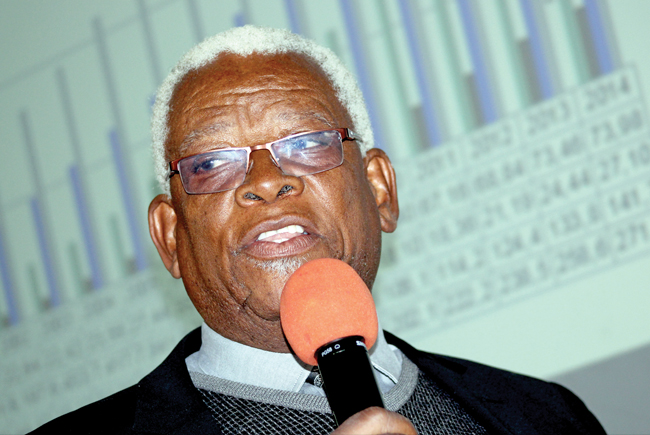
Ben Mphahlele, Managing Director of the Limpopo Economic Development Agency (Leda) at a recent Black Industrialist symposium held at Meropa Casino & Entertainment World called on an audience comprising possible local developers and industrialists to get ready and organised as roll-out of infrastructure growth and the Special Economic Zone (SEZ) in Musina will begin next year.
He asked for input in the budget and initiatives and said this meeting was the first of many to follow.
In 1995 the province’s economy was estimated at R31 billion and in 2014 at R271,7 billion, Mphahlele informed. The dependency index in the province stands at around six persons that must share in every R1 that is earned and ideally should stand at three persons for every Rand earned.
“The keywords for growth are economic transformation, and this gap must be closed. The current dependency gap is highly unacceptable and must be closed through accelerated progress.” He explained that the provincial government development strategy was that the province must be developed into corridors where the Vhembe-Makhado corridor for instance would be the food basket of the province and agriculture is to be expanded in the area, leading to massive food processing, but for now output was not enough for food processing plants to be established. The agricultural sector would have to double production to R11,6 billion.
He called upon developers, more specifically from the province, to come together and to share a common vision to develop the province with government and move towards transformation with other stakeholders such as research institutes, tertiary institutions, entrepreneurs and labour unions and to build social capital and special geographic areas. Referring to the SEZ to be formed in the Musina area he said a new city, the same as Pretoria or Johannesburg will arise within the next ten to 15 years.
“The same with Sekhukhune. The worst poverty is there now, but it is the wealthiest area in terms of resources. It will be a centre of growth once that SEZ is approved.”
He said social capital will be the common denominator for growth and sound social participation will be needed. “There cannot be growth without social participation.”
With the development of the SEZs supporting industries will put inputs in the production and services systems. More workers will need more food, more houses and schools and malls will be needed. All these create job opportunities and more money is poured into the economy. Mines will need transport, machines, tyres, protective clothing. He said things do not just happen spontaneously, but need drivers. Government will provide infrastructure such as roads, dams, electricity, as without it, development cannot take place. Skilled people will also be in high demand, so human capital must be developed.
Some of the real issues are that the province’s growth in GDPR must be lifted from 2,9% to 7%, and the agricultural sector be doubled. The Enterprise Development finances division would have to grow to R2,5 billion and the mining house Risima to R3,5 billion. Great North Transport will increase its revenue to R1,3 billion and broadband will be needed, at least in the Capricorn district for a start, which will cost R3,3 billion to establish.
The environmental impact study for the Musina SEZ will be completed in a year’s time, where after a massive roll-out of infrastructure will begin in terms of roads, water and railway facilities. He said the businessmen should start thinking what they could do to become wealthier. He told them that Leda’s divisions comprise mining, an agri-industry division, ICT, property, enterprise development and finance, public transport and an engineering division and services such as research policy, marketing and corporate services are at hand. A good, bankable business plan is what is needed to convince funders that there is potential wealth in a development.
He also said that people should consider the Black Industrialist Scheme and ask how it could accommodate them. The programme is an incentive programme to promote participation of black industrialists as manufacturers in key sectors, offering a cost-sharing grant ranging from 30% to 50% to approved entities to a maximum of R50 million.
Story: NELIE ERASMUS
>>nelie.observer@gmail.com
Featured photo: Ben Mphahlele, Chief Executive Officer of the Limpopo Economic Development Agency.