
Reflection before renewal: Amanzimtoti at the threshold of 2026
Much has been said and often loudly about decline, and the dominant negative narrative would have us believe that our town is unsafe, unwelcoming and beyond repair.
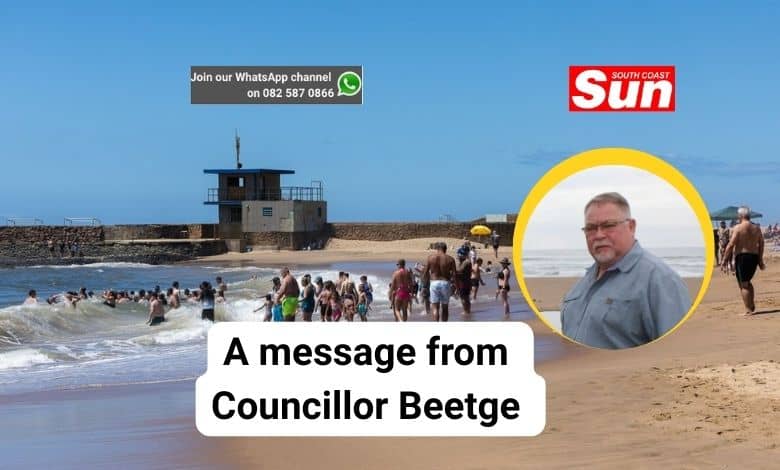
WHERE we are already approaching the end of the first week of the new year, it is worth pausing, if only briefly, to reflect on the recent and still-concluding 2025 festive season.
Much has been said and often loudly about decline, and the dominant negative narrative would have us believe that our town is unsafe, unwelcoming and beyond repair. Yet those who speak most passionately of decay frequently offer little in the way of solutions, instead laying blame and remaining observers rather than participants in change.
Also read: Improperly disposed-of waste blocks sewers: Councillor André Beetge
This raises an uncomfortable question: are the real consequences of livelihoods, tourism and community morale being weighed against the fleeting satisfaction of being first to highlight the negative? Or does outrage simply generate more attention than constructive action? Despite these negativities, the data tells a more nuanced story.
While Amanzimtoti may no longer dominate the traditional blue-collar tourism space, evidence suggests that this market is being replaced rather than lost. Retail figures indicate strong festive footfall, particularly along the coastal corridor of the N2.
Customer profiles reflected a predominantly African (black) market, while white and Indian shoppers also showed increases, with a healthy balance between locals and visitors, mainly from Gauteng.
Encouragingly, crime levels across shopping centres and residential areas were noticeably lower than in previous years. This improvement can largely be attributed to increased visibility and co-operation between the police, metro police, private security, municipal services and local political structures.
From a tourism perspective, accommodation occupancy averaged above 70% between Christmas and New Year, climbing to over 85% for the remainder of the season. Visitors consistently cited safety and a more relaxed environment as reasons for choosing the area over the City’s central beachfronts.
Also read: eThekwini to study court judgment on sewage pollution
Sea water quality, affected by rainfall and compounded by uninformed negative online speculation, resulted in some cancellations.
However, the fact that Amanzimtoti Main Beach remained open approximately 95% of the time allowed the town to absorb redirected visitors from other closed beaches.
Perhaps one of the most positive developments is the increasing number of physically disabled visitors travelling from across the metro to Amanzimtoti Main Beach. The availability of privately sponsored beach wheelchairs (still unique to our town) has made the coastline accessible to many families who were previously excluded from such experiences.
So, where does this leave us as we enter 2026? The answer is simple: the future of our town will be shaped by what we choose to amplify. Negativity feeds stagnation. Constructive engagement fuels progress. We cannot change the past, but we can influence the present, and in doing so, shape what lies ahead.
This is an election year, whether all welcome it or not. Even those uninterested in politics will feel its impact; do not cause yourself to be left behind. Now more than ever, we must place reason above emotion, collaboration above complaint and action above rhetoric. Let us take this year by the horns as together, we can make our town not only resilient, but even better.

Do you have more information pertaining to this story? Feel free to let us know by commenting on our Facebook page or you can contact our newsroom on 031 903 2341 and speak to a journalist.