
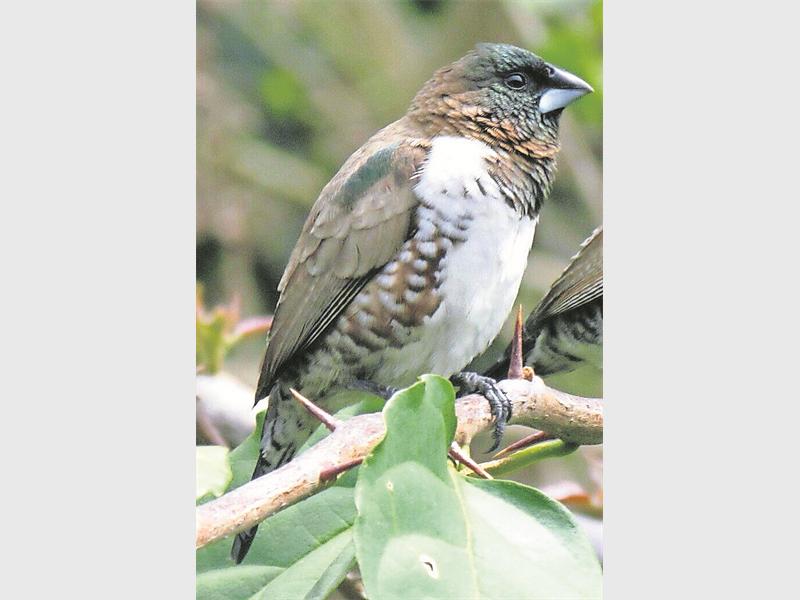
THE bronze mannikin is a small, common resident on the Eastern half of South Africa.
The male and female birds have the same markings.
The bronze mannikin’s voice is a high pitched, rapid contact call ‘tsree tsree tsree’, with a sharp ‘chuk chuk chuk’ alarm call. It likes the edges of thickets in savanna or open woodland, secondary growth around cultivation, parks, gardens and farmyards usually where there is water available.
It is found in pairs and family groups when breeding, from September until April and is otherwise gregarious in well co-ordinated flocks of up to 30 birds. The bird forages on the ground, off standing grass or feeding trays and it drinks often.
When disturbed, the bronze mannikin flies into the nearest bush or tree, its wings making a whirring sound. It can fly in any direction and hovers well.
They flick their wings and tail when anxious or alarmed.
Their food includes seeds, insects, green plant matter, nectar and algae. The nest is a ball of dry grass, with a tubular side entrance surrounded by grass stems, which is usually found between one and three metres above the ground in the bush, trees or on posts or the beams of buildings.
It may sometimes occupy the old nest of a bishop, weaver or waxbill.
The bronze mannikin lays three to six white eggs, and incubation lasts 12 to 14 days. Nestlings remain for 17 to 23 days.
There is no Zulu name but Xhosas call them Ingxenge and in Afrikaans they are known as gewone fret.