
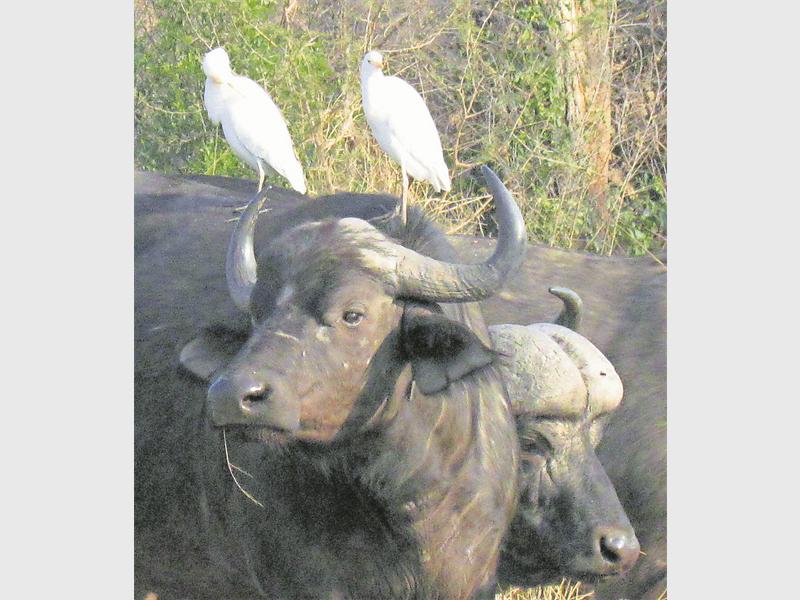
THE cattle egret is widely distributed in Africa, Madagascar, the Mediterranean region, South Asia, Northern Australia as well as north and south America.
The bird migrates far, with South African birds found as far as Uganda – 3500,km away.
Its habitat by day is grassland, pastures and open savanna, usually with large game animals or domestic stock.
In evenings, they usually gather in large flocks around shorelines, dams and pans to drink before roosting. This highly gregarious bird feeds on insects disturbed by grazing animals in grasslands. As such, it may perch on mammals’ backs and also follows ploughs to pick up soil invertebrates.
It sometimes fishes in shallow waters but most food is grasshoppers, caterpillars, earthworms, spiders, scorpions, frogs, lizards, nesting birds but only a few ticks.
Its voice consists of harsh croaks of one to two syllables ‘rik rak kraa’ and a deep, staccato ‘thonk’.
The cattle egret flies in V formation to and from roosts, and it flies low in strong winds. Its nest is a platform of sticks, which takes 11 days to build in a tree or reedbed.
They usually lay two to four pale blue or greenish blue eggs which incubate in 22 to 26 days.
Nestlings leave the nest after 20 days, start to fly after 30 days and are independent after 45 days.
The cattle egret’s Zulu name is iLanda and is also known as umLindankomo.
In Afrikaans, it is known as Bosluisvoel.