
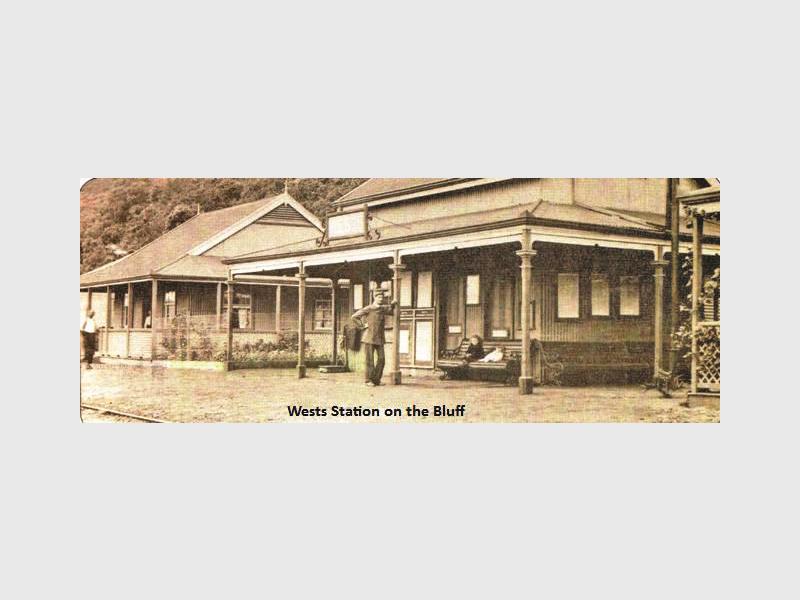
1898 – Opening of the Bluff railway
IN June 1898 large posters advertised the opening of the latest Natal Government Railways (NGR) branch line extension from Durban station to Wests at the tip of the Bluff headland.
The inaugural trip was set down for 13 June. On that day 30 paying passengers along with David Hunter, the general manager of the NGR, were aboard to mark the historic occasion.
The following stations marked the route the Bluff train took. From Durban Station the first stop was Berea Road, then Congella, Umbilo, South Coast Junction (Rossburgh), Clairmont, Jacobs, Wentworth, King’s Rest, Fynnland, New Brighton (Mrs Shortt’s property) and finally Wests.
The Mercury’s description of the journey published on June 14 provides an idea of the state of the environment at that time: “The route through mangrove, sugar cane and banana beside the lapping waters of the Bay afforded new glimpses of the port and neighbourhood.” Sugar cane was grown in the Umhlatuzana River area.
The historic first journey left Durban station at 9.50am and returned just before noon. Although Sam West was reportedly delighted that his name marked the terminus of the line, the occasion was without any fanfare. The railway had taken 14 months to complete at a cost of £3,000 per mile. The final mile terminating at Wests had required 13,000 cubic yards of stone for embankment.
The fare for first class, single journey was one shilling and nine pence. Return was two shillings and three pence. Second class was one shilling and two pence with return just four pence more expensive. Third class was just seven pence with no figure mentioned on the poster for return. Only two trips to the Bluff were scheduled daily, mid-morning and mid-afternoon with more frequent services over weekends.
Critics
On the very day of the opening of Bluff railway, the Mercury published a letter from an irate Bluff resident who signed himself ‘Wentworth’. The writer objected to the trip scheduling as being totally inconvenient for children attending schools in Durban or for those with business interests. “In the absence of any road worth that name, the least the government can do is to provide a decent train service.” One must remember that apart from the Catholic mission for Africans, there were no schools on the Bluff until after World War 2.
Nonetheless, the railway was a huge boon to Bluff residents and visitors as there was no established road which meant a difficult trek through bush to travel around the Bay. Alternatively, there was a ferry service from the Point across to Wests and Salisbury Island. However, that was not how the Durban Chamber of Commerce saw it. In a letter dated 13 June 1896 to Prime Minister John Robinson, without giving reasons, the Chamber said it was “disapproving of the Bluff railway scheme” and preferred to see the government develop more wharfage along the town side of the bay. In his reply, Robinson ignored the Chamber’s Bluff views and reassured it that his government was already proceeding to extend the wharfage on the town side.
Correspondence relating to the construction of the railway provides another insight on Bluff life. Jane Shortt, widow of Portland Bentinck who died in 1885, claimed compensation from the NGR for encroaching on her property. In 1896, when the rail route was being surveyed, Mrs Shortt noticed that it passed through part of her New Brighton Lot No. 27 which she stated had been bought by her late husband in 1857. The chief engineer of NGR promised that her claim would be dealt with in due course.
Although the establishment of the Bluff railway was indicative of the growth of the area as a residential node, there was also another reason for the line’s construction – harbour development and expansion envisaged the relocation of the messy coaling depot from the Point area to the Bluff headland. The railway was a crucial factor in that development which, as will be seen, required reclamation and wharfage construction in order to establish the coaling depot.
Researched and written by Duncan Du Bois
Sources:
- Natal Mercury, 13, 14 June 1898
- Pietermaritzburg Archives:
- MJPW 46, LW 2839, 1898
- MJPW 41, LW 3211, 23 November 1896
- CSO 1604, No. 1515, 17, 22 February 1899
- CSO 1468, No. 3333, 13 June 1896