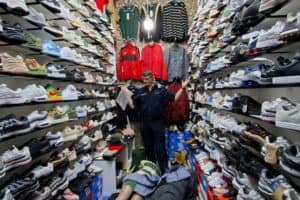
R100 billion is lost each year due to the illicit economy.

Pieter-Steph Du Toit in an authentic Iconic K-Way Puffer. Picture for illustration purposes only: Supplied


South Africans are increasingly being exposed to a flood of counterfeit goods, with fake versions of popular brands making their way into stores, informal markets and online platforms.
The surge is not only costing legitimate businesses millions of rand in lost sales, but is also hurting the economy in lost taxes while putting people at risk of buying substandard.
K-Way is among the brands vulnerable to counterfeiting, exposing consumers to fake products that often fall short of the quality and performance of genuine items. K-Way’s Martine Vogelman highlights that this has hurt the brand beyond lost sales, with counterfeit retail threatening local manufacturing jobs, specialised skills, and consumer trust.
The real cost of counterfeits
Vogelman said consumers typically purchase counterfeit products for one of two reasons: either knowingly, understanding that a product at that price point is unlikely to be authentic but viewing the discount as too good to ignore, or naively, deceived by the counterfeit’s close resemblance to the genuine item.
“There’s very little we can do to protect consumers who are willing to sacrifice quality and authenticity for a cheaper price tag, but it’s the unsuspecting buyer that creates the greatest reputational risk for brands.”
She adds that counterfeit products are often peddled via informal traders and market stalls, as well as, to an increasing extent, through third-party e-commerce platforms and social media marketplaces, where the images used online are often legitimate product photos taken from verified retailers.
“In many cases, consumers only realise they’ve purchased a knockoff once it arrives at their doorstep.”
Counterfeit market hurts jobs
Vogelman highlighted that in reality, the impact of the counterfeit market goes beyond lost revenue and reputational harm – it also threatens employment in the country.
“Counterfeit retail threatens the livelihoods of hardworking employees – a particularly significant concern for the Cape Union Mart Group, which manufactures K-Way products locally in Cape Town and employs more than 900 people across its manufacturing and distribution operations,” she said.
“When consumers choose authentic products, they’re not only investing in quality, they’re supporting an entire local ecosystem of designers, manufacturers, warehouse teams, retail staff and supply chain partners whose continued employment depends on trusted South African brands.”
How to spot a fake K-way jacket
As the winter shopping season gets underway, knowing how to spot the difference between a genuine K-Way product and a knockoff has never mattered more.
Here are a few simple ways to avoid a fake K-Way jacket and make sure the item you’re buying is the real deal:
- Inspect the branding carefully: Authentic K-Way puffers feature a high-quality heat-transfer logo. Counterfeit products often give themselves away through embroidered logos, distorted sizing, incorrect placement or inconsistencies in the font and branding.
- Check the stitching and finishing: Close attention to the finer details can reveal a knockoff. Look out for loose threads, puckering at the seams, uneven panelling and unbranded, low-quality zips or trims.
- Evaluate the materials and insulation: Premium materials are a hallmark of authentic K-Way products, which combine lightweight construction with warmth, durability and ethically-sourced down insulation. Counterfeit jackets may feel stiff or plasticky to the touch and often use low-quality synthetic insulation that creates clumping.
- Review the tags and packaging: Missing product information, spelling errors, low-quality labels or generic packaging can all indicate a knockoff.
- Put it to the real test: If you’re still unsure, stand outside with the puffer on. If it’s below ten degrees and you feel the cold, you know you’ve been sold.
Billions lost due to illicit markets
The South African Revenue Service (Sars) has previously stated it lost at least R100 billion in tax due to the illicit market.
Former Sars commissioner Edward Kieswetter said the illicit economy continues to drain the country’s resources, distort competition, and undermine public confidence in the tax system.
Activities such as smuggling, customs and excise fraud, under‑declaration, counterfeit trade, fuel and tobacco syndicates, and organised tax crime divert resources away from essential public services and place compliant taxpayers and legitimate businesses at a disadvantage.
“Sars estimates that the fiscus loses well over R100 billion in revenue each year to the illicit economy,” he said.
There is no such thing as a good deal
“People who buy illicit goods often believe they are getting a bargain,” said Kieswetter.
“In reality, they are funding the destruction of legitimate businesses and jobs, shrinking the country’s tax base, and weakening the very institutions meant to serve them.”
He stressed that every illicit transaction deprives the fiscus of revenue needed for schools, hospitals, and public infrastructure.
“There is no such thing as a cheap deal in the illicit economy, and the real cost is paid by society at large. We will not allow criminal syndicates to hollow out the tax system.
“Sars, working with other law-enforcement agencies, is determined to disrupt, dismantle, and shut down illicit trading networks, and to make non‑compliance hard and costly.”