Tau says SEZs nationally host 234 private companies with a combined investment value of more than R47 billion.
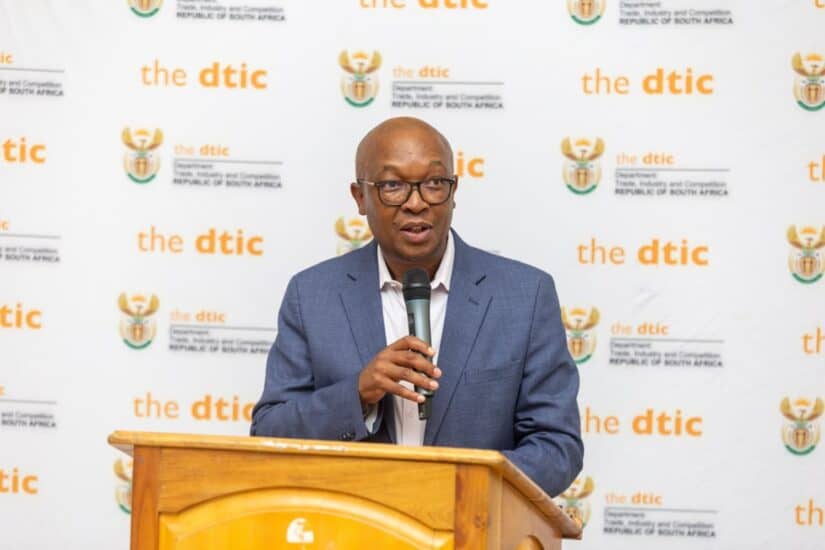
Minister of Trade, Industry and Competition Parks Tau addresses investors and stakeholders at the Fetakgomo-Tubatse SEZ engagement in Steelpoort. Picture: Supplied.


South Africa’s Special Economic Zones have secured commitments from 141 companies worth more than R548 billion, set to create more than 60 000 permanent jobs once fully operational, Parks Tau says.
The minister of trade, industry and competition confirmed this during a ministerial engagement in the Fetakgomo-Tubatse Special Economic Zone (FTSEZ) in Steelpoort, Limpopo, this week.
The session brought together national and provincial government, local stakeholders, industry, and traditional leadership to discuss implementing the FTSEZ, designated in May.
Tau said SEZs nationally currently host 234 private companies with a combined investment value of more than R47 billion and have created 134 478 jobs, 32 904 of which are permanent.
“The Fetakgomo-Tubatse SEZ is complementing the good South African SEZs story undertaken by democratic South Africa,” Tau said.
Fetakgomo-Tubatse SEZ
He said new zones such as Nkomazi, Fetakgomo-Tubatse and Musina-Makhado, designated to drive cross-border initiatives and mineral processing, have already begun bulk infrastructure work to lay the groundwork for investment, in line with the African Continental Free Trade Area objectives.
The FTSEZ alone carries a R52.6-billion investment pipeline, projected to create around 8 000 jobs in the short to medium term and up to 20 000 jobs over 10 years.
“Few places make the case for beneficiation better than Steelpoort. This zone sits between the Lion and Samancor ferrochrome smelters and is surrounded by some of the country’s major platinum and chrome operations,” Tau said.
“It has been planned for exactly this purpose: mineral processing, metal fabrication, manufacturing, renewable energy, and the logistics and services that support them.
“Our industrial policy is clear that we must process more of what we mine, manufacture more of what we use and export more of what we manufacture.”
Speaking on behalf of Premier Phophi Ramathuba, MEC for Economic Development, Environment and Tourism Tshitereke Matibe said government has committed R445 million to bulk infrastructure for the FTSEZ.
“This demonstrates our commitment to laying foundations required to attract investors and support industrial operations,” Matibe said.
“Our vision is to ensure that minerals extracted in Limpopo create greater economic value within our province.”
He said the zone is central to Limpopo’s strategy of building an economy that creates jobs, develops skills, supports local enterprises and expands opportunities for communities in and around Fetakgomo-Tubatse.
All talk, no action?
But the Bolshevik Party of South Africa (BPSA) is not convinced, saying Tau and Matibe are all talk and no action.
Party general secretary Seun Mogotji said the people of Sekhukhune, including communities around Steelpoort and the Fetakgomo-Tubatse industrial corridor, must become direct beneficiaries of mineral wealth extracted from their own land.
He said mineral-rich communities have carried the social and environmental consequences of mining for decades, while residents continue to struggle with unemployment, inadequate infrastructure, water shortages, and limited opportunities to participate meaningfully in the regional economy.
“The central question is not whether South Africa possesses mineral wealth. The question is whether that wealth is being transformed into sustainable livelihoods, industrial capacity, decent work and economic ownership for the people who live where these resources are extracted.
“Communities cannot be expected to remain spectators while their natural resources generate economic value elsewhere,” he said.
Mogotji said South Africa’s mineral resources must contribute to a stronger domestic industrial base and that, where commercially and technically viable, greater beneficiation should take place locally, supported by reliable infrastructure, skills development, appropriate technology, and investment in local manufacturing.
“Steelpoort and the wider Sekhukhune region should not be viewed merely as places from which raw materials are extracted.
“They must also be developed as locations for manufacturing, mineral processing, engineering services, industrial supply chains, and small-business development,” he said.
He said the FTSEZ must be assessed against verifiable outcomes rather than announcements alone, and that residents deserve transparent answers on:
- How many permanent jobs have actually been created for local residents;
- How many temporary construction jobs have been created, and how many have ended;
- How many local businesses and cooperatives have secured contracts;
- What infrastructure has been completed and is operational;
- What investment has been committed, what has been spent, and what remains outstanding; and
- What practical mechanisms exist to enable communities to participate in ownership and long-term benefits.
Mogotji said these questions should be answered through published, independently verifiable reports.
“BPSA calls for a public FTSEZ performance dashboard recording project milestones, infrastructure delivery, expenditure, employment figures, local procurement and SMME progress.
“Public reporting must distinguish between projected jobs, jobs under construction and permanent positions actually filled,” he said.
The party also called for clear local procurement targets, including publicly advertised contract opportunities and transparent tender criteria, supplier-development programmes for Sekhukhune-based businesses, training and certification support for local contractors, fair payment terms, published information on contracts awarded to local businesses and monitoring of subcontracting to prevent fronting.
“Our land must create opportunities. Our minerals must support industrial development. Our workers must receive fair opportunities.
“Our communities must participate in the wealth generated around them. The era of measuring development only through promises must give way to measurable delivery and public accountability,” Mogotji said.