


South Africa has formally joined Afreximbank as a Class A shareholder.
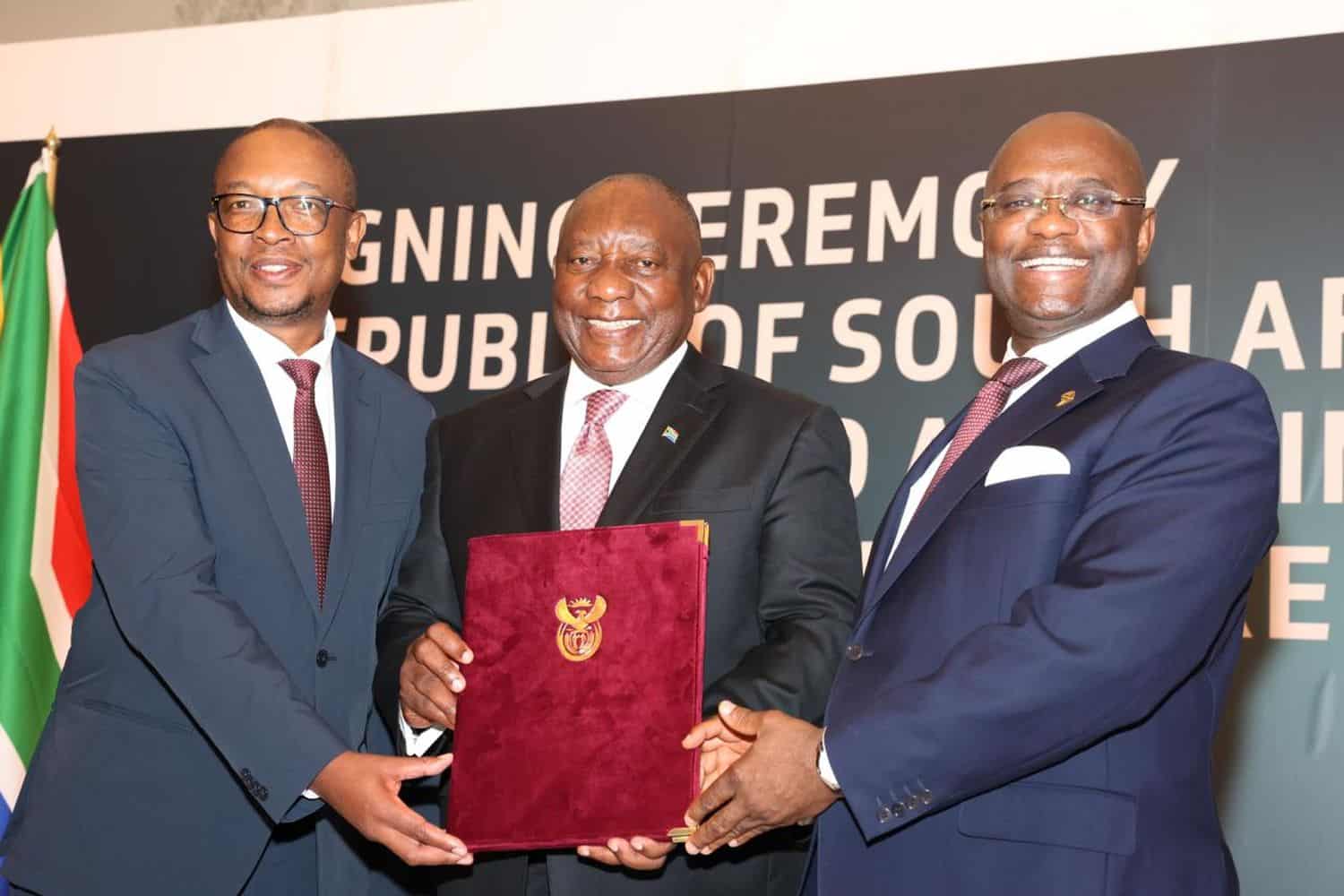
Minister of Trade Industry and Competition, Parks Tau, left, President Cyril Ramaphosa, and Afreximbank president George Elombi at the signing ceremony. Picture: X/ the_dtic


African Export-Import Bank (Afreximbank), the continent’s biggest trade bank, has committed an $8 billion (about R128 billion) financing package for new member South Africa to support the country’s industrial development goals.
South Africa has formally joined Afreximbank, with the accession signing ceremony taking place in Johannesburg on Wednesday, attended by President Cyril Ramaphosa, Afreximbank president George Elombi and Minister of Trade, Industry and Competition Parks Tau, among others.
How Afreximbank’s $8 billion will be used
Elombi said Afreximbank will launch major financial interventions, including a new $8 billion country programme designed to deepen the South African economy. This money is expected to back projects in sectors like mining, automotive and manufacturing.
“I am therefore pleased that together with the DTIC, under the leadership of Tau, we have put together what we consider an important package of $8 billion for South Africa.” he said.
“In particular, we will prioritise mineral processing, the expansion of automotive manufacturing and the expansion of industrial parks and specialised zones. The country programme is aligned with South Africa’s national development plan 2030 and national industrial and trade priorities, and targets key strategic areas.”
Afreximbank is a Pan-African multilateral financial institution mandated to finance and promote intra- and extra-African trade.
ALSO READ: The dtic considers ad valorem tax changes to lower car prices
Additional $3 billion from Afreximbank
Elombi also announced that it had set aside an additional $3 billion for inclusive growth by financing small and medium-sized businesses, township and black-owned enterprises, and projects that expand access to trade and economic opportunities.
“We intend to invest heavily in the local processing of natural resources, thereby helping retain value in our economies, create jobs and generate wealth for our people,” said Elombi.
South Africa was not able to join Afreximbank when it was established in 1993, but the cabinet approved a plan to move to a Class A shareholding in the bank last year November.
SA becomes a board member of Afreximbank
Class A shareholders are African governments and central banks who set policy and strategy, Class B are African financial institutions that partner in financing and delivery and Class C are private and non-African investors who provide capital without sovereign influence.
As a Class A shareholder, accession will be on a country basis, with South Africa entitled to a seat on the board of directors.
“We mark a major milestone in our quest to realise the economic integration of our continent,” said Ramaphosa.
“South Africa’s accession to the Afreximbank affirms our commitment to African industrial development and to deepening trade, investment and development across the continent.”
ALSO READ: Tau welcomes Agoa vote, still talking to US about trade
30 years of resilience
Ramaphosa noted that Afreximbank has for more than 30 years, demonstrated resilience, innovation and impact through a diversified portfolio across geographies and sectors.
The partnership will strengthen South Africa’s ability to support exporters, industrial projects and regional value chains, while advancing continental development.
“We seek to contribute to an Africa that prioritises intra‑continental trade, that builds its own industrial base and that mobilises African financial institutions to support development,” he said.
Perfect timing
He also highlighted that South Africa accedes to Afreximbank at a time of both challenge and opportunity for the continent, with global economic uncertainties, climate risks and shifting trade patterns, underscoring the need to build economic resilience.
“As a country, we are implementing far‑reaching reforms to restore growth, improve competitiveness and expand inclusion,” Ramaphosa said.
“We are working to accelerate economic growth by implementing structural reforms, increasing infrastructure investment and through targeted industrial policy.”
NOW READ: Ramaphosa admits that corruption is a problem as he asks Southeast Asia for investment
Support Local Journalism
Add The Citizen as a Preferred Source on Google and follow us on Google News to see more of our trusted reporting in Google News and Top Stories.

