
Chirping with Kloof Conservancy – the Little Sparrowhawk
Find out more about this feathered Highway resident below.
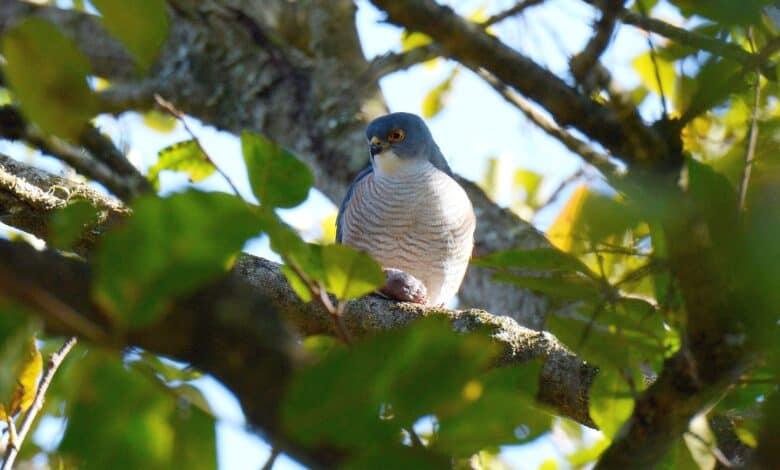
THE Upper Highway is extremely fortunate to be home to numerous resident and migrant raptors. While some like the Martial and Crowned eagles appear quite fearsome and very easy to see, there are other tinier species which you really need to look hard for and the Little Sparrowhawk is one of them.
Also read: Chirping with Kloof Conservancy – Cape Glossy Starling
Description
The Little Sparrowhawk is the smallest (about the size of a Laughing Dove) raptor in our area at between 23 and 27cm (wingspan of 39cm) and a weight of 106g. The head and upper parts are a dark grey whilst the throat is white. The chest is off-white with narrow brown, horizontal bars. The tail feathers are blackish with white on the tips. Males and females are very similar in appearance with the female being larger than the male. It can be easily confused with the larger African Goshawk. Two rows of white spots on the tail are a diagnostic feature which help with identification.
Distribution
This species is found in the northern and eastern parts of South Africa including the south-western Cape and is absent from the drier parts of the country. It has an average range of 148 square kilometres from its nesting site.
Habitat
It prefers to inhabit forest edges next to open grasslands. It will also be found in many well treed gardens where it will prey on small birds at bird feeders.
Feeding
The Little Sparrowhawk is extremely agile in flight and is a very aggressive hunter feeding mainly on small birds but will occasionally feed on insects such as termites and locusts
Breeding
This is a monogamous species and pairs for life. The nest is a small platform of sticks usually high up in a tall tree (they frequently nest in alien trees). Incubation and chick rearing duties are shared by both adults. They are also very territorial and will be very aggressive towards any intruder, including humans!
Predators and threats
The Little Sparrowhawk is listed as ‘least concern’ by the International Union for Conservation of Nature (IUCN) but deforestation for human development is a potential threat. As they like to nest in alien trees, including invasive gum trees, it is important to check for nests before eradicating any of these trees.
Local information
The Little Sparrowhawk is very secretive and has a very quiet and inconspicuous call so you will need to be very observant to spot it. If your garden has a reasonable number of trees then it is very likely that they will be seen in your garden. Other good areas to find them would be on forest edges next to some of our more established grasslands as they will fly into the grasslands to hunt for prey.
Interesting facts
Research has shown that Little Sparrowhawks ‘learn’ the behaviour of their prey, so they are often found hunting near bird feeders. They will sit quietly on a nearby tree and then swoop on small birds at the feeder – bird feeders create an ‘unnatural’ situation and this is one of the reasons why we do not recommend the feeding of birds!
For more from the Highway Mail, follow us on Facebook , X and Instagram. You can also check out our videos on our YouTube channel or follow us on TikTok.
Click to subscribe to our newsletter here