Buscor launches one of its kind in the world
Capable of seating 137 passengers, the Buscor bi-articulated bus trains are designed for use during peak commuter-density periods and significantly reduce the number of vehicles required to transport the commuter community in the province.
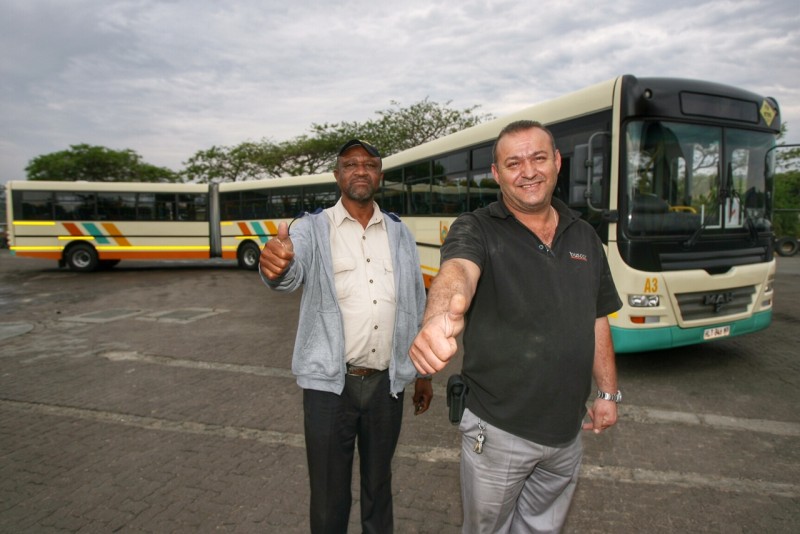
MBOMBELA – While the volume of traffic on South Africa’s roads continues to rise, Buscor in cooperation with MAN Truck & Bus, not only set an example to South Africa this week but also to the rest of the world as they celebrated Transport Month. They became the first company of its kind to launch a fleet of 12, 27-metre buses which can seat 137 passengers, permitted to travel on any class of road.
The 12 units that were officially launched by the minister of Transport, Ms Dipuo Peters, are the first bi-articulated front-engine commuter buses to be fully built by MAN and are the first of their kind in the world to operate on non-dedicated routes, invitees heard on Tuesday.
Peters, who were accompanied by the MEC for public works, roads and transport Ms Dikeledi Nhlengethwa as well as the executive mayor of the Mbombela Local Municipality, Mr Sibusiso Mathonsi, left for Bhuga, an informal settlement just outside Mbombela at 04:00 on one of the bus trains, not only to experience what 160 000 passengers have to endure on a daily basis, but also to create an opportunity for passengers to interact with the minister and her entourage.
The deployment of the new vehicles by Buscor follows a six-year pilot project initiated by the company in conjunction with MAN, in response to a call by the National Department of Transport (NDoT) in 2006 for bus operators around the country to find commuter transit solutions that would effectively alleviate road traffic congestion, improve passenger safety, limit carbon emissions and reduce axle overloading to minimise damage to road pavement surfaces.
According to Ms Nora Fakude, executive chairman of Buscor, the company has always been proactive in developing and deploying commuter bus solutions that meet the demands of consumers and government alike.
“Buscor built Africa’s first bi-articulated train bus in 2007 as a prototype for the government-sanctioned pilot project. The bus commenced commercial duty in October 2007 and, with the assistance of MAN Truck & Bus both in South Africa and in Germany, we added a further nine units to the fleet over the following three years,” Fakude said.
According to Buscor’s general technical manager, Mr Leon Grobbelaar, the six-year pilot project was extremely successful and he referred to no serious incidents that have been recorded after covering 2,2 million kilometres and carrying 3,3 million passengers. “This impressive record, combined with the economical and environmental advantages of the high carrying-capacity buses, enabled Buscor to acquire full and indefinite exemption from the NDoT in mid-2014 to operate its bi-articulated bus trains on approved routes within the province, he said. Grobbelaar has driven the project since its inception and was instrumental in persuading MAN’s German bus chassis production division to factory-produce a chassis according to Buscor’s specifications.
Pivotal to the pilot project was the granting of permits from the NDoT to operate these vehicles on public roads, a lengthy and often difficult task that had the prototype stand for a year in 2008/09 when its permit lapsed.
However, after successfully lobbying the NDoT to issue a new permit for the pilot project, Buscor became the first bus service in the country to not only become Road Transport Management System (RTMS) accredited in 2012 but also to get Performance-based Standards (PBS) certification and a fleet of buses permitted to travel on any type of road.
Capable of seating 137 passengers, the Buscor bi-articulated bus trains are designed for use during peak commuter-density periods and significantly reduce the number of vehicles required to transport the commuter community in the province.
“Without our single and bi-articulated MAN bus trains, our fleet would now number around 700 rigid-chassis buses. The bus-train solution has enabled us to keep our fleet size down to 415 units, effectively satisfying the NDoT’s mandate to improve safety and reduce congestion, carbon emissions and pavement damage on our roads,” Fakude added. According to Fakude one of these buses will keep more than 40 cars off the road.
The new buses will each transport around 145 000 passengers per annum, travelling approximately 72 000km per year over the next 10 years.