Macs extremely efficient at absorbing phosphates and calcium
When it comes to crop nutrition, macadamias are not heavy feeders and their lateral root systems with lots of fine roots and proteoid roots are extremely efficient at absorbing both phosphates and calcium, even in soils where relatively low levels of these nutrients are present.

Cluster roots, also known as proteoid roots, are found in all species of the Proteaceae family. These roots are known to grow in soils with very low nutrient levels. They play an important part in nutrient absorption, especially the uptake of phosphorous.
Crop nutrition
The phenological cycle is the primary determining factor for macadamia orchard management and fertilisation, and not the calendar.
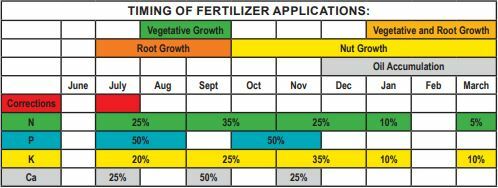
Macadamia flower initiation begins in May, with August, September and October as the main months for flowering and root growth, depending on the variety and the climate. Nut set occurs in October and November, depending on the variety and climate.
Nut growth increases in December up to a certain size, thereafter, nuts convert starch into oils until February. The oil accumulation period is very important; nut quality improves with the increase of oil content. Between March and May, the mature nuts drop from the trees. The aim of a fertilisation programme should be to keep the tree and the root system healthy, and to replace at least the amount of nutrients removed each year by the crop.
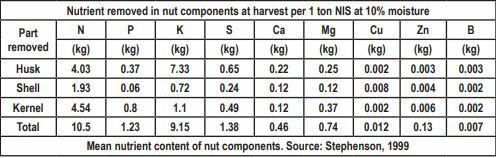
Macadamias mostly requires nitrogen (N), which is the most important nutrient for tree growth, a key component of chlorophyll and essential for the synthesis of plant hormones and potassium (K), which is important for the opening and closing of stomata, the synthesis and movement of starches, sugars and oils, and ultimately has a direct effect on nut yield and quality.
Macadamias have a low requirement of phosphorus (P), but a high requirement of iron (Fe). Where high soil P levels are present, there tends to be Fe deficiencies, as this can be induced by high soil P levels. High soil pH levels also tend to decrease the availability of certain micronutrients like Fe.

Although South African soils are generally abundant in Fe, it is an important nutrient to keep in consideration, as deficiencies could cause sparser leaf coverage and possible tree die-back.
Products
• YaraRega Aquaflex
The YaraRega Aquaflex range is a low-P, -ammonium nitrate and -potassium sulphate-based NPK compound fertiliser with macronutrients such as sulphur (S) and magnesium (Mg), and micronutrients such as zinc (Zn) and boron (B).
• Aquaflex 18 with its high N content is an ideal balanced fertiliser for the vegetative growth stage of macadamias.
• Aquaflex 13 with its high K content is an ideal balanced fertiliser for the nut growth stage of macadamias.
As most fertilisers are applied by hand, the distribution of each element at each tree is of utmost importance.
It is suited for convenient dissolution and use in fertigation systems (i.e. macro and micro sprinklers and pivots) as well as for dry application.
• YaraVita Rexolin Fe
The YaraVita Rexolin Fe range includes EDTA, DTPA and EDDHA.
This is stable, water-soluble iron chelate products that can be used either as a foliar feed or as soil applications where Fe deficiencies are present.
Fe has a critical function in the production of chlorophyll.
• YaraLiva Nitrabor
YaraLiva Nitrabor is a fast-acting calcium nitrate fertiliser especially formulated for crops requiring calcium and boron, or for soils that are low in calcium (Ca) and/or boron (B).
Calcium plays an important role in cell division and cell development in new leaves, nuts and root tips.
Boron plays an important role in cell division and cell growth. It is also very important in the flowers, nuts and root tips where cell development is significant
The dry applied product, YaraLiva Nitrabor, utilises Yara’s highly efficient coating system to keep the product free-flowing, ensuring excellent spreadability.
For more information:
Visit our website
Give us a call
Send us a mail
Like us on Facebook