Keep your livestock healthy
The health of your livestock and poultry is keystone to any livestock or poultry agricultural endeavor. Being knowledgable about infectious diseases and protection your stock is an important aspect of conservation.
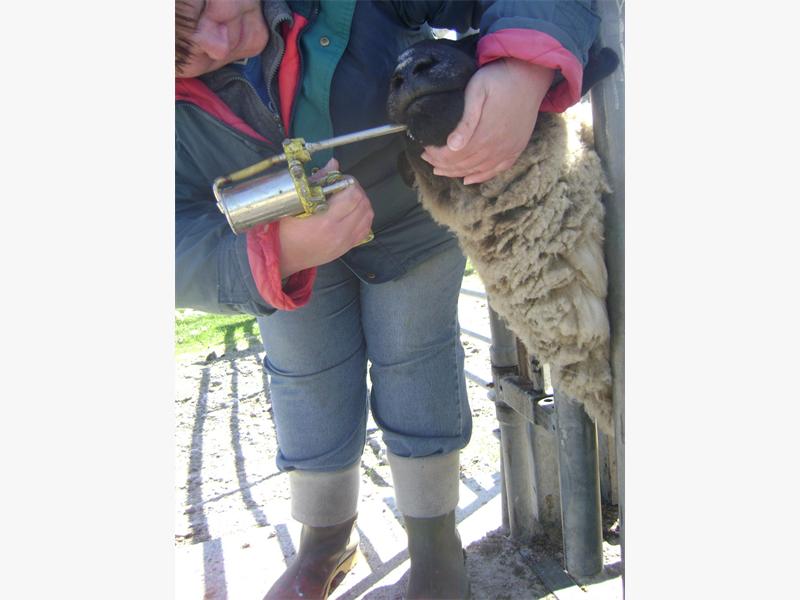
Keeping livestock and poultry healthy is the keystone to any livestock or poultry agricultural endeavor. Healthy animals grow better, reproduce more efficiently and produce more economically valuable products. Unhealthy animals cause a producer to spend more time managing the stock, more money on health inputs and vet bills, and often produce less or poor quality products. Without healthy animals, conservation, production, and profitability are impossible.
Protecting your stock from infectious disease is an important aspect of conservation. The activities and strategies employed in preventing disease transmission constitutes a biological security program. Biosecurity is important at all times, but during outbreaks it is even more important to review your biosecurity practices.
Internal parasites can be divided into three groups, namely round worms, tape worms and flukes.
They are divided according to their various life cycles.
Roundworms
• They have a direct life cycle. This means that they do not need an intermediate host to complete the cycle.
• Adult female worms occur in the gastro-intestinal tract of the host animal where she lays eggs that are passed out in the faeces of the animal onto the pasture.
• Temperature, light and moisture are important factors influencing the hatching of eggs.
• Three larval stages occur before the infectious stage is reached.
• The infective larvae are taken in by the host animal together with grazing.
• A further two larval stages occur before the worm is sexually mature. Even these stages have a negative effect on the host animal, which makes diagnosis of the infection difficult.
• Diagnosis of roundworm is done by means of faecal egg counts.
• The two most important roundworm species are wireworm, a blood sucker, and brown stomach worm, which causes the animal to waste away and severe diarrhoea.
• In cases of severe infection, an animal can die before any symptoms are observed.
Tapeworms
• Tapeworms require an intermediate host to complete their life cycle.
• The adult tapeworms are found in the small intestine of the host animal.
• Ripe segments are released from the worm and excreted together with the faeces of the host. These segments are filled with thousands of eggs.
• Different tapeworms require different intermediate hosts. All the important species affecting sheep, goats and cattle require grass mites. The mites ingest the eggs while feeding and the larval stages of the worm develop inside the mites. The mites are taken in by the host together with grazing and the tapeworm attaches itself to the wall of the small intestines to complete its life cycle.
• Tapeworms do not cause much physical damage to the host animal, but absorb the nutrients that the animal needs for growth.
• Diagnosis in live animals are often difficult and sometimes a postmortem is necessary.
• Symptoms of severe infection may include extended belly (or potbelly) and retarded growth.
• Total obstruction of the small intestines by heavy worm infestations may result in rapid death.
Flukes
• Flukes require an intermediate host to complete their life cycle. In this case it takes the form of a freshwater hard-shelled snail.
• Flukes are usually associated with freshwater sources such as pans or marshes and occur mostly in autumn and winter when animals are forced to graze the greener edges of the marshes as a result of a lack of pastures.
• The most important species are liverfluke and conical fluke.
• Liverfluke occurs in the bile ducts of the liver. The eggs are passed into the bile and are then excreted with the faeces of the host animal. Immature stages infect the snails where further development takes place. The parasites escape from the snails and encyst on the herbage to form the infective stage which is taken in by the host.
• Conical flukes inhabit the rumen of sheep, goats and cattle and have a similar life cycle to that of liverfluke. The adult parasites do not cause any pathology to the host, but the immature stages destroy the mu cous membranes of the small intestines, causing severe diarrhoea. Diagnosis depends on time of year and grazing history of the area involved.
All parasites mentioned can be limited by effective management and the use of worm remedies or anthelmintics
Worm resistance
• This occurs when a worm population or a worm strain becomes im mune to the effect of a remedy. Such a remedy then no longer achieves the control for which it was registered, because certain resist ant worm strains render them less effective.
• No worm remedy can, however, be rejected as resistance varies in different region or farms.
How does resistance develop?
• It is often the result of the frequent use of remedies in small stock, most often at times when they are not really necessary.
• Underdosing (to save cost) of animals can also result in the develop ment of resistance.
• Resistance initially develops very slowly but then rapidly increases to a high stage.
• Once resistance to a specific anthelmintic group has developed, it is permanent and cannot be reversed.
How to determine the level of anthelmintic resistance
Consult you nearest veterinarian or animal health technician and have a faecal egg count reduction test done.
Helpful hints
• Dose according to the mass of the heaviest animal.
• Never estimate the mass, always use a scale.
• Do not underdose to save money.
• Read and follow the instructions on the label.
• Check apparatus frequently for accuracy.
• Dose all animals and make sure not to skip any.
Always seek professional advice for the control of internal parasites