
German grant funds expansion at wildlife college
Funding through KfW has paid for additional staff houses, office space and lecture rooms to accommodate the increased staff complement and growing student body.
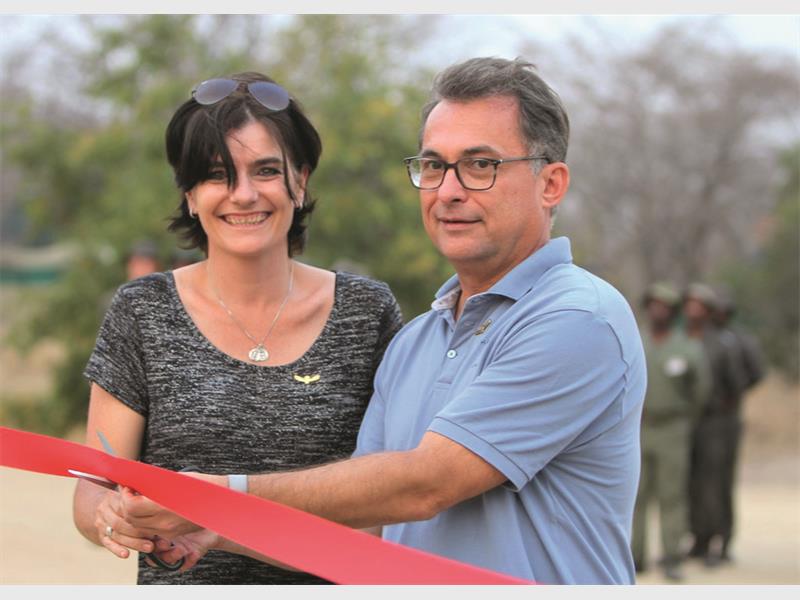
Dr Joachim Nagel officially open the new facilities.
A substantial grant from the German government through the German Development Bank (KfW) has taken the Southern African Wildlife College (SAWC) to the next level.
“Conservation in Southern Africa is facing enormous challenges. We are proud of the role the college plays in developing the human and social capacity to tackle these effectively,” said college CEO, Theresa Sowry, at the inauguration of the new facilities earlier in September.
“This generous grant has equipped us to better serve the region as a recognised South African Development Community (SADC) centre of specialisation in conservation education, training and skills development, to the benefit of people and wildlife.”
As part of the R61,4-million grant, which follows an initial infrastructure development grant of R28 million in 1996 when the college was established, the “phase two” funding through KfW has paid for additional staff houses, office space and lecture rooms to accommodate the increased staff complement and growing student body, as well as a fully equipped field ranger training base.
The college has also made significant steps towards greening its campus, with infrastructure service upgrades and the piloting of more environmentally and economically sustainable building techniques.
“Our sincere thanks to SADC and the German government for the funding, which also helped us leverage support for extra strategic projects, such as our K9 unit,” continued Sowry.
“As a promotional bank, KfW supports change and encourages progressive ideas on behalf of the German government,” said KfW’s board member, Joachim Nagel.
“The college works with various conservation agencies and organisations across the region to give the custodians of protected areas the skills they need. It also places a high priority on cooperation with local communities, who play a vital role in the unified approach to the sustainable management of natural resources. We believe that KfW’s support for these infrastructure upgrades at the college will enhance its ability to deliver on its training mandate for the SADC region.”
To date the college has trained more than 16 000 people across various accredited programmes, learnerships and short courses, from protected area managers to field rangers. As most trainees and the conservation agencies that employ them lack the financial means to cover the costs of this training, the SAWC relies on the generosity of donors to fund it.
In the unified approach to the sustainable management of natural resources, a high priority is placed on cooperation with local communities, who play a vital role. As such, the Mnisi community was a major stakeholder of the project, given that the community lives alongside the college and conservation areas such as the Kruger National Park and Manyeleti Reserve. To this end the college aimed to ensure that the community, as conservation partners, benefited fully from the “phase two” infrastructure development.
“The college has since, its inception, empowered people from African countries to manage and conserve some of the world’s most biologically diverse areas. A huge thank you to everyone involved in this project. It’s taken us to the next level,” concluded Sowry.