
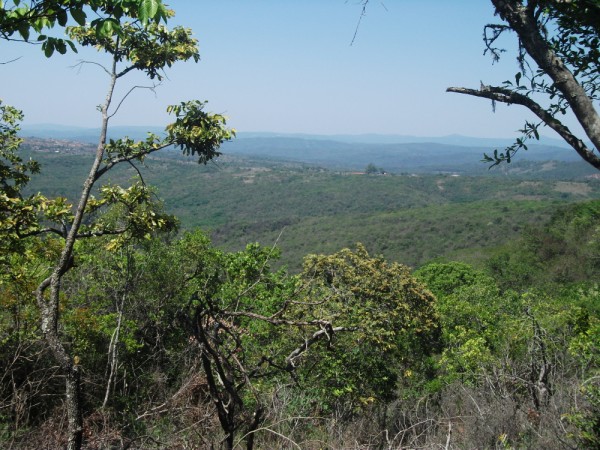
This reserve lies on the R40 towards Bushbuckridge, not far from Inyaca Dam. At around 900 metres the climate is pleasant, with beautiful views over the Lowveld and the Drakensberg towering in the west.
This reserve is special because it drops down into the Lowveld, changing in landscape and vegetation. Down in this region is a more open bushveld. Here on top the vegetation is classified as Legogote sour bushveld, a dense bushveld which transforms into forest, especially on the cool southern and eastern slopes.
The forest is called mist-belt forest, with trees like forest bushwillow (Combretum kraussii), cape ash (Ekebergia capensis), cape beech (Rapanea melanophloeos), red beech (Protorhus longilfolia), forest croton (Croton sylvaticus) and red current (Rhus chirindensis). In the undergrowth you find things like wild iris, forest num num, wild asparagus, forest peach and jackal coffee. The Piet-my-vrou has arrived and a narina trogon can be heard. Away from snares and dogs, the forest must be a sanctuary for the red duiker. It could also be the habitat for the rare Samango monkey.
The bushveld areas have been kept open by people and fire and have most of our common trees. Veld which burns often is characterised by mobola plum (Parinari curatellifolia), corky bark thorn (Acacia davyi) and broad-leaved beechwood (Faurea rochetiana). The last two species especially, distinguish this veld type from the more open Pretoriuskop veld at lower altitudes.
Bushbuckridge Nature Reserve dates back to the years of the homelands and was established as part of Gazankulu homeland. Old ruins of thatch-roof buildings remain, reminding of ambitions of the past. At present, entrance to the reserve is not controlled, but new buildings are being erected. With a size of 6 800 hectares it has much potential, economically for the community of bushbuckridge, but also because of its biodiversity. Apparently the reserve is 100 per cent under land claims, but let’s hope it can remain a reserve.



