En garde, as Springbok fencer illustrates ‘extremely awesome’ sport
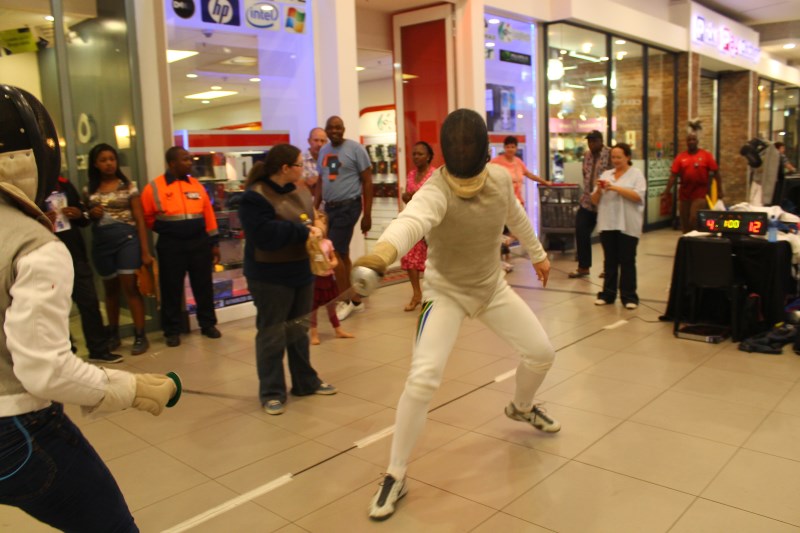
Andrew Howitt showed off his dueling skills when he joined the Mpumalanga fencing club for its demonstration in I'langa Mall last weekend.

The fast action, and interesting costumes, left passers-by gaping at the sight of fencers duelling in I’langa Mall on Saturday.
Mpumalanga Fencing Club held an event to demonstrate this sport, and hosted a special guest, national fencer Andrew Howitt (19).
Greta Ingram, coach of the club, says they aimed to offer not only the fencers exposure to a professional, but also to introduce the sport to people.
Judging by the reactions from the public, the display piqued a lot of interest. At present, the club has about 25 members in Mbombela and White River.
The Limpopo native, Howitt started participating in the sport at the age of 10, and is currently taking a gap year, after having finished high school last year, to focus on fencing.
Between competitions, he often travels and helps other clubs promote the sport.
“It is extremely awesome,” he says. “It develops a lot of different things in a person.”
He says a fencer needs the stamina of a marathon runner, as competitions can last a whole day; the mental strategies and tactics of a chess player, to draw your opponent out in order to take control of a duel, and the strength and flexibility of a ballerina or gymnast.
Howitt himself did ballet before switching to fencing, the second-fastest sport in the world, after target shooting, for the speed at which athletes need to move.
- Watch the video:
Aside from the different age groups in which they can compete – the oldest fencer Howitt knows of, took the sport up at the age of 70, there is a number of different styles. The weapons are slightly different for each.
With the epee, fencers are allowed to strike one another with the tip of their weapons anywhere from the head to the toes.
Points are scored on a sudden-death basis and if both strike at the same time, both parties score points.

In the foil, fencers can only score by striking their opponents on the lamet covering their torsos using the tip of the sword.
The one who attacks first has right of way to score. Points can be scored by attacking or defending.
Any hit off target stops the action, and then the duel restarts from the unguarded position.
The saber has a less-flexible blade, and fencers are allowed to attack with a cutting action to score points.
They have to strike on the foil, which in this case includes their opponent’s arms and head.
Other than the foil, there is no white light restarting play when someone hits the other off target.
Howitt loves all three. He says he is ultimately aiming to compete in the Olympics, but to qualify one needs to be ranked in the top 34 in the world by the International Fencing Federation.
While he is working on realising this dream, he is also doing all he can to grow the sport he loves.
Enquiries: Greta Ingram on 082-438-4042.
- See more photos of the fencing demonstration here.