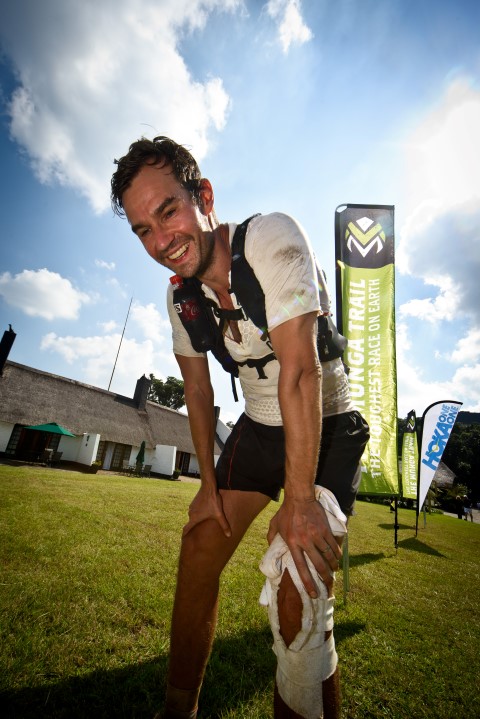
Because there is only a fastest and slowest time to measure against, the athletes still do not really know what is on par. This in addition to what nature can throw at them. These uncertainties, coupled with a strong field, more experienced Munga Trail runners and some fast, international runners, meant that Munga 2019 was always going to be exciting.
But when the race started last Wednesday amid rolling thunder and dark clouds at Lakenvlei Forest Lodge, it was clear that this was not going to be a predictable race. Defending champion Bennie Roux started confidently, but he was put under pressure almost immediately by rookie, ultrarunner Eben van Wyk. Englishman, Paul O’Sullivan, who came into the race with an impressive 77-hour time for the Moab 240, also made his presence felt.
The pace was very fast from the start and by the time the whole field had moved through Race Village 1 at Elandskloof Trout Farm, it seemed certain that a record time and a close race was on the cards. But the weather had other ideas and torrential rain seemed to follow the runners from Coromandel Estate, across the Kwena Valley and up into the Mokobulaan Forests where the mist was thick.
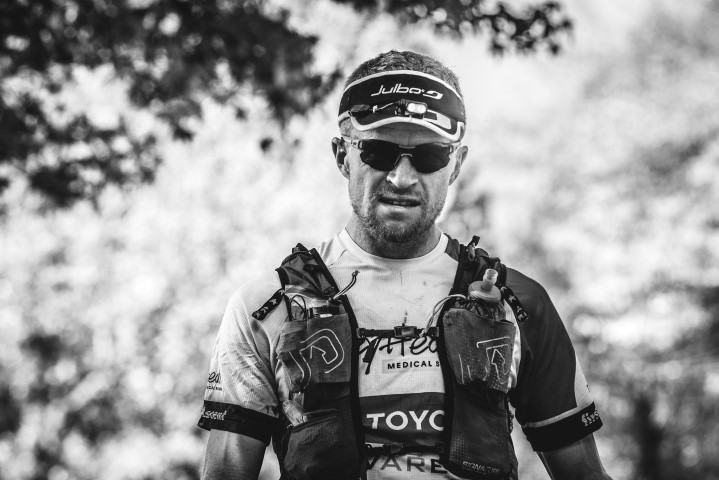
Paul O’Sullivan.
The leaders, Roux, Van Wyk and O’Sullivan had kept each other in their sights all the way up to Race Village 3 with all of them aware of the Dane, Carsten Nielsen (who famously cut Roux’s lead by 5 hours in 2017), about to hit his stride on his favourite part of the course, the Fanie Botha Hiking Trail to Graskop.
Roux’s small time advantage allowed him to tackle Towerwoud in the afternoon daylight, and that saw him into Summit Lodge in Graskop with a lead of several hours. While excitement was unfolding at the front of the race, the bulk of the field still moved well and ultimately only four runners scratched from the race.
While the runners were experiencing the toughest weather conditions yet on The Munga Trail, so were the race organisers. At 14:00 on Friday race organisers were informed of violent protest action at the scheduled race finish venue. Faced with a choice of shortening the race or finding an alternate finish, they set about using their local knowledge to re-route the race finish. By 16:00 they had caught up with Bennie Roux to give him the new route file. All the other runners were given the new route at Race Village 4.
The combination of weather and fast pace caused many runners to battle with keeping their feet blister-free; a combination that put an end to Carsten Nielsen’s race at WP8. Roux extended his lead over a visibly injured Eben van Wyk to take the win in 89 hours 35 minutes, with Van Wyk in second and Paul O’Sullivan in third.
Nicky Booyens was never challenged in the women’s race and, like Bennie Roux, took her third win out of three starts, finishing on Sunday in a time of 101 hours, 59 minutes and placed fourth overall. Nicky was the only woman to finish the race.
Only eight of the 18 starters finished the race this year, making The Munga Trail among the toughest races in Africa.
Over the race’s three-year history, the organisers have only handed out a total of 26 hand-crafted medals that depict the runner’s finishing position. But some of the greatest achievements are not about the medals. They are about the almost-ordinary people who run this race to push their boundaries. Like Vicki van Zyl who returned to the race for the third time.
She’s progressed from making it to RV1 (66km) in 2017, to RV3 (228km) to completing 328km this year, still leaving her with a score to settle. Then there is Philip Boardman, who at the age of 69 scratched when he was behind the cut-off schedule at water point eight, 287km into the race.
These folks are as determined as the winners, and their achievements are equally monumental. Some will argue more so, as they spend far more time on the route and serve as inspiration for those looking to attempt the seemingly impossible.
At Caxton, every story is written by humans. We use AI only to perform quality checks - never to generate the news. Happy reading!
Stefan de Villiers, based in Mbombela, Mpumalanga, is currently the Editor at Lowvelder. He brings a wealth of knowledge and experience from previous roles at Lowveld Media, such as Sports Editor, Journalist and Photographer. He started on November 1, 2013.