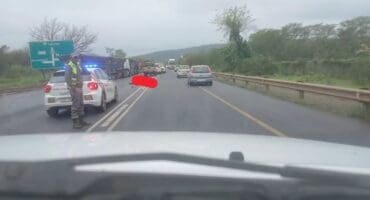
R40 Truck Forum keeps the pressure on
John Robinson, of White River, and his trusty band of road warriors are keeping the pressure bandage on the painful problem of too many large ore carriers on our local roads.
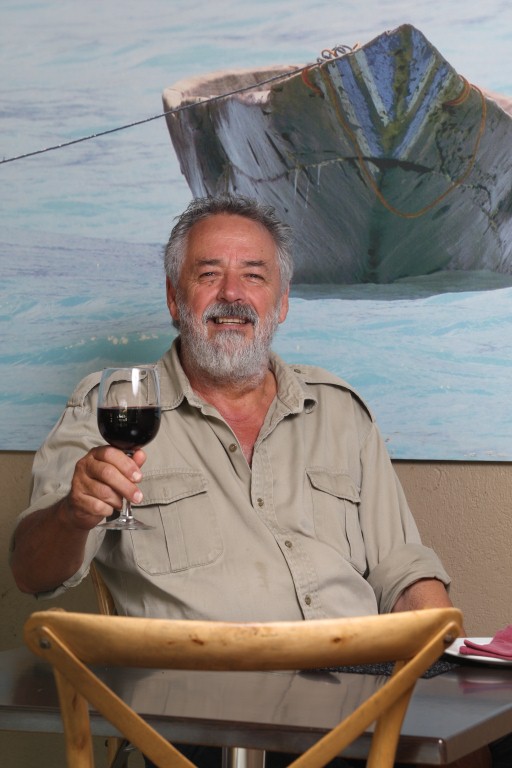
John Robinson single-handedly managed to get all the key stakeholders around a table to discuss the pressing issue of the ever-increasing number of ore-carriers on our local roads. From the patio of his son’s restaurant in White River, John watched the truck numbers increasing and decided to do something about it. He set up the R40 Truck Forum and has persistently been a niggling thorn in the side of the stakeholders.
“At one point, between 350 to 500 ore-carriers travelled on the R40 in both directions on a single day,” says John. The big question John posed to stakeholders is, “Who determines the saturation point?”
Pressure from the R40 Truck Forum forced a mining group to commit to re-building the R538/Plaston Road. This is a mammoth achievement for the forum and can be attributed to the steely determination of John and his trusty band of road warriors. Another few notches on their belt includes pushing through a code of driving safety for the truck drivers to adhere to and getting a law passed that prevents large trucks from driving through White River CBD.
“We’re not trouble makers, we’re more of a lobbying group,” stresses John. “Road forums in other provinces have been revived as a spin off of how active we are.”
John is of a generation who rolls up their sleeves and get elbow deep in finding a solution to a problem. This, no doubt, stems from a lifetime of selflessly helping people; a characteristic that defines John.
Statistics from Sanral: average daily traffic of ore-carriers
In 2009, 145 ore-carriers to Hazyview and 180 to White River per day
In 2012, 301 ore-carriers to Hazyview and 386 trucks to White River per day
The role of the railways
Transnet has identified the railway corridor between Phalaborwa and Kamatipoort as a priority area. Considerable funds, to the tune of R300 billion, has been earmarked by Transnet Freight Rail to re-establish the line so it will be able to handle double the current volume by 2019.
Phalaborwa Mining Company (PMC) has stated its intention to transport all magnetite from PMC for export vial rail within the next three to four years.
More about John

John was born in the Free State and spent his formative years helping his dad on their mielie farm. After his army service and a stint in the motor- and building trade, he joined a good friend and went into game capturing. John tells one story after another of his game capture days, not all with a happy ending. “We lost a few buck from what they call white muscle disease, which is basically caused by stress. Remember, things were different in those days and game farms weren’t as popular as they are now. Game capture today is much more refined but in our day, it was a bit rough.”
From John’s stories, it sounds like it was as basic as darting an animal and then throwing yourself off the truck to pin it down. “My good mate, Paddy, would go to the local rugby club and find himself a handful of muscled rugby players. With the promise of a few cases of beers at the end of the day, they would jump off the back of the vehicle, landing in thorn bushes and on rocks and sometimes, if they were lucky, onto the darted buck.”
John remembers one tracker who was terrified of buffalo. “He followed the buffalo’s tracks the wrong way, leading us away from the beast.” When John confronted him with his “mistake’ the tracker said, “The buffalo she promised to kill me. But you, you won’t.” Those were the days when rangers would track without rifles. “I preferred to walk in the bush with only a sjambok as I didn’t want the temptation of of using my rifle if I got into a tricky situation,” John says.
John changed direction and went into the hospitability industry with his new wife, Elche. “I’ve been in the Klaserie for most of my life,” says John, running through a list of prestigious game lodges and hotels they’ve been involved with. “I had a wife and a daughter and was paid R100 per month in those early days,” says John. Elche is a fantastic cook and still caters for luxury game lodges. “She couldn’t boil an egg when we were first married. I taught her to cook,” laughs John, without Elche around to correct him.
John is a devoted family man and a walking ‘brag book’ when it comes to his wife and children. They all share a love of cooking and both his children are carving out successful careers as chefs. “We had a Staffie named Mahoi and we’ve used the name for a few of our businesses – and it’s the name my son chose for his restaurant.”
John launches into telling us about his son’s new enterprise; making canvas bags under the name of Hank and Grey. “I think this one was named after me,” he says, affectionately patting the largest canvas bag called Big John. Using an industrial sewing machine, Elche used to make bedrolls from rip-stop canvas and even made canopies for their Landrover. “Jonathan asked us if he could borrow the old sewing machine and the next thing we knew he was making these gorgeous bags,” adds John.
The Robinson’s are a family of many talents and at the helm is a father they must be immensely proud of. Our community can thank him for his selfless efforts to stand up to the large mining conglomerates.