Say jinba ittai – unity between car and driver
This year marked the 25th anniversary of the debut of the Mazda MX-5 Roadster. Originally pioneered by European car makers, this fun-to-drive lightweight sports car has matured and evolved over the past quarter century.
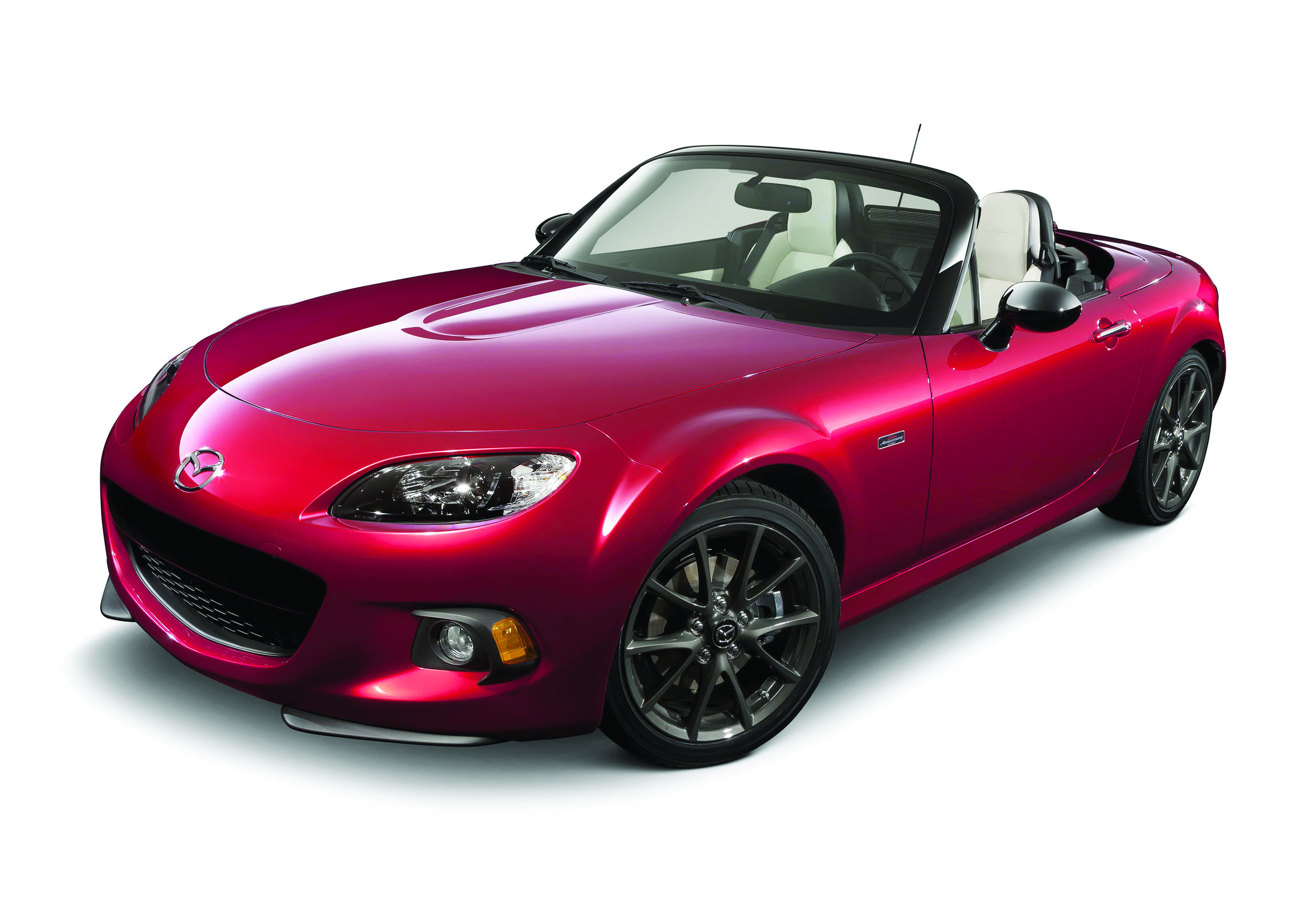
Right from the first generation, Mazda’s philosophy for the MX-5’s development has remained the same: create a car that delivers true driving pleasure and is an irreplaceable partner for the people on board as well as onlookers.
This includes Mazda’s hallmark, Jinba ittai, the feeling of oneness between car and driver, and the lots-of-fun characteristics that go beyond driving pleasure.
The MX-5 has steadily evolved in a way that is possible thanks only to an unchanging passion shared between Mazda and countless MX-5 owners and fans around the world.
On February 9, 1989 Mazda announced its two-seat open-top lightweight sports car, the MX-5 Roadster at the Chicago Auto Show. At that time, there were virtually no cars remaining in the category that had first appeared in Europe in the latter half of the 1940s, gaining popularity thanks to its agile handling, characteristic style and affordability.
After the 1960s the market focused more on safety and comfort and the cars in this category had all but disappeared. For this reason, the debut of the MX-5 was a great sensation. In order to create a truly enjoyable car, the engineers and designers adopted jinba ittai (the oneness between car and driver) and ‘a car that appeals to human sensitivity’ as the key development concepts.
Following the example of famous European cars of the 1960s, they set the principal requirements for Mazda’s new sports car: lightweight, a compact open-top two-seater body with a front midship-engine rear-wheel drive configuration, a 50:50 front-rear weight distribution, a low yaw inertia moment and an affordable price and with exhilarating direct handling and superb control via the throttle, so characteristic of jinba ittai.
A second-generation model was announced at the Tokyo Motor Show in October 1997 and was certified by the Guinness World Records as the world’s best-selling two-seat roadster when production reached 531 890 units in May 2000.
The third-generation model was announced at the Geneva Motor Show in February 2005. Production reached 900 000 units in February 2011, which led to an update of its Guinness certification. Both the second – and third-generation models inherited the MX-5’s basic principles.
Jinba ittai driving has evolved and improved as technology advanced. It is an essential part of all the cars Mazda makes.
The 25-year history of the Mazda MX-5 is the history of the pursuit of a unique driving feel in which the car and driver become one. It is also a record of the distance Mazda has travelled to establish its own inimitable style of driving pleasure.
Times have changed drastically during the MX-5’s 25-year history. Each successive model of the past three generations has seen slight increases in size and weight in response to social requirements as people’s awareness of safety and the environment increased.
But today, demands for safety and environmental performance are exponentially higher. This is clearly summed up by the maxim that indicates the direction of the next model – innovate in order to preserve.
The coming model is entirely new and incorporates all the latest advancements in Mazda’s SKYACTIV Technology which will provide extraordinary driving pleasure and lots of fun in the owner’s life.