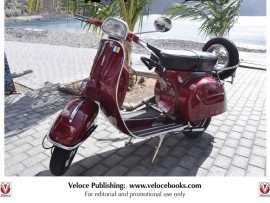
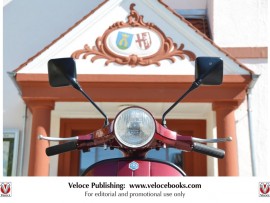
Nearly 70 years of Vespa history celebrated
Vespas have split opinions ever since they first appeared on the scene. The members of one camp bemoan “those horrible things,” while those in the other camp develop a twinkle in the eye.
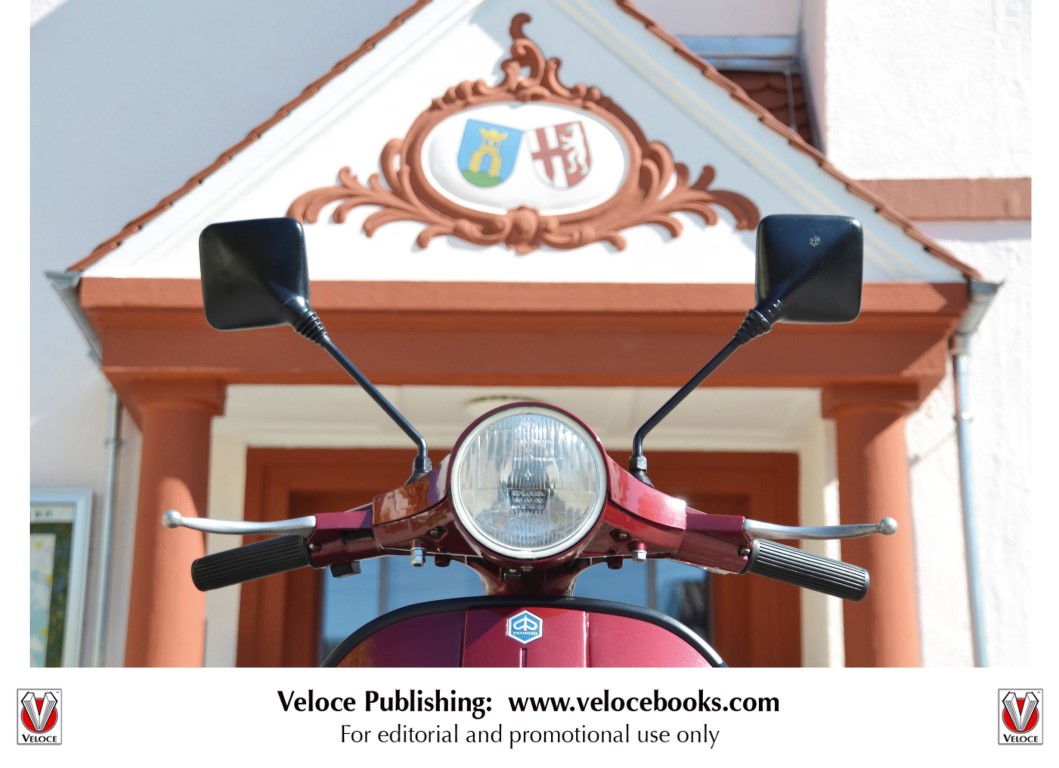
For some, it’s just another motor scooter, for others, a revelation, and, for a few, an entire religion. Born in the turmoil of the immediate post-war years, the Vespa grew up in the Swingin’ Fifties, came of age in the Golden Sixties, and remains immortal in the third millennium.
Eighteen million Vespas have buzzed their way into the world since 1946. Stood end to end, they would form a line measuring
32 000 kilometres – 20 000 miles – in length. This is an almost inconceivable statistic, as with many things that transcend conventional measures and at some point achieve cult status. How did the little machine come so far?
The answer is simple. The Vespa has always remained the Vespa, true to itself, and has what others lack – real character! The secret of the Vespa scooter’s success lies in its uniqueness, in the unmistakable sheet metal skin that, over the span of decades, has proven its versatility without ever abandoning its familiar face. Today, the Vespa shines forth like a lighthouse from the monotonous sea of industrial mass production. Nowhere else can one buy a factory-new legend.
Naturally, the Vespa’s success brings out the copycats, the freeloaders and the wannabe’s. Distributed throughout southeast Asia, scooter makers drape a plastic skin that bears a deceptively authentic resemblance to the Vespa shape, over a cheap tube frame, and bring it to market at a fire-sale price. The same is true for accessories of all types, from vehicle parts to scale model collectibles, and, unfortunately, to an increasing degree, Vespa literature.
The Vespa is so “hip” that everyone wants a slice of its pie. Text is copied and disseminated without discretion; even mistakes, once they appear in print, are immediately passed along as gospel truth. Surprisingly, an Italian specialist publisher has shamelessly copied the serial number chart from Vespa mi’ amore, neglecting to notice that in optical character recognition scanning a “B” might turn into an “8” and a “1” might become an “I.”
No wonder, then, that with every newly released Vespa book, with every Vespa magazine article and with every “Vespa special edition,” the potential for the corruption of information grows.
This book is intended to be the antidote to that corruption. As the pile of available illustrations began to take on frightening proportions during work on the latest edition of the classic title Vespa mi’ amore, the concept of this book was born.
The result is a Vespa book, through and through – as unique as the Vespa itself, with illustrations that have never been seen before. It is a volume that lets the reader become immersed in the culture of Vespa and la bella vita. Vespa – The Story of a Cult Classic in Pictures by Günther Uhlig.