Sissou sets tarmac on fire in Nissan GT-R35
Stelios Sissou is SA’s fastest man over one kilometre, breaking the 1 000-metre barrier in an official speed of 346,3km/h at ODI Raceway on Sunday August 9 and in the process shattering his 2014 record for street-legal cars.
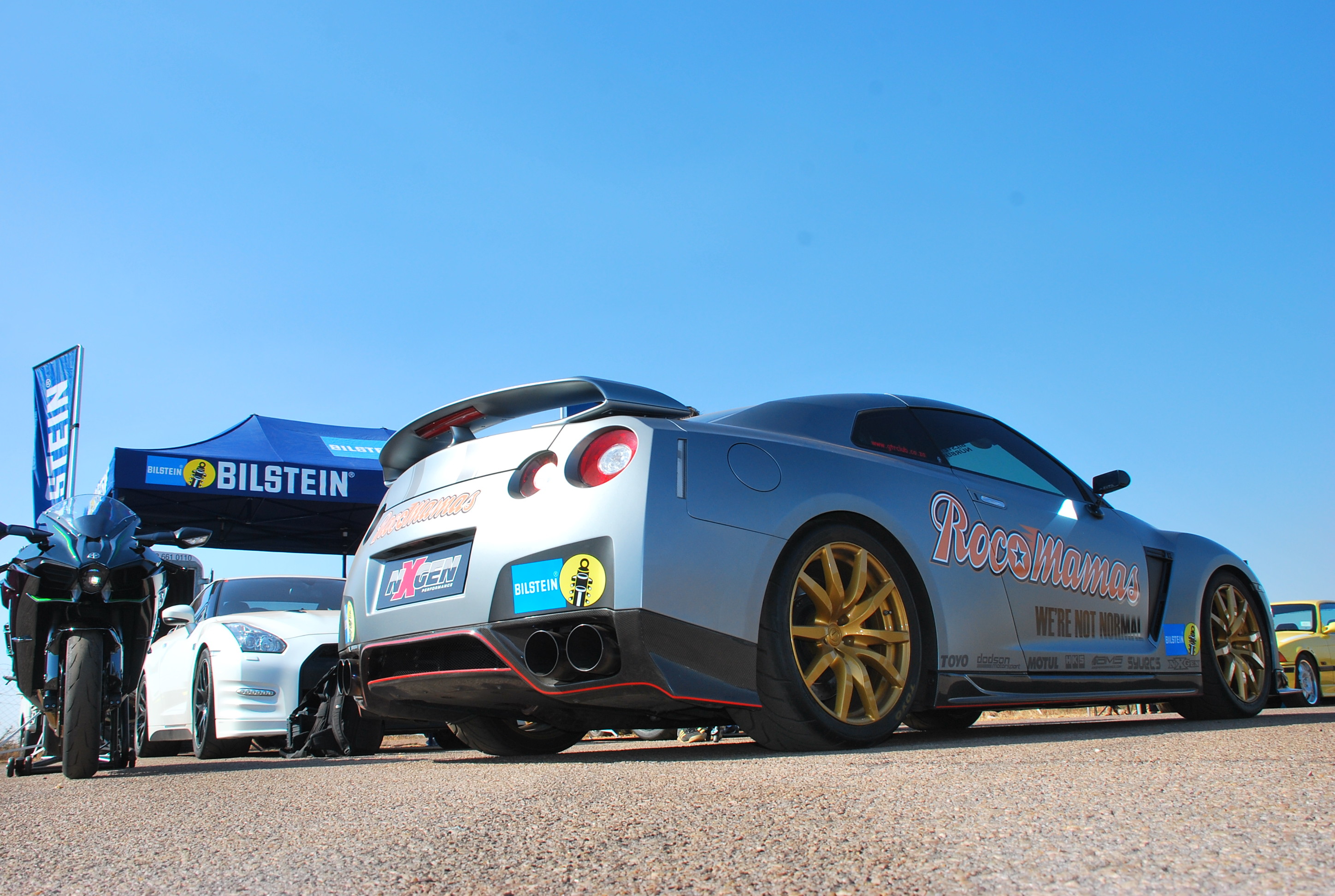
The Gauteng businessman’s Bilstein-backed 1200kW Nissan GT-R35 endured a morning of technical niggles at the annual One Kilometre Invitational before it all came together late in the day, Sissou launching his final attack on the tarmac with the sun already heading towards the horizon.
With his own record of 337km/h and a strong contingent of GT-R35 rivals to beat, the car underwent further refinements compared to last year’s specification, primarily an upgrade to Bilstein’s sophisticated Modular Damper System (MDS) suspension which allows fine-tuning of the shock absorbers. The rate of compression and extension (commonly referred to as bump and rebound) as well as ride height can be adjusted. This enables start-line traction to be optimised, while at the same time ensuring maximum stability at velocities beyond the take-off speed of a jet fighter.
“The Modular Damper System is Bilstein’s flagship product for high-performance cars. It allows the driver to adjust key settings to achieve a desired result, whether the car is going to be used for drag racing, track days, or even a gymkhana. It allows for quick and easy changes to bump and rebound via colour-coded rotary adjusters and with a little more effort ride height can also be altered,” explains Bilstein’s Ted Garstang. “Dialling in the ideal settings for a given circuit or driving discipline can be the difference between a good result and a great one and we’re really proud to have played a part in Stelios’s victory today.”
Interestingly, every GT-R35 leaves the Nissan factory fitted with Bilstein electronically controlled dampers as original equipment, so an upgrade to MDS is a natural progression. A jubilant Sissou added, “The morning was really character-building, and something went wrong on every run. With the temperatures rising quickly and a bit of a headwind I was worried whether we’d be able to get past 340km/h. But my final run was perfect: I went for a very conservative start strategy and didn’t use launch control, but when it did all hook up it was like riding a rocket ship – talk about warp speed!”
As it turned out, the victory was an emphatic one with the monster GT-R35 faster at the 800-metre mark than the next fastest car was at the end of the full kilometre.
According to a Video VBOX datalogger the NXGen-prepared GT-R35 achieved the following results as it powered its way into the record books:
• 0- 200km/h – 8,37 seconds
• 0-300km/h – 13,48sec
• 100-200km/h – 3,19sec
• 200-300km/h – 5,11sec
• 0-1000 metres – 18,35sec @ 346,74km/h
• 0-800 metres – 16,24sec @ 334,1km/h
Maximum speed 349,6km/h (achieved beyond the finish line).