Olifants River goes Carte Blanche
Derek Watts, the senior anchor of M-Net’s investigative programme, Carte Blanche, says they have had many stories of water quality over the years, and feels it was the right time to investigate the looming destruction of the Olifants River.
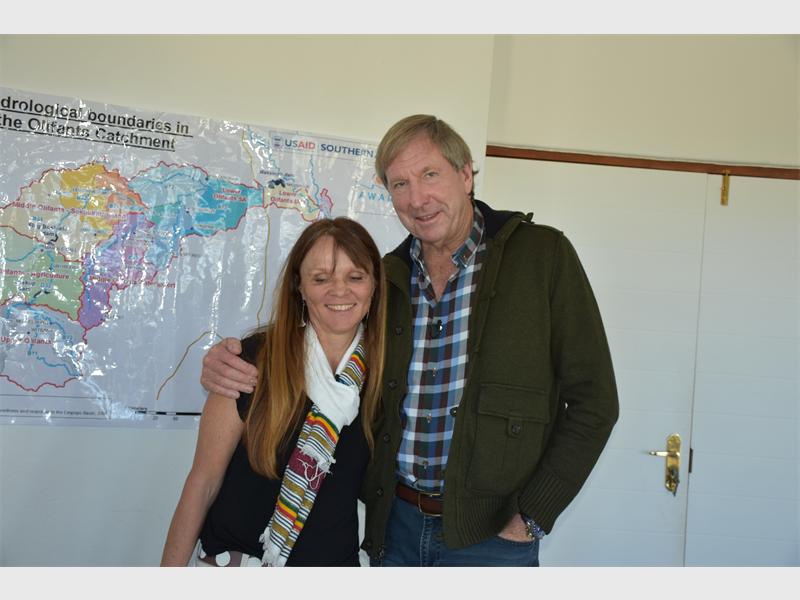
Carte Blanche is South Africa’s longest-running investigative journalism programme, and Watts has been with the programme for 28 years.
“I have done a lot of environmental and pollution stories, however as a programme we haven’t looked at the Olifants River. There is a lot of work being undertaken by different stakeholders in the catchment to stop the ‘near death’of this important natural asset,” he said.
Watts said he had witnessed soiled nappies, raw sewage, and mining effluent polluting one of South Africa’s biggest river systems.
“We have to look at what does the future hold for the two million people living along the banks of the Olifants River?” he said.
In an interview in Hoedspruit, at the offices of The Association for Water and Rural Development (AWARD), Watts said it is of great concern for him personally and his team at Carte Blanche to see such an important river in South Africa being degraded at such an alarming rate.
“When I started working on this story I was amazed at the level of pollution in certain areas and all the factors that are leading to the river’s death. In general, I also think that there should be more awareness of what is happening to major water systems in and around the country,” he said.
Contaminants in the catchment area of the Olifants River pose a serious risk to South Africa’s food production, agricultural exports, and human health.
The river is polluted by, among others, sewage, acid mine water, industrial refuse, weed killer, and pesticides.
The Olifants and its contributing waterways are critical for supporting life in the catchment. Unchecked pollution, inappropriate land and resource use, weak and poorly enforced policies and regulations and poor protection of habitats and biodiversity are degrading the Olifants at an alarming rate.
USAID’s Resilience in the Limpopo River Basin program, known as RESILIM is working to address the ongoing deterioration at both a basin and catchment level.
RESILIM B facilitates trans-boundary cooperation to protect biodiversity and livelihoods in the Limpopo Basin, while the RESILIM O program is working to support a more resilient Olifants Catchment in South Africa and Mozambique.
The Association for Water and Rural Development – AWARD – is the organization implementing RESILIM O in South Africa. Adopting a systemic approach to natural resources management, the organisation evaluates contributing factors holistically.
AWARD’s work with stakeholders from grassroots to government level is aimed at reducing vulnerability and building a more resilient and sustainable set of livelihoods and management practices throughout the Catchment.
USAID: RESILIM O is a five-year programme implemented by the AWARD to support a more resilient Olifants Catchment in South Africa and Mozambique. The objective of the programme is to reduce vulnerability by building improved transboundary governance and management of the Olifants catchment so as to enhance the RESILIENCE of its people and ecosystems through systemic and social learning approaches.
In 2013 a team of 30 scientists from the Council for Scientific and Industrial Research (CSIR), the Universities of Pretoria, the University of Stellenbosch, the Department of Water Affairs and Sanitation, and the Mpumalanga Parks & Tourism Agency found that the water in the Olifants River catchment area was so polluted that it held serious health risks for consumers.
Researchers also focused on consumer health risks posed by different pathogens in the water. Seven different pathogens were found in the water, including giardia, cryptosporium, salmonella, and norovirus.
On further investigation, the researchers found that extremely high levels of fecal pollution in the river came from inadequate wastewater treatment.
At some monitoring points on the river, situated near towns and settlements, the e.coli count was more than 1 000 units per milliliter of water.
Sasha Schwendenwein, a journalist with Carte Blanche, says the Olifants’ story is too big a story to go untold. In an interview, Sasha who investigated the story, says they haven’t done a piece on the river before.
“When we heard about the pollution going into the Olifants and the number of the people being affected by it, we felt we could not turn a blind eye to the situation. We saw a need, to help expose and solve this problem. Poor communication between the communities who are dependent on the river seems to be a major issue, she adds. Schwendenwein says during her investigation; she observed that the use of water in some of the dams shows high risks to people’s lives.
“On our way to Hoedspruit, we passed the Steelport River, which is considered to be one of the most polluted rivers in the country. We saw children bathing and brushing their teeth while others were fishing. At the same time, water was being drawn for drinking and domestic use. This could lead to a lot of health hazards,” she said.
Sasha continued by saying, it is the role of the media to educate and inform the public about the dangers of using unprotected water bodies, as well as informing industry, government and the general public about the dangers of polluting our water bodies.
Pollution is one of the major challenges facing the entire catchment area. Disposable nappies produce mountains of waste each year in most areas, but more so in the Burgersfort area. In many instances‚ nappies are being dumped in rivers or dams.
Carte Blanche will be doing an expose on the dumping of disposable nappies in tributaries leading to the Olifants River. During their investigations, they met with Peter Mashile who took them to visit a farmer in Burgersfort who lost 16 of his cattle. The cattle died due to consuming disposable nappies.
Read other stories here:
(Grafiese Inhoud) – Perd gekastreer, doodgeslaan
EFF causes stir during council inauguration
Groei baard groei! Jy het nog tyd tot Woensdag
Send a message to our SMS line 33 658 or add us onto Facebook and Twitter @Mobserv to receive your free daily news updates.
Also check out our Video’s on Youtube daily!