
South Africa's petrol price outlook has flipped back to its starting point
Picture: Neil McCartney


South Africa’s petrol price outlook has flipped back to its starting point at the beginning of August, wiping out mid‑month recoveries.
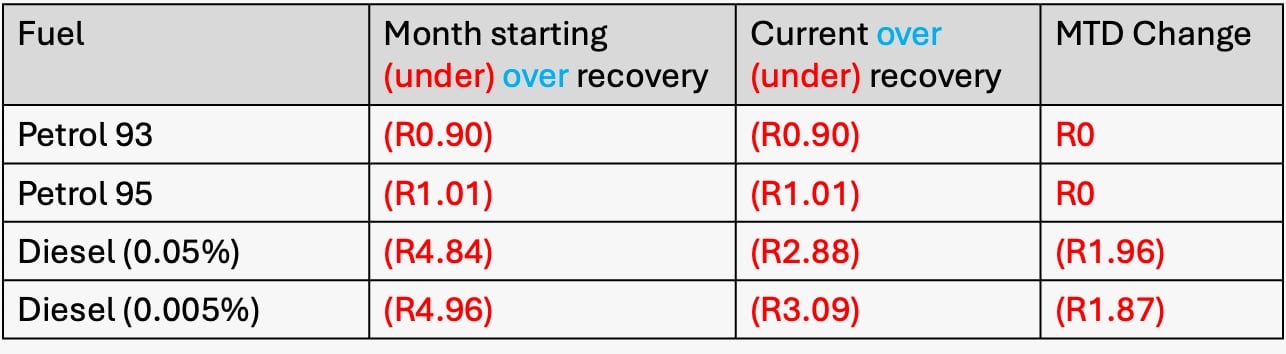
Data from the Central Energy Fund (CEF) shows petrol 95 is now under‑recovered by R1.01 per litre, almost identical to the R1 level recorded at the start of the month.
Petrol 93 is tracking in the same direction.
Oil prices
Global oil prices have swung sharply, climbing to $100 a barrel when the US‑Iran conflict reignited, dropping to $80 as tensions eased, and rebounding to $95 after Washington threatened new sanctions.
Diesel remains heavily under‑recovered at around R3 per litre, though this is an improvement compared to early August.
Rand
The rand, trading close to R16/$ per $, has cushioned the blow, trimming the petrol under‑recovery by about 15 cents per litre.
With geopolitical tensions driving oil volatility, the “U‑turn” in recoveries means South African motorists face renewed pressure at the pumps heading into September.
Forecast
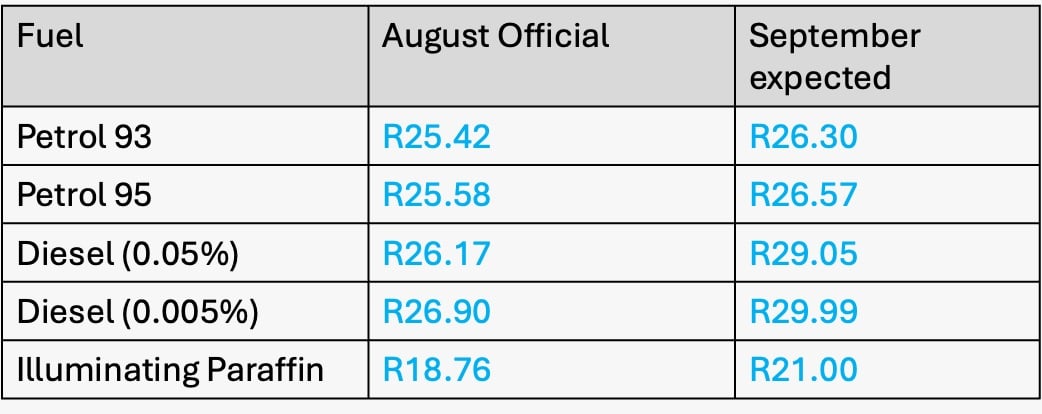
If these projections hold, motorists could pay the following in September 2026:
- Octane 93 petrol: possible increase of 90 cents per litre
- Octane 95 petrol: possible increase of R1.01 cents per litre
- Diesel 0.05%: possible increase of R2.88 per litre
- Diesel 0.005%: possible increase of R3.09 per litre
- Illuminating paraffin: possible increase of R2.24per litre
This is how much fuel could cost in September 2026
Iran
Meanwhile, oil prices declined as the US ramped up economic pressure on Iran and its trading partners in a bid to force the resumption of energy flows through the Strait of Hormuz.
Brent traded near $92 a barrel, after falling more than 2% in the previous session, while West Texas Intermediate was around $85.
Countries will face a specific timeline to shut down links with Iran or face unilateral punishment, Treasury Secretary Scott Bessent said on Monday as part of what he called an “economic D-Day” campaign.