A decade of breaking barriers as SA women take the lead in first-time homeownership
South African women are driving change in the property market. New data reveals women are entering the market younger, earning more, and investing strategically to secure financial independence and build long-term wealth.

The past 10 years have seen a steady rise in the number of women entering the South African property market, with female first-time homebuyers overtaking their male counterparts.
According to Careen Mckinon, Head of Sales at ooba Home Loans, this is a clear indication that women are determined to achieve financial independence and build generational wealth, despite some of the income disparities that still exist today.
“An increasing number of women view property ownership as a key marker of financial independence. Over the past decade, trends have shown not only a steady rise in demand from female first-time homebuyers, but also a shift toward younger women entering the market,” says Mckinon.
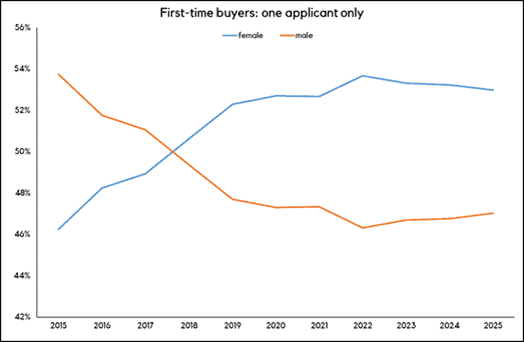
Decade-long data from ooba Home Loans shows that while women made up 46.3% of first-time homebuyers purchasing on their own in 2015, this number has since steadily climbed to 53% in 2025. “Since 2018, the trend of women entering the property market without the dependency of a partner has outpaced their male counterparts, a trend which is likely to continue.”
Strong Regional Performance
“KwaZulu-Natal recorded the strongest increase in first-time female homebuyers, rising from 47.7% in 2015 to 57.7% this year – a full 10 percentage point gain,” she says. “While the Eastern Cape also stands as a top contender for first-time female homebuyers purchasing alone.”
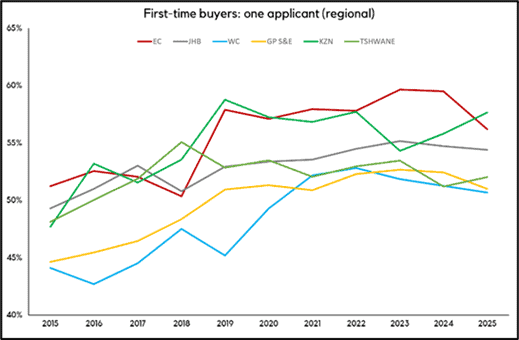
According to Mckinon, even in traditionally more expensive markets such as the Western Cape – which has the lowest percentage of female first-time homebuyers nationally – women have made notable inroads. “The proportion rose by 6.6 percentage points over the decade to reach 50.7% in 2025. This milestone underscores the determination of women to overcome affordability barriers.”
And when it comes time to spend, Mckinon shares that there is a higher concentration of solo female homebuyers in more affordable regions such as the Free State and Gauteng South & East. “The data shows that lower-cost markets like these reduce the barrier to entry, making it easier to acquire property at more affordable prices.”
Female Homebuyers are Getting Younger
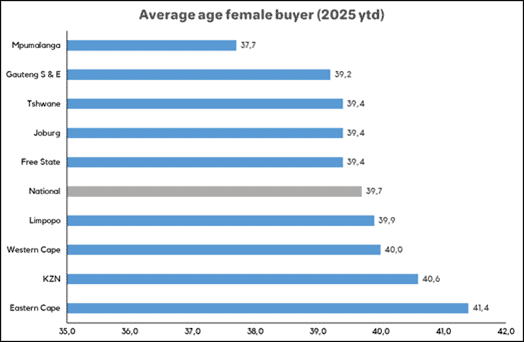
One of the most notable shifts over the past decade has been the drop in the average age of female first-time homebuyers. “In 2015, the average age was close to 47 years, but this has since fallen by more than seven years to 39.7 years in 2025,” says Mckinon.
Year-to-date, Mpumalanga is home to the youngest average female first-time homebuyer group – at 37.7 years – while the Eastern Cape is home to the oldest – at 41.4 years.
Mckinon adds that the Western Cape saw the largest age drop – down 8.5 years from 48.5 in 2015 to 40 in 2025. “This indicates that younger women are taking decisive action to secure their place in the property market earlier, whether through strategic savings, bigger salaries, smaller deposits or targeting more affordable properties.”
“Overall, lower average ages suggest that women are recognising the long-term benefits of buying property sooner,” adds Mckinon. “The earlier you buy, the longer you have to enjoy capital growth.”
Income Growth and Shifting Property Choices
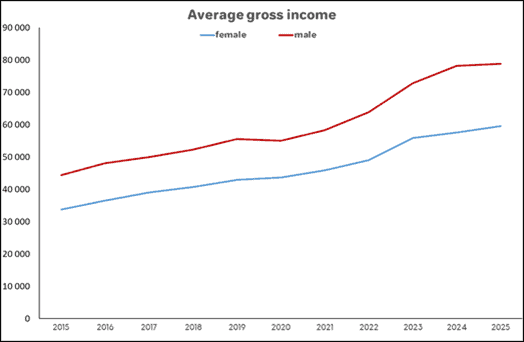
Mckinon shares that over the past decade, female first-time homebuyers have grown their purchasing power significantly. “Since 2015, the average gross income of women applying to purchase a home has risen by 76.3%, reaching R59,549 in 2025,” she says, adding that the increase in income outpaces the rise in consumer inflation between 2015 – 2025 (YTD) (at 59.2%).
“Albeit marginally lower than the average income of male first-time homebuyers, this income increase reflects both greater earning potential and the growing capacity for women to take on home loans independently. This strategic financial planning will work towards offsetting these income gaps over time.”
Regionally, the Western Cape tops the list with an average female homebuyer income of R73,079, followed by strong earnings growth in the Eastern Cape – up by 81.8% over the past decade. “This is likely prompted by the semigration of more affluent homeowners to the Garden Route which is renowned for its luxury coastal lifestyle.”
Mckinon notes that while recording the lowest average income at R43,009, the Free State still demonstrates that homeownership is well within reach for women in more affordable provinces.
When it comes to property choices, women are slowly shifting towards sectional title properties as these are often associated with lower maintenance, increased security and a ‘lock-up-and-go’ lifestyle.
“In 2015, 37.1% of female homebuyers chose sectional title properties, compared to 39.4% in both 2024 and 2025,” she says. “Regionally, there is a stark contrast between Tshwane – as the sectional title province of choice (at 53.3% in 2025) – and Eastern Cape with the lowest uptake of sectional title properties, at just 25.8% over the same period.”
Not forgetting buy-to let demand, Mckinon shares that single female first-time homebuyers currently account for 45% of buy-to-let applications. While this statistic has remained constant over the past decade, the percentage of buy-to-let applications from this segment has more than doubled since 2015. “While single females may face income disparities compared to their male counterparts, they are increasingly taking on homeownership to generate additional income and build wealth.”
“Regionally, the Western Cape leads with 21.6% of females entering the property market this year as investors. This is followed by the Eastern Cape at 9.3% and Tshwane at 8%.”
A Bright Future Ahead
The past decade’s data shows that young South African women are not simply participating in the property market, they’re driving it forward. They are entering the market at younger ages, achieving higher earning potential and making strategic choices about where – and what – to buy.
“This is not just about property,” concludes Mckinon, “it’s about empowerment, security and building wealth over the long-term. Every percentage point increase we see in female first-time homebuyers represents real progress towards greater financial empowerment and gender equity in homeownership.”
Issued by Jess Gois