
DIY law in SA: How to draw up a will
Life is unpredictable, which is why even young people are advised to have a will.
*This feature was compiled by Helene Viljoen, attorney and director of law firm Helene Viljoen Incorporated.
In a 1789 letter, Benjamin Franklin famously said that the only certainties in life are death and taxes. Today, this statement rings as true as it had more than 230 years ago.
However, one can ensure more certainty regarding what happens to your belongings after you have passed away. This is done using a will or testament.
In such a document, the person making the will (the testator) carefully indicates how their estate must be dealt with after death. An executor is appointed as the person responsible for administering the deceased’s assets and liabilities after death.
The process of estate administration requires the executor to collect the assets, pay off all debts, and pay the balance to the rightful heirs of the deceased. Having a valid will therefore ensures that your wishes will be honoured during the division of your estate.
While attorneys, banks, chartered accountants, boards of executors, insurance companies and trust companies can help you draft your will, you can draw up your own if you ensure certain legalities are met.
The South African Department of Justice has issued detailed guidelines on wills and estates on its website. This article summarises key aspects to help you draw up a valid will.
Why should I have a will?
A will or testament allows you to decide who will inherit from you once you die. It also allows you to appoint an executor, the person who will administer your estate.
Do I need to wait until I am 18 or older before drafting a will?
No. All people aged 16 and older who are mentally able to appreciate what it means to make a will, are legally competent to determine how their estate should devolve when they die.
When drafting a will, is there any information or set of documents I should have with me?
According to Legal Aid South Africa’s article ‘Drafting of wills’, you should be able to provide your full names, surname and identity number, as well as those of your executor and spouse. You will need to indicate whether you are married in or out of community of property, and whether the accrual system applies or not. Also, have a copy of your marriage certificate on hand. Any persons you want to benefit from your will should be identified by names, surnames and identity numbers. The same applies to minors mentioned in your will. Also have details of all assets, liabilities and insurance policies close by.
Which formalities must be met for a will to be legally valid?
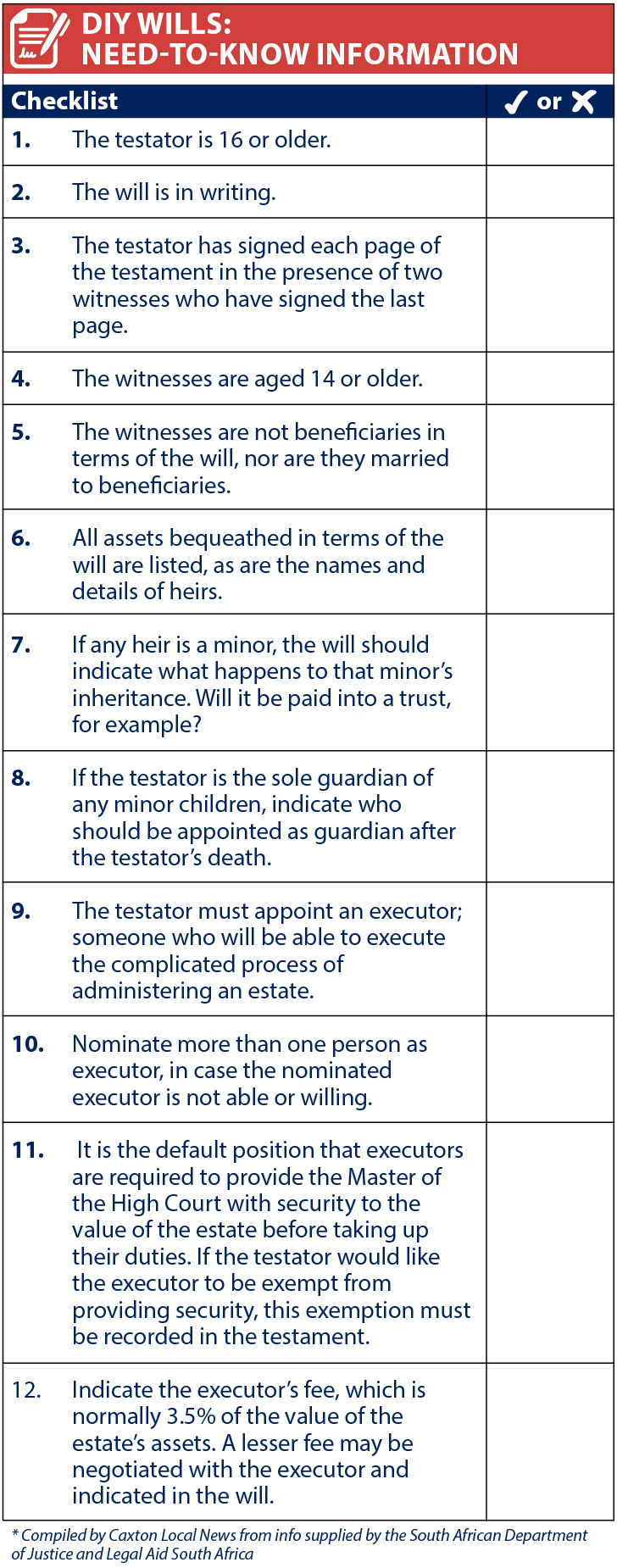
The South African Department of Justice and Legal Aid South Africa have issued handy guidelines to ensure your draft meets relevant requirements. Caxton Local Media consolidated it in the below checklist.
Where should I keep my original will?
Ensure that your originally signed will is kept by a trustworthy person or institution, as a copy of a will is not considered a valid testament.
Is it wise to draft my own will?
You can draft your own will, but you will need to ensure that all legal formalities are met. As can be seen above, this is often rather complicated. This is why many experts advise getting assistance from aptly qualified professionals.
The Department of Justice and Legal Aid South Africa have made standard forms used during the administration of estates available. Visit ‘Deceased estates’ and navigate to the forms page. For more information on drafting of wills, you can visit Legal Aid South Africa’s website.
Read original story on www.citizen.co.za

