
Election disinformation is coming: What to expect and how not to fall for it
A fake voter-registration website and IEC recruitment scams have already emerged ahead of the elections. Here’s how you can protect yourself.

Times of uncertainty provide fertile ground for the spread of false information. This was evident during the Covid-19 pandemic, the 2024 national and provincial elections and the recent anti-migrant protests across the country.
With the Independent Electoral Commission of South Africa (IEC) already warning against fake IEC recruitment ads and websites impersonating its domain, the municipal elections in November are likely to face similar disinformation threats.
Adding to the challenge, AI is making it easier than ever to create convincing deepfake videos, manipulate images and share false information at scale – making it even more important for South African citizens to know how to spot disinformation in the lead-up to, during and after the elections.
False claims that typically spread at election time
The same themes often repeat themselves in election-related disinformation. Besides IEC job scams, the disinformation usually includes false claims related to:
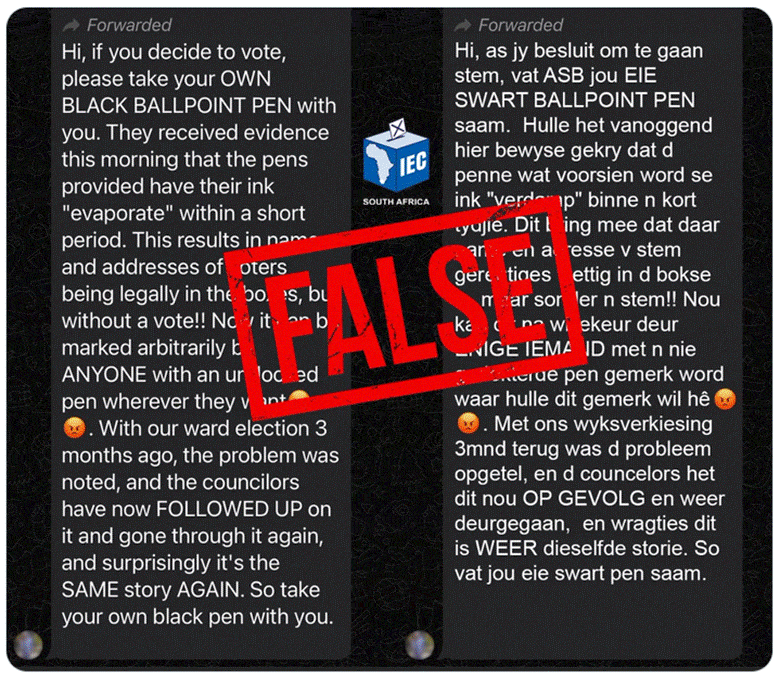
- Ballot papers that have allegedly been pre-filled with votes or ballot boxes that have been tampered with (in the 2024 national election, a false claim that the ink of pens provided by the IEC evaporated also did the rounds)
- Allegations that some votes weren’t counted or that votes were counted more than once
- Allegations that foreign nationals are contesting in the elections or registering to vote
- Rumours that certain politicians or political parties won’t be taking part in the elections anymore due to ill health or other reasons
- Unofficial election results announced prematurely
- Fake endorsements of certain parties or threats made by well-known public figures, often from other countries
In the lead-up to the national elections in May 2024, fact-checking organisation Africa Check debunked several claims, including one suggesting that the US rapper Eminem was encouraging South Africans to vote for the EFF, Donald Trump was endorsing the MK party and that then US president Joe Biden threatened South Africa with sanctions should the ANC win the election. The same Biden clip was manipulated and shared in the lead-up to the Namibian elections later that year.
How to spot scams and other disinformation
- Be sceptical about any information that triggers your emotions, especially if it makes you scared or angry.
- Check the source. If it’s not from an official source like the IEC or a credible, well-known media organisation, don’t trust it.
- Check whether you can confirm the facts by looking at what news platforms or fact-checking organisations are reporting.
- With images or videos, ask yourself whether they might be old, used out of context, manipulated or AI-generated. You can find out more about an image by searching for it on the internet – simply upload it onto Google Images or the Google Lens app and carefully sift through the results.
- Pay close attention to website addresses (URLs) as fake websites are often used to lure internet users into sharing their personal information or clicking on harmful links.
- Be careful of job advertisements on random websites or social media pages. Legitimate vacancies are usually advertised on organisations’ official websites and communication channels. A request for payment at any stage should be considered a red flag.
Report harmful or false online content
If you come across online disinformation or hate speech, report it on the Real411 platform or app, run by Moxii Africa, previously known as Media Monitoring Africa.
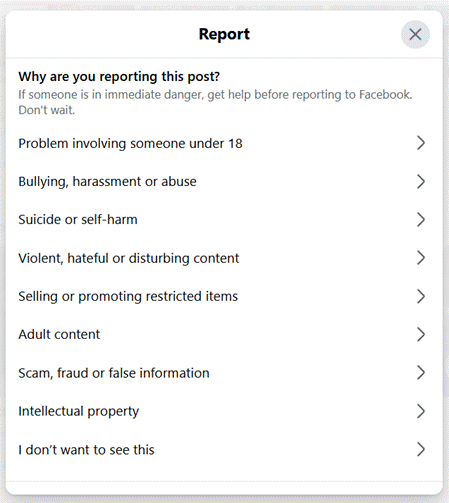
If you see a post on Facebook that you suspect is false, click on the three dots next to the post (usually in the top right-hand corner) and then on ‘report post’. You’ll be redirected to a page where you have to provide a reason for flagging it.
Find reliable information here
The IEC
The official IEC site: elections.org.za
The only official online voter registration portal: registertovote.org.za
IEC social media accounts:
Fact-checking organisations
Breaking news at your fingertips… Follow Caxton Network News on Facebook and join our WhatsApp channel.
Nuus wat saakmaak. Volg Caxton Netwerk-nuus op Facebook en sluit aan by ons WhatsApp-kanaal.
Read original story on www.citizen.co.za

