
South Africa’s trendsetting TikTok doctor
TikTok doc has over one million followers and counting.
Nico Gous
In 2020, Dr Siyamak Saleh told a friend in a chat on WhatsApp that he wanted to become famous on short-form video-sharing app TikTok. His friend’s reply? Just a smiley face emoji.

“I think people laughed at me last year when I told them that I wanted to become TikTok-famous,” Saleh said in a recent interview with Caxton.
But he has since been vindicated – “I am TikTok-famous now,” Saleh laughed.
With over one million followers on TikTok, Saleh (40) has become known for his videos that bust medical myths, such as ‘too much screen-time is bad for your eyes’, ‘sugar is addictive’, and the ‘Covid-19 vaccine will kill you’.
TikTok named Saleh one of the top 10 creators on the platform in South Africa at the end of last year.
@doctor.siya Thank you for all the love & support ❤ Appreciate every single one of you 🤗 #tiktokdoc #risingvoices
He also shares medical information about less topical conditions, such as endometriosis and stomach ulcers. He said it is rewarding to help people get answers because ‘there are people craving information and they cannot get it’.
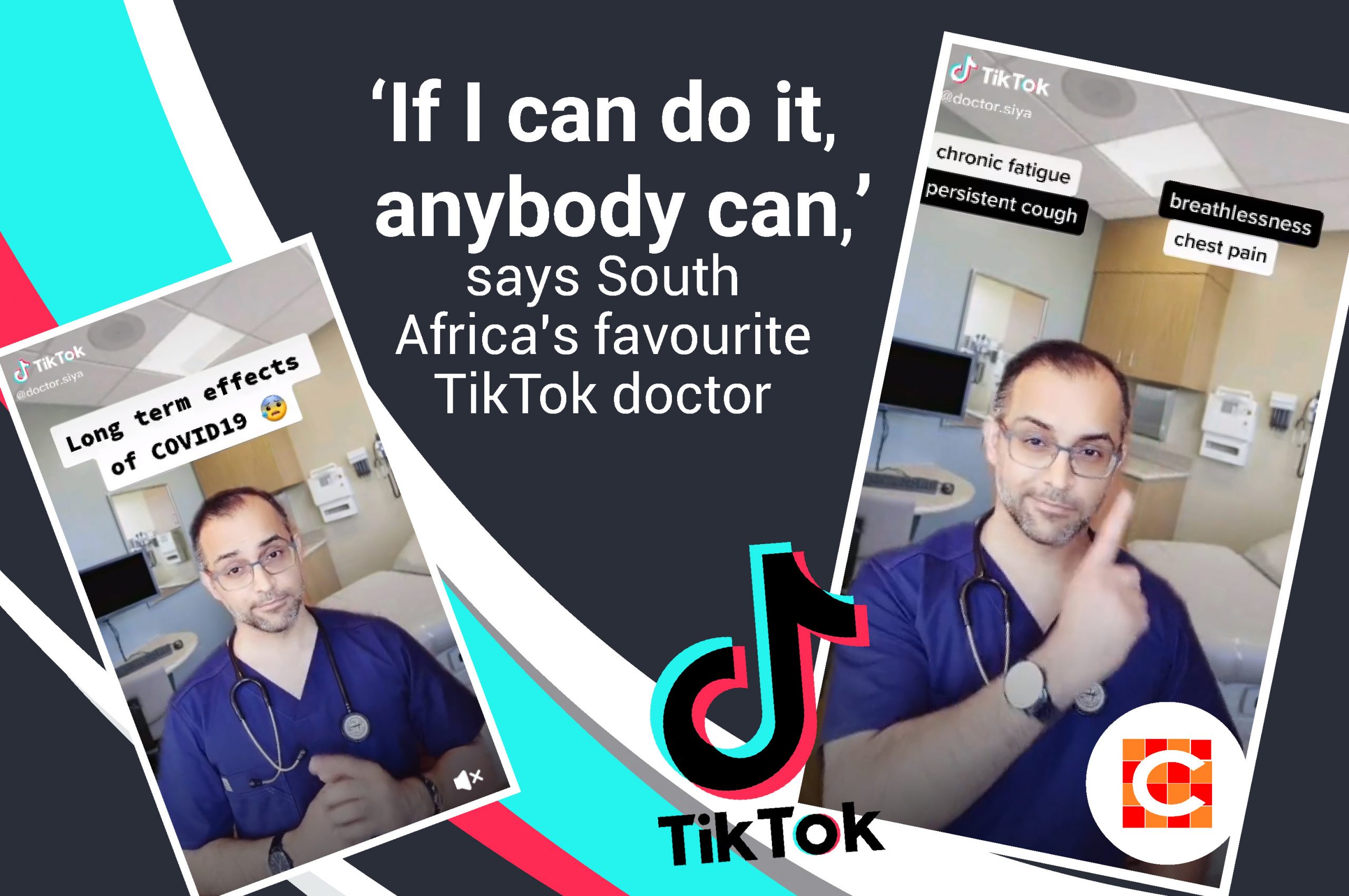
@doctor.siya One reason why I took my vaccine! Here are some of the long-term effects of covid19! #fightcovid #covid19 #educate #tiktokdoctor #risingvoices
Spreading awareness and fighting misinformation is personal for Saleh.
He worked at the coalface of the pandemic as a primary healthcare doctor in Cape Town – dealing mainly with Covid-19 patients – in 2020, when the city was an infection hotspot.
“It was bad [during the first peak],” he said, explaining that patients would die waiting for an ambulance or would be dead on arrival at the hospital.
During this traumatic time, Saleh started making playful videos with his daughter Lea (9) to relieve his stress.
“It [TikTok] was a nice escape, because you could see people dancing, people making jokes, pranking [each other]; so it was a very fun escape for me, and [I] obviously got addicted to it,” he said.
However, he noticed many people asking questions about Covid-19 and so he changed his tack and soon had followers asking medical questions related to a variety of topics.
His social media work has even been mentioned in the prestigious British Medical Journal and he was one of only three social media influencers who recently addressed a panel consisting of delegates from the World Health Organisation, the Cabinet of the United Kingdom, YouTube, Amazon, Facebook, and others, on how to fight online misinformation.
“I said that in Africa, it is actually even harder to fight the misinformation, because you have politicians, presidents – I’m not necessarily talking about South Africa … that are calling Covid-19 a hoax,” he said.
One example was former Tanzanian President John Magufuli, who died in March. He claimed Tanzania eradicated the pandemic through prayer after the government stopped updating its Covid-19 data.
Saleh believes the key challenge is making information ‘sexy’ to entice viewers to share verified information.
“If I say, ‘This doctor died of the vaccine’, then everybody is going to read it, but if you say, ‘The vaccine saved a million people,’ then nobody is going to read it,” he said.
Information obstacles
Saleh says he is up against politicians and orchestrated online misinformation campaigns, which he claims are ‘proper, fully-funded campaigns that are doing their job to spread all this misinformation’.
One example of this was the online video ‘Plandemic’, which went viral in May 2020. It contained a combination of false claims and conspiracy theories which were later debunked.
These campaigns and others have seen Saleh receiving hostile messages, claiming, among other things, that he is a liar and being funded by Microsoft founder and billionaire Bill Gates, who conspiracists believe helped orchestrate the pandemic.
“Initially, it gets to you, especially when you’re not used to people hating on you, [and then] suddenly, you have hundreds to thousands of comments attacking you,” he said.
Saleh has now incorporated some of these conspiracy theories into his videos and he makes fun of them.
He puts his followers in these three categories:
- Those who support and appreciate his work;
- Those who are unsure if they should get the Covid-19 jab; and
- Those who cannot be reasoned with and despise his work.
Saleh, who is originally from Kuwait, studied medicine in Moscow before continuing his education at the University of Cape Town. He speaks English, Persian, Arabic and Russian.
Despite his popularity, the good doctor has never spoken on any of his videos. The first time his followers heard his voice was during a livestream on World Health Day in April.
His next aim is to host regular livestreams. He believes speaking is his key to reaching the ‘next level’ on TikTok.
He said, tongue-in-cheek, that he sometimes wishes TikTok was his full-time job, because it takes two to three hours to research a topic, and shoot the video. “It must have good lighting. I must not look tired,” he joked.
TikTok trendsetter
Saleh is one of the TikTok success stories in South Africa. According to technology research firm World Wide Worx and brand intelligence company Ornico’s ninth annual study on the South African social media landscape, published in June 2020, TikTok has about six million users in South Africa.
This means it only lags behind messaging service WhatsApp (10.1 million users), Facebook (9.1 million users) and YouTube (9.1 million users). TikTok was launched in the country in 2018.
According to the latest estimates by Statistics South Africa, the country has a population of 59.62-million people and, according to DataReportal, 38.19-million internet users. This means that about one in six local internet users use TikTok.
Some of Saleh’s friends and colleagues tend to be dismissive of TikTok, which is often stereotyped as an app only for teenagers posting make-up tutorials or lip-syncing videos. He disputes this, saying he has friends who are lawyers, doctors and fitness experts, among others, who use the platform to raise awareness about important issues.
“I’ve learned a lot, and I’m sure many people learn a lot of life hacks or body hacks,” he added.
Despite his popularity, Saleh does not earn a cent from his TikTok profile.
“I mean, I’ve had offers, but I believe it [his TikTok work] must fit with my values,” he said.
Saleh’s tips for growing your TikTok following:
- Take the first step and start making content;
- You will learn by creating and seeing what people like; and
- Don’t focus on likes and followers.
Read original story on rekord.co.za

