
Watch: Refugees ‘scared’ after relocation from Pretoria to remote farmland
Refugees said the place they were moved to is "scary" and that they are frightened.
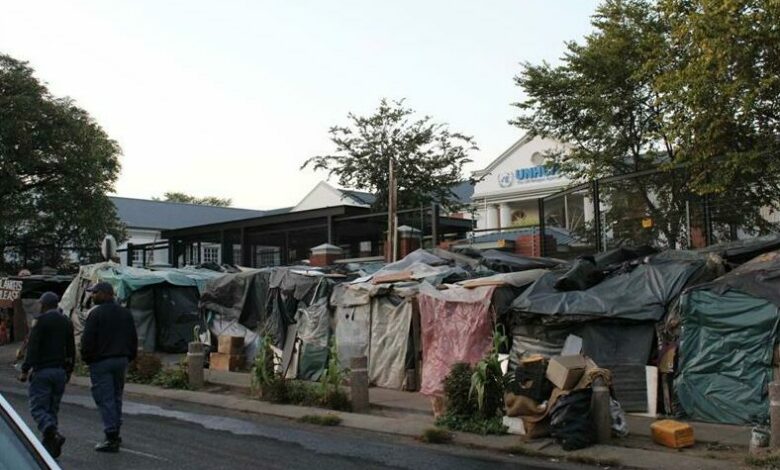
The Brooklyn refugees, who were relocated to a plot of farmlands near Bronkhorstspruit, are uncertain about their future.
A group of 28 women, 15 men and 55 children – originally from the Democratic Republic of the Congo, Malawi, Burundi, Rwanda and other areas – were evicted last Friday.
They illegally gained access to the UNHCR offices in Brooklyn in November 2019.
Refugee Chris Tambwe alleged that the farmstead did not have water or electricity and no food was provided.
“We are about 10 families in one single room. We have babies and other young children. We are living in the bushes, far from transportation and healthcare services.”
Fellow refugee Lukombo Kiese said the only food that they had was what was left from charity donations from their final days of protesting in Brooklyn.
She said the food items were maize meal, bread and peanut butter.
“This place is scary. We are frightened. We could be raped or anything could happen, we are worried for our lives.”
“We are in the veld. Farmers have warned us that we cannot live here as there is no water.”
She said the area was also prone to veld fires according to the farmers dwelling nearby.
“We cook with firewood due to lack of electricity.”
She said an intervention was needed as they did not feel safe.
The United Nations High Commissioner for Refugees (UNHCR) told Pretoria Rekord that the majority of the migrants had refugee status and could legally work in South Africa.
UNHCR spokesperson Laura Padoan said they were relieved that the women, children and men that had camped outside their offices in Waterkloof Road were peacefully removed and placed in suitable housing conditions.
Padoan said the refugees and asylum seekers were separated, with about 18 moving to the court-ordered Lindela Repatriation Centre and about 70 relocated to a farmstead in Emalahleni rural, near Bronkhorstspruit.
According to Padoan, a fraction of the people placed at the farm in Emalahleni rural had already obtained refugee status.
“Almost all of them are refugees and asylum seekers. Those with refugee status can work legally in South Africa.
“Eighteen people left to go to Lindela, where the authorities will provide them with food, shelter, sanitation and medical facilities for the next six months.
“We understand that just under 70 people are staying at a farm outside of Pretoria.”
Read original story on rekord.co.za

