Wind tunnels are shaping the future of automotive performance
Wind tunnel testing is crucial for optimising vehicle aerodynamics and fuel efficiency.
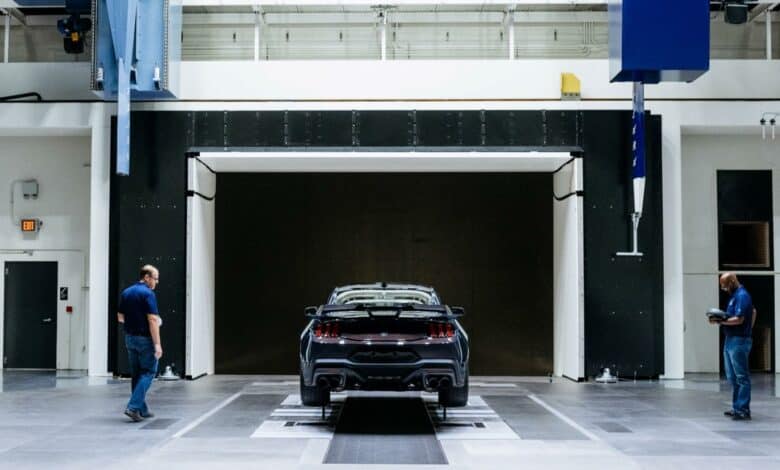
Ford’s state-of-the-art rolling road wind tunnel (RRWT) simulates real-world driving conditions, enabling engineers to fine-tune the design of vehicles across its entire line-up, including the high-performance Mustang Dark Horse.
Beyond static testing: The RRWT advantage
The RRWT offers significant advancements over traditional wind tunnels. By simulating both wind and road surface speeds up to 322 km/h, it provides more accurate data on wind drag and downforce, crucial for improving range and efficiency in both electric and internal combustion engine vehicles.
“The closer we can get to reality in the lab, the better and faster we can create more energy efficient vehicles,” said John Toth, Ford’s North America wind tunnels engineering supervisor. “Testing, while the wheels and tyres move, is instrumental to improving aerodynamics for track-ready vehicles like the Mustang Dark Horse.”
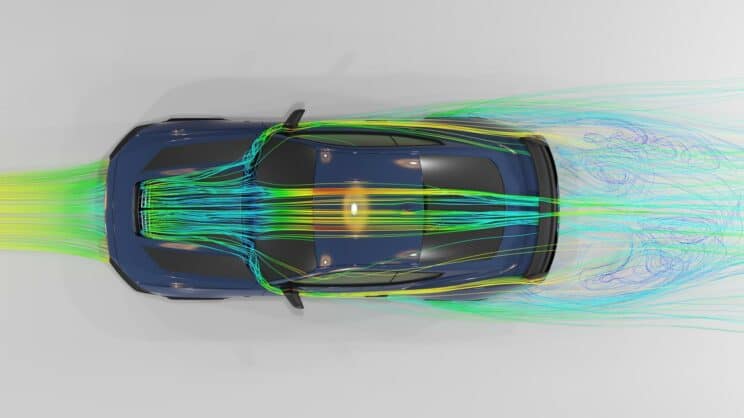
A revolutionary rolling road system
The RRWT incorporates a unique five-belt rolling road system, effectively bringing the road to the vehicle. Each wheel has its dedicated belt, while a fifth belt runs beneath the vehicle’s centre. This innovative system allows for precise simulation of real-world drag forces, enabling engineers to assess for optimal aerodynamic performance in various driving scenarios.
Maximising downforce for track performance
The Mustang Dark Horse exemplifies the RRWT’s capabilities. While passenger vehicles prioritise low drag for fuel efficiency, high-performance vehicles like the Dark Horse require a balance between drag and downforce. Downforce enhances grip and cornering stability, crucial for track performance.
Extensive wind tunnel testing played a key role in the development of the Mustang Dark Horse. Aerodynamic enhancements, including a redesigned front bumper, a lower valence, a spoiler, and unique wheels, were meticulously fine-tuned to optimise airflow, reduce front lift, and increase downforce.
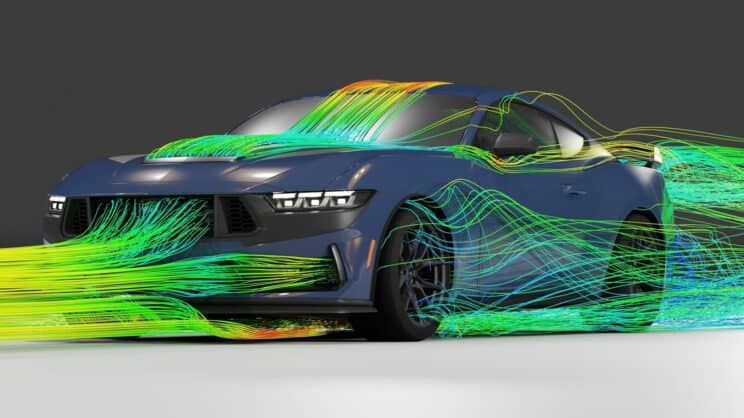
“We spent approximately 250 hours in the wind tunnel developing the 2024 Ford Mustang,” said Jonathan Gesek, programme aerodynamicist. “The aerodynamics of Mustang Dark Horse, along with several other factors, have created the most track- and street-capable 5.0-litre Mustang to date.”
By simulating real-world driving conditions with unprecedented accuracy, this innovative technology empowers engineers to develop more efficient, safer, and more exhilarating vehicles for the future.
Source: QuickPic