Across the country, public facilities built to support communities and local economies are being left vulnerable to theft, neglect and decay.
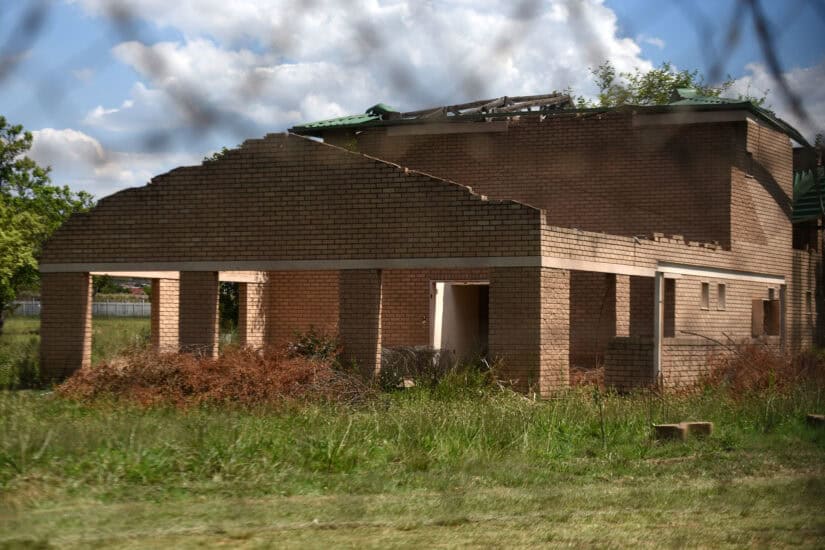
An incomplete structure at Ga-Mothakga recreation resort in Pretoria. Vandalism of youth camps are among broader problems affecting the city’s resorts, including inadequate security, maintenance backlogs, overloaded septic tanks, blocked drains, roof leaks and insufficient lighting. Picture: Nigel Sibanda/The Citizen


Across South Africa, billions of rands have been spent on public infrastructure – schools, clinics, community halls, sports facilities wastewater treatment plants, industrial parks and agricultural projects – but many of these assets have been left to deteriorate, are vandalised or stand unused.
Too often, the focus is ostensibly on getting a project approved, building it and handing it over.
A ribbon is cut. A project is announced. A contractor is paid. A photograph is taken.
And then, in some cases, the public facility begins a slow journey towards abandonment.
Public projects left vulnerable to decay
Recent cases illustrate the extent of the problem; from a R30 million agricultural hub in Mpumalanga that has been stripped by thieves, to historic sites and industrial parks left to deteriorate.
The Citizen has revealed how a R30 million agricultural hub in the Dr JS Moroka local municipality in Mpumalanga was stripped of machinery, water tanks, irrigation equipment, electrical fittings and other infrastructure.
Another layer of the problem involves facilities inherited from the former apartheid regime.
Some of these facilities were established decades ago and, despite their origins in the apartheid-era Bantustan system, had been important economic and service centres for communities.
But many subsequently deteriorated after the dawn of democracy in 1994.
Industrial parks struggle to support local economies
In February this year, parliament’s portfolio committee on planning, monitoring and evaluation welcomed plans by the Mpumalanga government to refurbish three large and 15 small industrial parks inherited from the former KwaNdebele and KaNgwane administrations.
But the same issue has been reported at industrial parks elsewhere in the country.
Facilities intended to attract businesses and employment have since become little more than empty shells due to investment in maintenance, security, management and tenant development failures.
Ga-Rankuwa and Hammanskraal’s industrial parks have become symbols of the failure to turn long-promised economic development into sustainable local opportunity, with years of underinvestment, deteriorating infrastructure and weak economic activity leaving once-promising industrial areas struggling to attract and retain businesses.
Zithabiseni resort now lies in ruins
The once luxurious Zithabiseni Resort and Conference Centre, located inside the 13 000-hectare Mabusa Nature Reserve in Mpumalanga, was established by the former KwaNdebele government as a major tourism, conferencing and leisure facility.
Now, the facility is in ruins, with most recent refurbishment needs estimated at more than R100 million.
The situation highlights a broader failure of government’s industrial park revitalisation efforts to translate public investment into functioning economic hubs capable of creating jobs, supporting local businesses and reversing the spatial inequalities inherited from apartheid Mxolisi Malinga, a former anti-apartheid activist, said facilities like industrial parks and many others that were inherited from the apartheid government were neglected and left to deteriorate at the expense of local communities, who relied on these facilities for economic, recreational and cultural purposes.
He said the main reason was that many local municipalities face deferred maintenance and budget priorities, shortage of engineering and technical skills.
“Theft and organised sabotage. Exploding demand and rapid urbanisation,” he said.
“Corruption and maladministration is also rife in many local municipalities across the country, the national government through [cooperative governance and traditional affairs] must urgently intervene in maintaining the collapsed infrastructure.”