The families argue that the state's continued reliance on apartheid secrecy laws was irrational
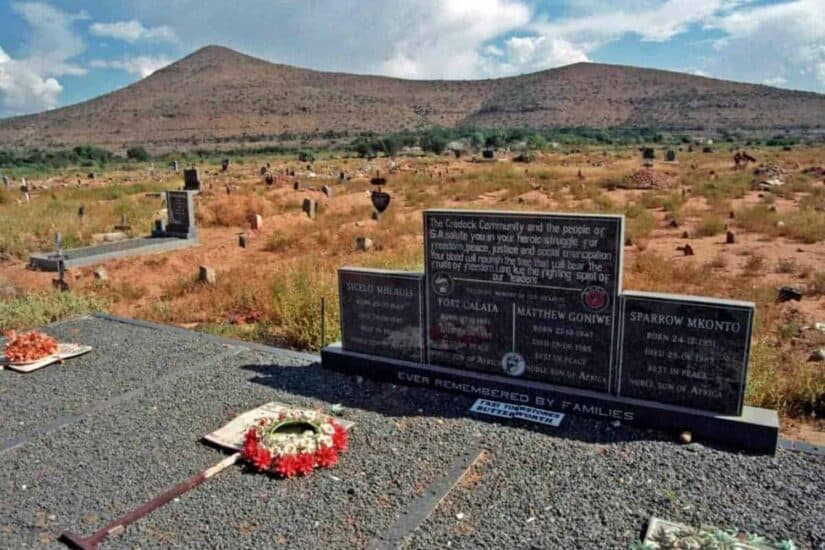
Sicelo Mhlawuli, Fort Calata, Matthew Goniwe and Sparrow Mkhonto, collectively known as the Cradock Four, were buried in Cradock on 20 July 1985. Picture: Gallo Images


The families of the slain Cradock Four activists have brought a contempt of court application against Acting Secretary of Defence Dr Thobekile Gamede and the Department of Defence (DOD), accusing the state of deliberately withholding key apartheid-era documents linked to the killings.
The application follows allegations that the Department of Defence failed to comply with a court order issued by Judge President Enoch Beshe during the reopened Cradock Four inquest, directing the department to disclose military and intelligence records related to the case.
Department accused of refusing to declassify documents
According to the Foundation for Human Rights (FHR), which is supporting the families, the department has “wilfully and intentionally” refused to declassify documents generated between 1982 and 1987 that are currently held by the South African National Defence Force (SANDF).
The documents remain classified under apartheid-era legislation enacted by the former South African Defence Force (SADF), despite SA’s transition to democracy more than three decades ago.
The families argue that the state’s continued reliance on apartheid secrecy laws was irrational and impedes efforts to uncover the truth behind the political assassinations.
“The families assert that the DOD is improperly seeking to block investigations into the past and is attempting to protect the erstwhile SADF and its officials from scrutiny,” the Foundation for Human Rights said in a statement.
National security concerns
The Department of Defence has argued that releasing the unredacted documents could prejudice national security and compromise intelligence methods, sources and operational capabilities of the SANDF.
However, the families question how records created in the 1980s to combat threats to the apartheid state could still pose a security risk more than four decades later, particularly when many of the institutions involved no longer exist.
The dispute over the records has been ongoing since 2021, when the families first requested access to the documents.
Limited access to documents
Instead of fully declassifying them, the department reportedly offered limited access under strict conditions.
The approximately 13 000 pages of documents may only be viewed in hard-copy format at a secure location, without the ability to copy, share or openly refer to the contents in court proceedings.
The families argue that these restrictions make it practically impossible to meaningfully use the documents in the reopened inquest, which seeks to determine who was responsible for the abduction and murder of the Cradock Four.
Cradock Four
The Cradock Four – Fort Calata, Matthew Goniwe, Sicelo Mhlauli and Sparrow Mkonto – were anti-apartheid activists abducted and murdered by Security Branch operatives on 27 June 1985.
Previous inquests held in 1987 and 1993 failed to identify those responsible for the killings.
In 1999, eight former Security Branch officers applied for amnesty before the Truth and Reconciliation Commission (TRC) in connection with the murders, but amnesty was granted to only two individuals who were found to have played peripheral roles.
In 2025, the third inquest into the Cradock Four was opened before the Eastern Cape division of the high court in Gqeberha, as part of the families’ ongoing efforts to uncover the truth and secure accountability for the killings.
The Cradock Four families are parties to constitutional damages litigation against the government, National Prosecuting Authority and South African Police Service.
They are suing for the violation of their constitutional rights due to the delays and political interference in investigating and prosecuting the Cradock Four case and other TRC cases.
They also form part of the Calata group, which is participating in the Khampepe Commission of Inquiry looking into the suppression of TRC cases.
The next sitting of the reopened inquest is scheduled for 6 July 2026.
The families say access to the classified records is essential to finally uncovering the full truth behind the killings and ensuring accountability after more than four decades.