
Placement offers begin on 15 October, and parents having seven days to accept or decline.
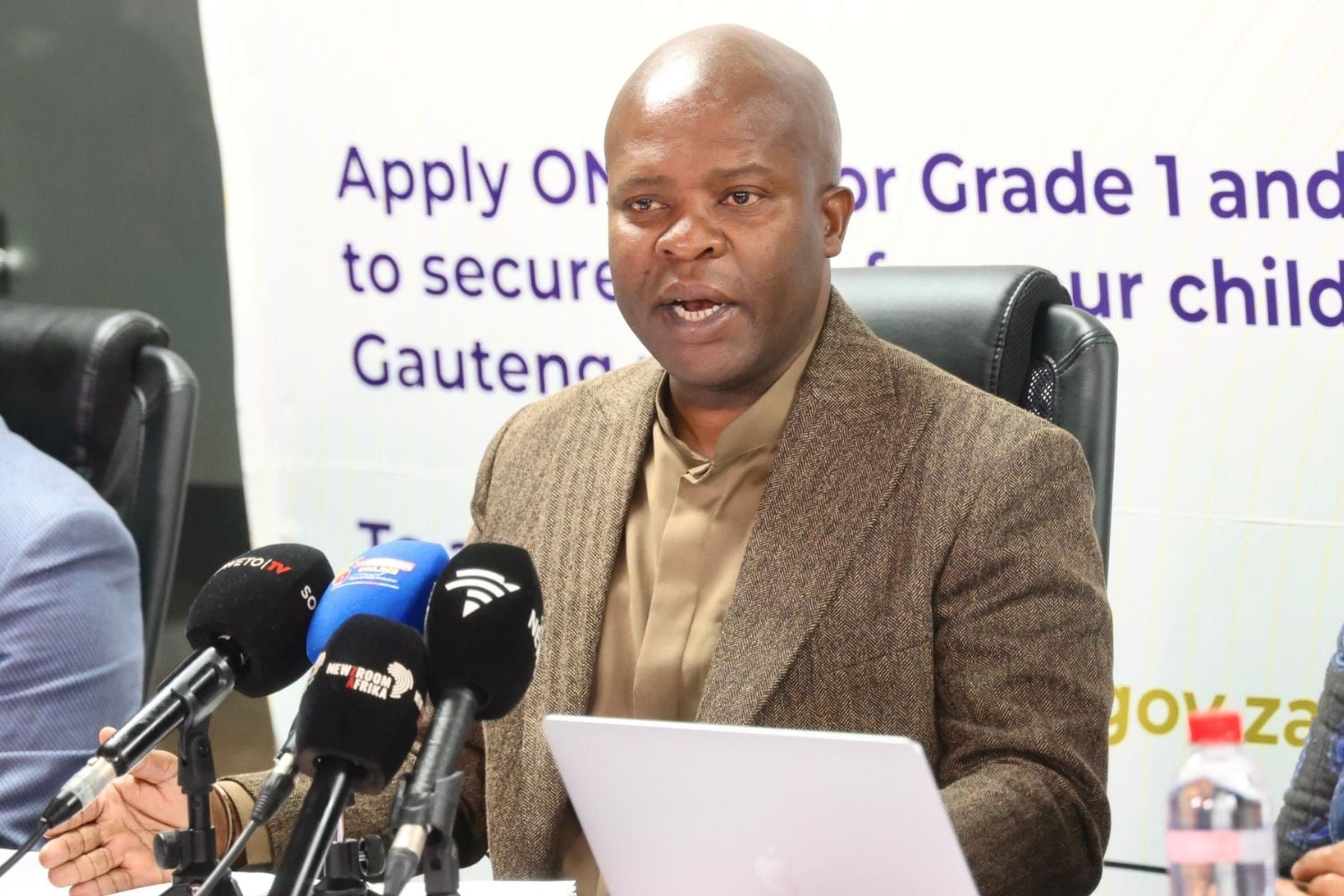
Gauteng’s public education system is under unprecedented strain, with 805,688 applications for Grades 1 and 8 received for the 2027 academic year. Picture: Gauteng Education Department.


Gauteng’s public education system is under unprecedented strain, with 805 688 applications for Grades 1 and 8 received for the 2027 academic year – a tidal wave of demand that MEC Lebogang Maile said must force a rethink of learner placement, school capacity and infrastructure delivery.
Maile made the remarks during a media briefing on Sunday, 6 September 2026, following the closure of the application phase of the 2027 online admission period for Grade 1 and Grade 8 pupils.
Applications
The Gauteng Education Department received 805 688 applications from 357 468 parents and guardians for Grade 1 and Grade 8 places before the online admissions system closed at midnight on Friday, 4 September 2026.
The applications represent 346 877 individual pupils because parents can apply to more than one school.
Maile said the department had 405 627 available spaces, adding that the distribution of spaces was a major challenge.
Warning
He warned that education cannot be treated as “just another government function.”
“Education is not preparation for life; education is life itself.”
He stressed that the province’s responsibility is not only to place every child but to ensure quality, discipline and safety across the system.
The numbers reveal the scale of the challenge: 169 396 unique Grade 1 pupils and 177 481 Grade 8 pupils require placement. Popular schools are buckling under demand – Hoërskool Langenhoven in Tshwane West drew 3 462 applications, while Alberton High received 2 756. At primary level, Laerskool Akasia topped the list with 1 355 applications.
Imbalance
Maile cautioned against the imbalance of oversubscribed schools while nearby institutions remain underutilised:
“We cannot sustain a situation where one public school is overwhelmed by thousands of applications while another, sometimes only a few kilometres away, has available classrooms.”
Fair placement,
Male said placement will follow strict criteria: home address within feeder zones, sibling attendance, proximity of previous schools, and work addresses.
“Parents who cannot be accommodated at their chosen schools will receive transfer offers. Our responsibility is to every child who requires a place in a Gauteng public school,” Maile said.
Infrastructure
The MEC admitted that infrastructure delivery lags behind Gauteng’s rapid urbanisation. He called for pragmatism.
“A modern developmental state must know when to build directly, when to partner, when to lease, when to refurbish existing assets and when to use alternative construction technologies.”
He said public‑private partnerships, prefabricated classrooms, and hybrid e‑learning models are all on the table to ease immediate pressure.
“We cannot tell a child there is no classroom today because a permanent school may only be completed several years from now. The learner requires an education now,” he said.
Protecting schools
Maile condemned vandalism and theft of school infrastructure.
“Stealing electrical cables, aluminium window frames, taps, computers or fencing is not simply stealing from government. It is stealing from children.”
He insisted that quality education cannot remain concentrated in a handful of prestigious schools. Township schools, many in Quintile 1-3, receive the highest per‑learner funding, but excellence requires strong leadership, discipline, and community support.
Challenge
Maile said the immediate challenge is to place every learner for the 2027 academic year.
The greater task is to build a public education system in which the school closest to every child is safe, properly resourced, adequately funded, sufficiently capacitated, technologically enabled and capable of delivering quality education.
“We must build a Gauteng in which parents do not feel compelled to compete for a small number of highly sought-after schools because quality, discipline, safety and educational excellence are the standard throughout our public schooling system,” he said.
New social compact
Maile closed with a call for collective responsibility.
“It takes a village to raise a child, and Gauteng must rebuild that village around every school. Business, labour, civil society, parents, teachers and communities must all identify a role and perform it excellently.”