Today marks 374 days without load shedding.

Picture: iStock


Despite a full year without nationwide load shedding, Eskom’s load reduction programme continues to disrupt power supply across dozens of Gauteng communities this week.
Several Gauteng residents should brace for outages scheduled each morning and evening from 25 to 31 May 2026.
A year of stability, but local disruptions continue
South Africa has now gone 374 consecutive days without load shedding, its longest uninterrupted national power supply since September 2018.
At midnight on 15 May 2026, Eskom reached a full year without nationwide power interruptions, a milestone not achieved since that benchmark was last set. As of Monday, 25 May, the streak extends to 374 days.
Despite this national improvement, Eskom’s load reduction programme continues to affect thousands of Gauteng households on a daily rotating basis.
Unlike load shedding, which cuts power across broad national stages, load reduction is a localised intervention.
Eskom has confirmed that it targets communities where illegal connections and ageing infrastructure place sustained pressure on localised networks.
“The load reduction outages follow a rotating schedule that varies by area,” Eskom said, adding that, depending on the location, outages can last anywhere between four and five hours per slot.
Morning outages
The morning window runs from 5am to 9am daily.
Several Gauteng communities are affected during this slot across the week of 25 to 31 May 2026.
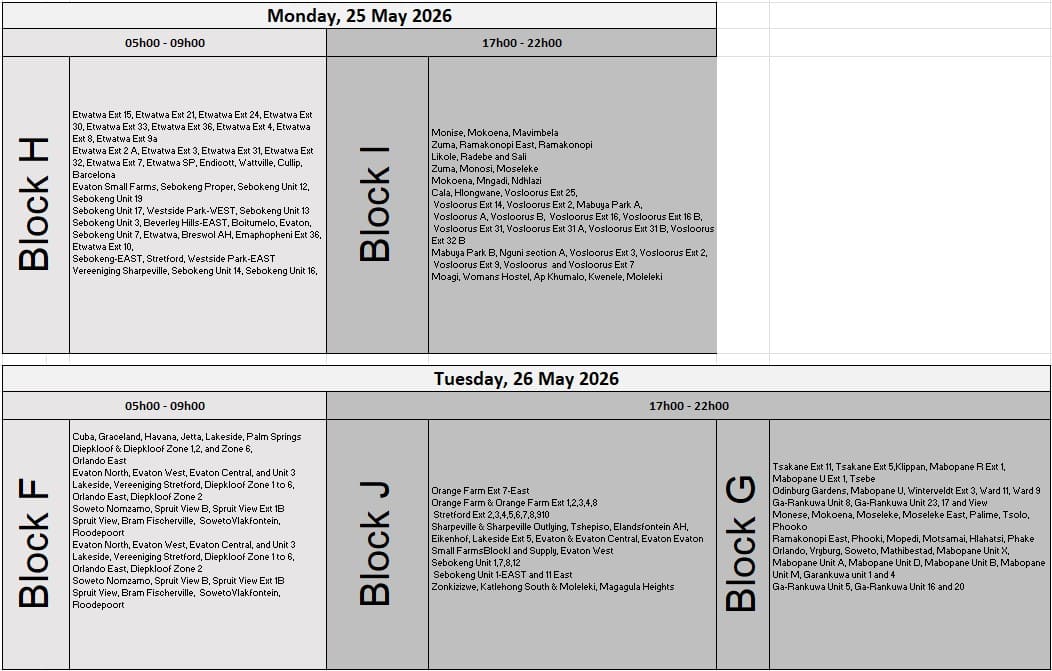
On Monday, 25 May, Block H areas face morning cuts, with Etwatwa, Sebokeng, Beverley Hills-East, Boitumelo, and Evaton among those affected.
Tuesday, 26 May, sees Block F communities lose power in the morning, including Cuba, Graceland, Havana, Diepkloof and Orlando East, among others.
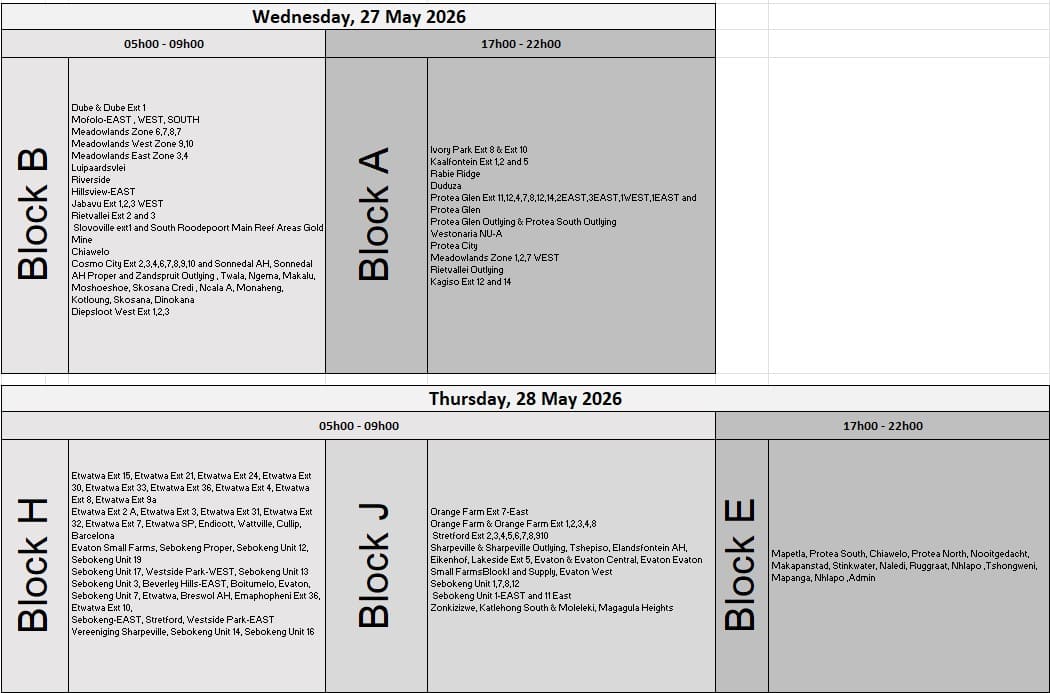
Wednesday’s morning disruptions affect Block B communities across Dube, Mofolo, Meadowlands West Zone 10, Cosmo City and Diepsloot West.
Thursday, 28 May, again affects Block H communities.
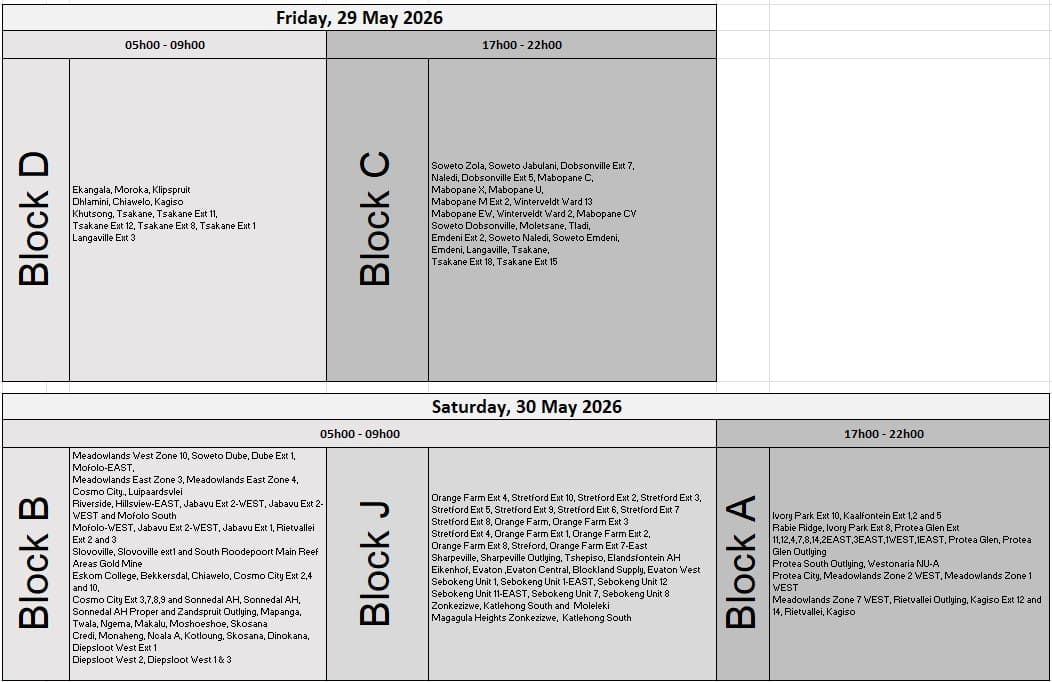
On Friday, 29 May, Block D areas face morning cuts, with Ekangala, Moroka, Dhlamini, Khutsong, and Tsakane among those on the schedule.
Block B communities return for another morning slot on Saturday, 30 May, covering Meadowlands, Soweto Dube, Hillsview-East and Cosmo City, among others.
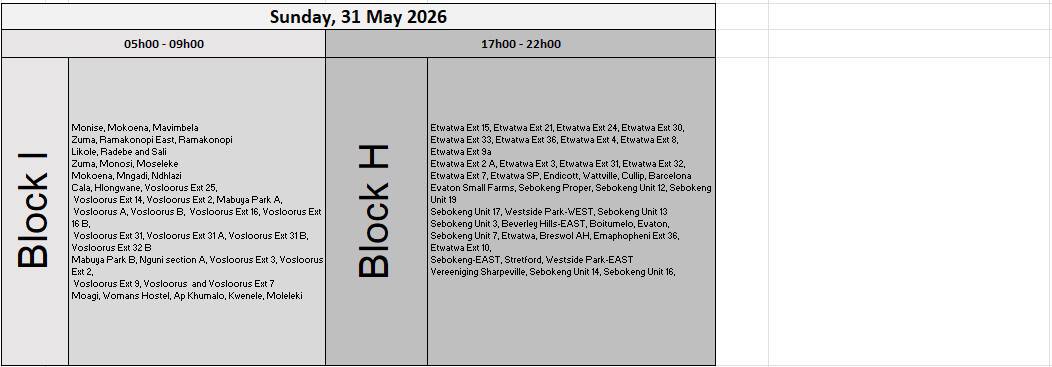
On Sunday, 31 May, Block I areas face the morning slot, with Vosloorus, Ramakonopi, Mokoena, and Mavimbela among the communities affected.
Eskom reiterated that “the load reduction outages follow a rotating schedule that varies by area,” ensuring no single community bears the burden every day.
Evening outages
The evening slot runs from 5pm to 10pm and carries an equally wide reach across the province, with multiple blocks sometimes scheduled simultaneously on the same evening.
On Monday evening, 25 May, Block I communities face outages, including areas around Vosloorus, Ramakonopi East, and Moleleki.
Tuesday evening, 26 May, brings disruptions to both Block J, covering Orange Farm, Stretford, Sharpeville, Tshepiso and Sebokeng, among others, and Block G communities, including Tsakane, Mabopane, Ga-Rankuwa, Tsebe, and Mathibestad.
Wednesday evening, 27 May, affects Block A areas, with Ivory Park, Kaalfontein, Rabie Ridge, and Protea Glen facing cuts.
Thursday evening, 28 May, sees both Block J and Block E communities affected, Block E includes Mapetla, Protea South, Chiawelo, Makapanstad and Stinkwater, among others.
“The load reduction outages follow a rotating schedule that varies by area,” Eskom confirmed, adding that the programme is structured to distribute the disruption rather than concentrate it on any single community.
Friday evening, 29 May, falls on Block C, with Soweto Zola, Jabulani, Naledi, Dobsonville, Moletsane, and Emdeni among those affected.
On Saturday, 30 May, both Block J and Block A face evening outages; Block A includes Ivory Park, Rabie Ridge, Protea Glen, Meadowlands, and Kagiso.
Sunday evening, 31 May, returns to Block H, covering Etwatwa, Sebokeng, Vereeniging, Beverley Hills-East, Boitumelo, and Evaton.
To see if your area is affected, click on or download the document below:
Grid improvements, but the work is not finished
While localised load reduction continues, Eskom’s broader performance metrics reflect a system in sustained recovery.
According to Eskom, for the financial year to date, 1 April to 21 May 2026, the utility’s Energy Availability Factor stands at 62.06%, up from 57.13% over the same period last year.
Eskom noted this also represents a 9.74% increase compared to the same period three years ago, at the outset of its generation recovery plan.
Between 15 and 21 May 2026, average unplanned outages declined to 9 296MW, down 5 217MW from the 14 513MW recorded over the same period last year.
Eskom likened this reduction to restoring capacity that exceeds the installed capacity of the Kusile power station. The Unplanned Capacity Loss Factor dropped by 10.83 percentage points to 19.65%, from 30.48% in the corresponding period last year.
“This strong and stable grid also provides a critical safeguard for all customers, including those with rooftop solar, ensuring uninterrupted supply when solar generation is unavailable due to nightfall or weather conditions, and reinforcing the value of a reliable national system that supports all users,” Eskom said.
The utility added that it “remains focused on sustaining these gains while advancing the power system through a disciplined approach to integrating new generation capacity,” and has maintained that the load reduction programme is not permanent, remaining directly linked to resolving infrastructure challenges in affected communities.