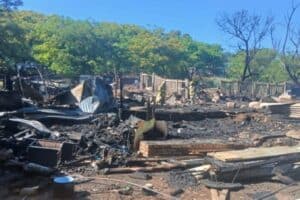
Motsoaledi said the remaining repairs were concentrated in the parts of the hospital that had suffered the worst fire damage.

The parking lot at the Charlotte Maxeke Academic Hospital after the fire that started on 20 April 2021. Picture: Nigel Sibanda


Health minister Aaron Motsoaledi has revealed that more than R353 million has been spent so far on repairing and restoring the Charlotte Maxeke Johannesburg Academic Hospital, which was gutted by a fire in 2021.
Responding to a written parliamentary question from IFP MP Nompumelelo Mhlongo, Motsoaledi said the expenditure covered a wide range of restoration activities.
“This expenditure includes professional services, demolition, structural rehabilitation, temporary works, specialist investigations, replacement of mechanical and electrical infrastructure, and associated construction activities,” he said.
Charlotte Maxeke Hospital fire repair costs breakdown
According to figures supplied by the minister, the total amount spent since the project began was R353 669 357.83.
This was made up of R20 923 176.12 in professional service provider fees, R153 485 247.08 in construction costs, R163 225 488.10 in propping costs, and R16 035 446.53 in implementing agent fees.
Motsoaledi said the money had been spent progressively since the 2022/2023 financial year, with spending rising sharply as reconstruction work intensified.
He noted that as at 1 June 2026, “approximately 75% of the planned remedial infrastructure works have been completed.”
The minister explained that the completed work included structural repairs and the demolition and reconstruction of fire-damaged areas.
“Progress has been made in structural repairs, demolition, and reconstruction of fire-damaged areas, installation of building services, and phased reinstatement of clinical levels,” he said.
Outstanding work and completion dates
Motsoaledi said the remaining repairs were concentrated in the parts of the hospital that had suffered the worst fire damage.
He said the outstanding work included brickwork, surface beds, mechanical and electrical services, and internal finishes on the more severely affected floors, as well as commissioning and regulatory compliance processes.
Turning to timelines, the minister cautioned that completion dates depended on several factors beyond the department’s direct control.
“Subject to the continued availability of funding, timely payment of certified invoices, and the absence of unforeseen structural discoveries or other project risks, the projected completion dates are 30 September 2026 for levels 6 to 9 and 30 November 2026 for levels 1 to 5,” he said.
Oversight strengthened after Public Protector findings
Mhlongo’s question also referenced findings by the Public Protector regarding delays in the repair process. Motsoaledi said his department had since introduced several measures to tighten oversight and accountability for the outstanding work.
He said governance structures had been strengthened through regular engagements between various authorities.
“Enhanced governance through regular project steering committee meetings involving the National Department of Health, Gauteng Department of Health, CMJAH Management and the implementing agent,” he said, describing this as one of the central interventions.
The minister added that monitoring of the project had become more rigorous on several fronts, including reporting, cost control, and procurement.
“Monthly progress reporting against approved milestones,” he said, alongside “continuous project controls, risk management and cost monitoring” and ongoing technical oversight and quality assurance inspections.
He said contract administration had also been tightened, with closer monitoring of procurement and payment processes to minimise further delays.