Public Protector Kholeka Gcaleka found that former Ekurhuleni city manager Imogen Mashazi acted improperly in a metro police appointment.
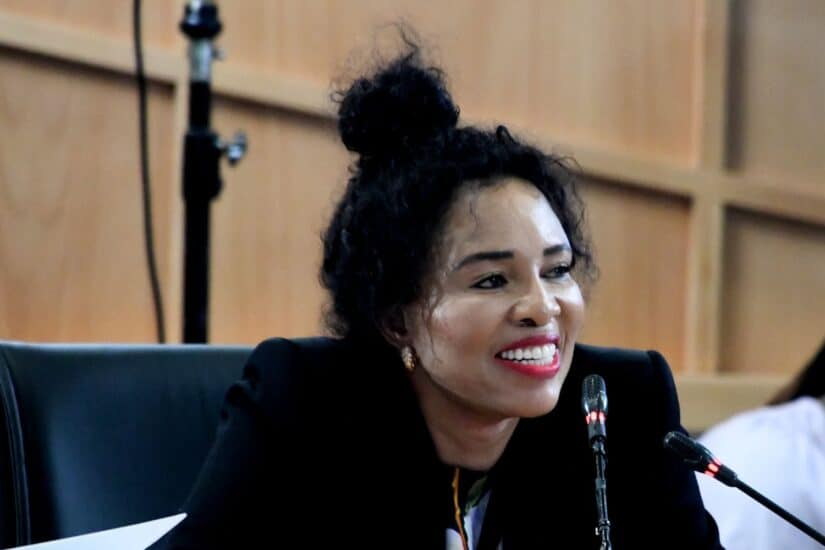
Former Ekurhuleni city manager Imogen Mashazi at Brigitte Mabandla Judicial College in Pretoria on 2 December 2025. Picture: Gallo Images/Frennie Shivambu


Public Protector Kholeka Gcaleka found on Thursday that former Ekurhuleni city manager Imogen Mashazi committed improper conduct by appointing an official who did not qualify for a senior metro police post.
The finding formed part of a series of investigation reports released on Thursday afternoon.
No action to be taken against Mashazi
It centred on the appointment of Ndumiso Gcwabe as deputy chief of Metro Police: Security and Loss Control.
According to Gcaleka, Gcwabe lacked the NQF level 7 qualification the job required.
Instead, he held a National Diploma in Policing and certificates in crime prevention.
“As a result, we find that Mr Gcwabe did not qualify for the position of Deputy Chief of Metro Police. In the circumstances, we further find that the conduct of the former City Manager, Dr Imogen Mashazi, as Accounting Officer of CoE at the time of appointment of Mr Gcwabe constitutes improper conduct,” Gcaleka said.
She recommended that the appointment be taken on judicial review.
However, according to Gcaleka, no remedial action could be taken against Mashazi because she had left the state’s employ.
“Once a person has left the employment of the state, then such remedial action may not necessarily be implementable. But we highlight this in the sense that we do see people sometimes being appointed in some areas of government, and that consideration of such conduct, and pronouncements that have been made by the public protector as part of a remedial action, should be taken into account,” Gcaleka explained.
Mashazi has been heavily implicated in evidence before the Madlanga commission.
She faces charges of corruption and defeating the ends of justice, alongside other City of Ekurhuleni officials.
Weak verification behind unqualified appointments
The Ekurhuleni case was not isolated. According to Gcaleka, the city checked that Gcwabe’s documents were genuine but never confirmed their NQF levels.
“Accordingly, this administrative deficiency amounts to an infringement of the constitution, the Municipal Systems Act and other recruitment regulations,” she said.
A similar problem surfaced in Musina Local Municipality, where Ms Mavhula was appointed as an integrated development plan officer.
A verification report had warned the then municipal manager about her work history before he approved the appointment.
Gcaleka said the report meant that “no records of employment could be found for the candidate”.
She added that the evidence also showed Mavhula had misled the municipality.
“It is also apparent from the evidence gathered that Ms Mavhula misrepresented facts regarding her work experience, both in the application form as well as in the CV,” Gcaleka said.
In a third municipality, a manager was hired on a one-year advanced diploma although the post required a three-year qualification. Officials wrongly assumed the qualification was equivalent.
Public Protector warns of qualification gaps
Gcaleka said her office had received several complaints following the same pattern.
In these cases, people were appointed on degrees from private universities that did not match national standards.
“Now when departments verify this, they assume that these people qualify and the candidates themselves assume that they qualify because they have the degrees,” she said.
She asked the Minister of Higher Education and Training to review the national qualifications framework and publish clear, uniform guidelines.
According to Gcaleka, the aim was to protect graduates who were unfairly caught out.
“The Public Protector has a duty to be developmental in its approach,” she said.
What happens next
The Public Protector’s office is also working to stop implicated officials from simply moving elsewhere.
Gcaleka said her office was working with the Department of Public Service and Administration and local government structures to “keep a live database of people who have been implicated in the reports of the Public Protector”.
The goal, she said, was “so that as those people move from one state organ to another, that must be considered by government”.