



Democrats' sweeping victory in US midterm elections has raised hopes of a possible thaw in relations with India and SA.
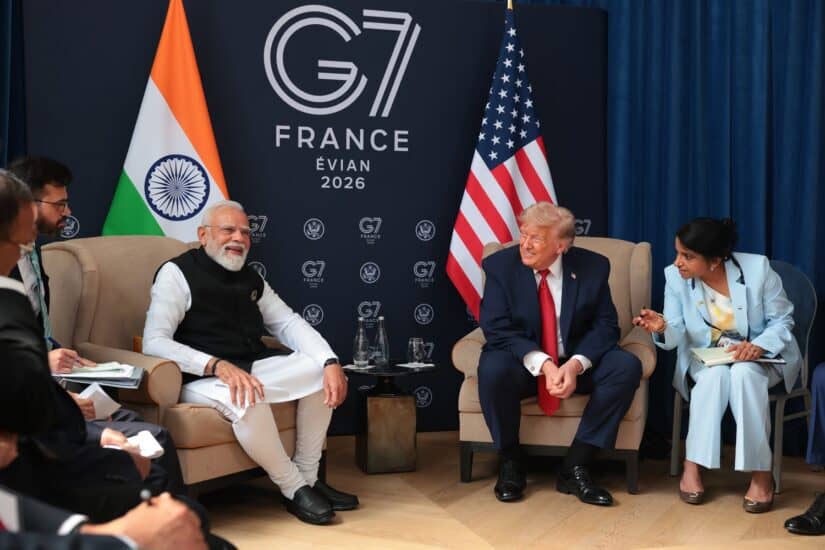
President Donald Trump and Indian Prime Minister Narendra Modi at the G7 Summit in France in June. India and SA have been hit particularly hard by Trump’s tariff policies. Picture: Gallo Images


The Democrats’ sweeping victory in the US midterm elections has raised hopes of a possible thaw in relations between Washington and two key partners, India and South Africa, both of which have suffered diplomatic and economic setbacks during Donald Trump’s second term as US president.
However, there’s no guarantee Trump, whose political wings will be clipped to some extent by the Democrats’ control of Congress, will moderate his foreign policy stance.
Some analysts say that, with the White House potentially forced to retreat from some of its more controversial domestic policies, Trump may become more aggressive on foreign affairs to demonstrate he remains firmly in control.
India and SA have both borne the brunt of Trump’s hardline Make America Great Again (MAGA) agenda, including punitive trade tariffs on their exports, restrictive immigration measures and the economic fallout from the Iran war, which has contributed to spiralling fuel prices.
India, the world’s third-largest oil importer, was forced, for a period, to halt purchases of Russian oil amid Washington’s pressure on New Delhi to comply with US sanctions against Moscow. This disrupted India’s energy strategy, placing additional strain on its economic performance and growth.
There are hopes the Democrats, with their newly acquired control of Congress, will pressure Trump to ease tariffs, which have contributed to rising commodity prices in the US, and use its legislative powers to curb his authority over trade policy.
However, there is also the possibility an unpredictable Trump will double down on tariffs to compensate for his diminished domestic political influence.
Under this scenario, India could face even greater tariff pressure as Washington seeks to force New Delhi into a swift bilateral trade agreement, allowing Trump to demonstrate he remains in charge. South Africa was dealt a double blow by Trump.
Washington not only imposed tariffs of up to 50% on certain SA exports, it also announced its intention to withdraw the trade benefits extended to the country under the African Growth and Opportunity Act (Agoa) from January next year.
President Cyril Ramaphosa has expressed hope the Democrats’ ascendancy in Congress could help preserve Agoa, with several prominent Democrat lawmakers already criticising the proposed withdrawal.
Nevertheless, there is no guarantee that Trump, driven by the unfounded narrative of a “white genocide” in South Africa and his opposition to redress policies such as broad-based black economic empowerment will reconsider his position.
However, the prospect of SA white farmers also losing out from the preferential trade arrangements under Agoa may provide an incentive for Trump to rethink the withdrawal.
Another source of friction is Trump’s immigration policy, which has particularly affected highly skilled Indian professionals seeking to work in the US.
They face increasingly onerous restrictions under the H-1B visa programme, a temporary, non-immigrant work visa that allows US employers to recruit foreign nationals with bachelor’s degrees or higher qualifications in specialised fields.
Electoral trends suggest MAGA’s anti-immigration stance may have cost the Republicans support among Indian-American voters, more than 60% of whom backed the Democrats in the midterms.
Trump’s immigration policies have also targeted South African nationals, government officials and, in some instances, their family members, reflecting the president’s perceptions of racial discrimination against whites by the ANC-led government and his opposition to its land reform policies.
Afrikaners, however, have been granted special consideration, including refugee status and facilitated entry into the US, on the grounds they are allegedly being persecuted by the South African government.
With their newly strengthened position in Congress, the Democrats are expected to scrutinise the controversial immigration and refugee policies affecting South Africa.
This could take the form of committee investigations, the use of congressional funding powers and increased public oversight of the administration’s decisions.
However, the recent appointment of Stephen Miller, an immigration hardliner, as White House chief of staff has raised fresh concerns.
Trump has little intention of softening his immigration agenda. Trump may be more inclined to rely on executive powers to pursue a foreign policy that has alienated traditional partners and, arguably, contributed to his party’s electoral setbacks.
Ultimately, the lesson for India and SA is clear: they cannot afford to remain overly dependent on the prospect of any goodwill from Washington.


