The SIU is investigating officials living beyond their means while also probing academic fraud and ghost-writing at universities.
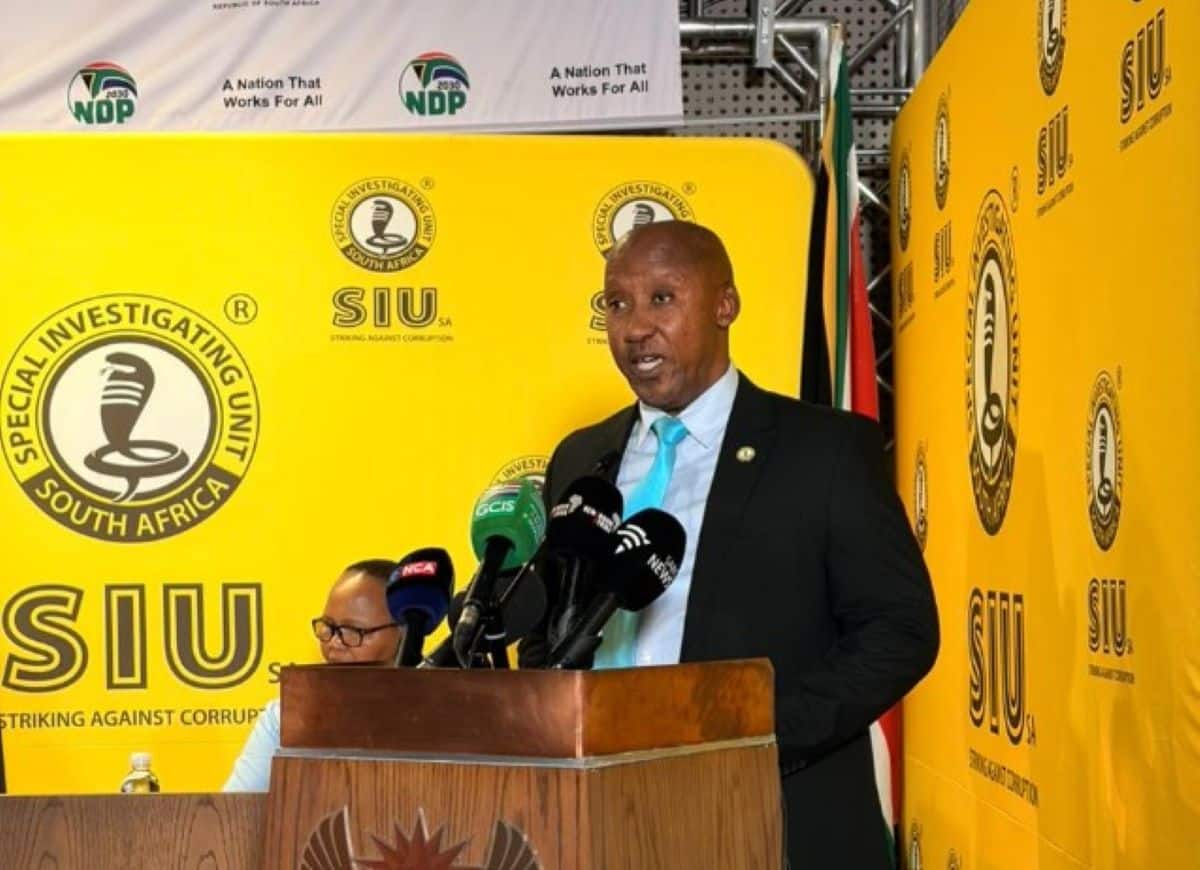
FILE| Leonard Lekgetho, Acting Head Of the SIU, briefs media on investigation outcomes into the Free State office of the Premier’s awarding of bursaries. Picture: SIU/X


The Special Investigating Unit (SIU) has widened its scope of investigations to include suspicious lifestyles of government officials and academic fraud at universities.
This was revealed by SIU acting head Leonard Lekgetho during a lecture he delivered at North-West University’s Vaal campus in Vanderbijlpark yesterday, attended by university staff and management, students and SIU officials.
Lifestyle audits become a key anti-corruption tool
Lekgetho said the SIU was probing cases where officials appeared to live far beyond their means, acquiring luxury homes, expensive vehicles and other assets that could not be explained by their legitimate income.
At the same time, universities are under scrutiny for ghost-writing practices and admitting students who did not meet entry requirements.
Lekgetho said lifestyle audits had become a critical component of the SIU’s anticorruption arsenal.
Investigations often begin with a simple review of an official’s lifestyle and escalate into full audits when red flags are identified.
Officials are required to provide asset declarations, bank statements, investment records, company interests and other financial documentation.
Officials face scrutiny over unexplained wealth
Indicators of concern generally considered include unexplained ownership of expensive properties, substantial bank deposits, undeclared business interests, unauthorised outside remuneration and discrepancies in asset declarations.
In some cases, officials were found to have conflicts of interest, fraudulent qualifications, or even undeclared criminal records.
Digital platforms, particularly social media, have become a source of information for these investigations.
“Thieves tend to talk about their newly acquired wealth to show off, but are unaware that they are giving it away,” Lekgetho said.
Social media helps investigators trace corruption
Posts flaunting luxury lifestyles often provide leads that investigators follow up with forensic audits.
Lekgetho warned that corruption has evolved far beyond the stereotypical “brown envelope”.
Today, illicit transactions are concealed through complex financial arrangements involving companies, intermediaries, procurement networks and digital platforms.
Money is hidden behind layers of ownership structures and seemingly legitimate business activities.
“As corruption evolves so, too, must the methods we employ to detect, investigate and ultimately combat it,” said Lekgetho.
SIU findings
The SIU has uncovered cases where relatively low‑ranking officials amassed unexplained wealth.
In one instance, an official earning R25,000 a month built a mansion and paved a private road to her home, allegedly linked to beneficiaries of fraudulent visa applications.
In other cases, some Home Affairs officials were using eWallet to solicit bribes to process fraudulent documents for asylum seekers
Parallel to lifestyle probes, the SIU is investigating universities for academic fraud.
Lekgetho said ghostwriting-where individuals pay others to conduct research and write academic work on their behalf- was among the practices under review. Some institutions also admitted students who did not meet minimum requirements, raising questions about integrity in higher education.
Although he did not provide details of specific cases, Lekgetho confirmed these investigations were ongoing and formed part of the SIU’s broader mandate to protect public institutions from malpractice.
Corruption costing SA billions
He emphasised that corruption costs South Africa billions of rands annually, often through collusion between public officials and private businesses exploiting procurement systems.
The losses are not confined to senior officials; corruption permeates all levels of government.
The SIU operates under constitutional and legislative authority to investigate maladministration, malpractice and corruption involving state institutions, assets and public money. Increasingly, however, the unit is focusing on prevention and early detection.
To strengthen its work, the SIU has developed the National Corruption Risk Management and Prevention Framework, which was to become a blueprint to probe and prevent all corruption in the state.
This incorporates integrity checks, vetting processes, risk assessments, data analytics and lifestyle audits.
The aim is to identify risks before they result in losses to the public purse.
Lekgetho stressed that technology alone cannot solve corruption.
“Investigations could have the most sophisticated technology in the world, access to enormous quantities of data, and advanced analytical tools, but if the people operating those systems lack integrity, professional competence and ethical judgment, technology will not solve the corruption problem,” he said.
The fight against corruption remains fundamentally a human endeavour.
Institutions provide accountability mechanisms, and the law provides the framework, but integrity is the foundation.
Without ethical leadership, even the best systems fail.
He warned that corruption contributes directly to inequality and hardship, undermines trust in public institutions, and threatens social stability.
The erosion of confidence in government services, coupled with the diversion of resources meant for development, deepens poverty and fuels public anger.
Lifestyle audits and preventative frameworks are important tools, and as Lekgetho emphasised, integrity underscores the deeper challenge.
He said graft is not only about systems; it is about people who are ethical and have integrity.