


A property markets tracker recently showed that almost 12 million South Africans need low-income housing.
Picture: iStock


The rate at which houses are being built is well below the pace needed to meet the demand for houses in the low-income bracket.
While aiming to address the housing backlog for poorer households, the government’s annual self-imposed target is only a quarter of the way to being reached.
Private industry players recently illustrated the overwhelming need for low-income housing, although the number of new units registered by private-sector developers was only fractionally higher.
At 27% by halfway point
Minister in The Presidency for Planning, Monitoring and Evaluation, Maropene Ramokgopa, gave an update on Friday on the department’s work between April and September last year.
The Department of Planning, Monitoring and Evaluation (DPME) oversees multiple sectors that work toward achieving national development outcomes.
The Department of Human Settlements set itself an annual target of roughly 63 000 low-income units, with only 17 028 having been delivered in the first two quarters of the current financial year.
An annual target for the completion of serviced stands is set at 62 800, with 12 623 stands delivered for the six-month reporting period.
Additionally, 8 014 title deeds were issued against an annual target of 16 000.
To increase completion rates, Ramokgopa recommended prioritising bulk infrastructure by municipalities, digitising deeds, improving town planning, and enhancing interdepartmental collaboration.
Most households earn less than R26k per month
Housing affordability was highlighted by a report released in mid-2025, which noted that only one in five households in South Africa had an income over R26 000.
A report by Lightstone Property showed that 67% of South African households earn less than R13 000 per month, while 80% earn less than R26 000.
Lightstone’s report stated that almost 12 million low-income households were competing for just over 2 million registered properties in their price range.
“Affordability remains a major obstacle to most households having a property to call their own.
“This pushes many into backyard rentals, informal structures, or traditional dwellings that aren’t formally registered, and often these options are further away from work than is ideal.
“In many towns, it is lower-income working people who struggle most to find accommodation while property values rise for the more affluent,” Lightstone stated.
Statistics South Africa reported in November 2025 that 265 132 new properties developed by the private sector were registered between 2014 and 2023 in the eight largest metropolitan areas across South Africa.
This number — 26 513 per year over 10 years — included free-standing houses, townhouses and flats.
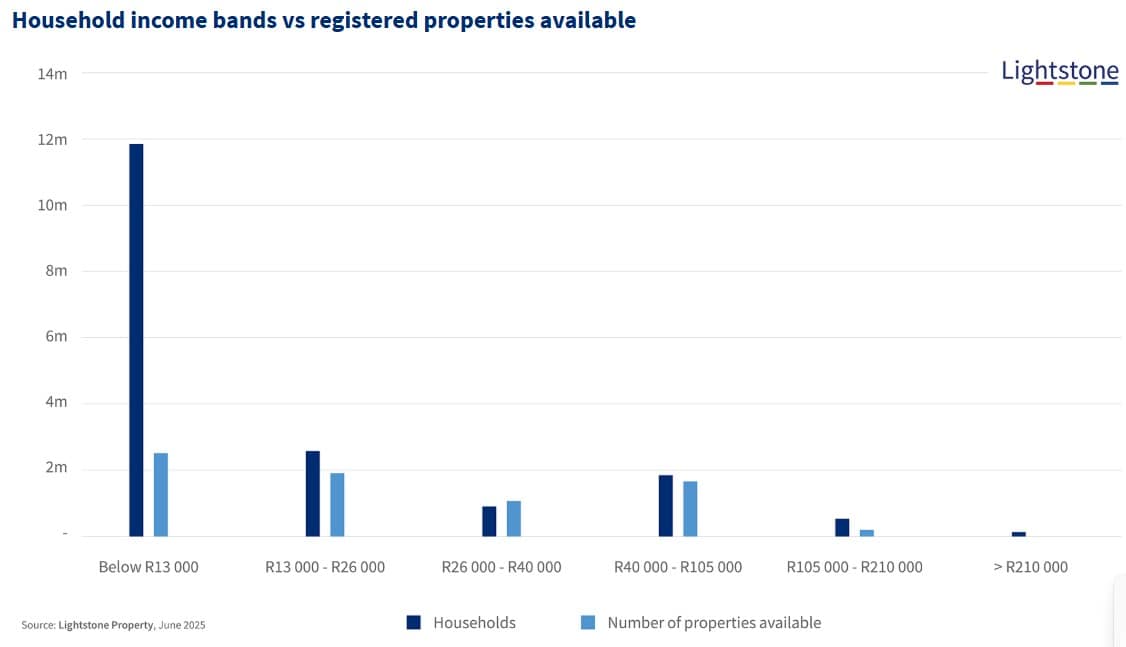
Above: A graph showing the available properties for relevant income groups. Picture: Lightstone Property.
19.2 million on social grants
Ramokgopa’s medium-term development plan speech from Friday also stated that 19.2 million social grant beneficiaries had been supported in 2025.
Additionally, 452 302 South Africans relied on food and nutrition programmes, while 120 935 gender-based violence (GBV) victims received psycho-social services.
“High unemployment continues to undermine poverty reduction efforts, while challenges persist in grant payment systems and resourcing for GBV interventions.”
Ramokgopa added that tuberculosis treatment success improved to 77%, and HIV viral suppression stood at 96%, although antiretroviral treatment coverage stood at 79% against a target of 85%.
In terms of incoming investment, R44.2 billion in industrial-sector investment had been secured in the evaluated quarters.
NOW READ: Social housing projects grind to halt
Support Local Journalism
Add The Citizen as a Preferred Source on Google and follow us on Google News to see more of our trusted reporting in Google News and Top Stories.

