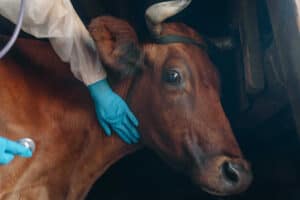
Another case of foot-and-mouth disease was identified in the Eastern Cape this week
Picture for illustration: iStock


Earlier this week, another case of foot-and-mouth disease (FMD) was identified, this time in Amahlati Local Municipality, in the Amathole District, Eastern Cape.
Chief State Veterinarian Dr Ayla Newmarch confirmed the virus was isolated on a positive PCR lab test.
“This animal was born and is an adult in the village in Keiskammahoek, where it was identified earlier this month. Backward tracing has yielded very little information, and the owner has not introduced new animals or been travelling himself.
“In the communal setting, the animals all graze together, and thus the source could be from another person or animal not yet identified. There is a team of animal health technicians sampling any new suspect cases,” she said.
KZN the epicentre of FMD
Last month Minister of Agriculture, John Steenhuisen said KwaZulu-Natal was the epicentre of FMD and added that by February next year, his department aimed to take delivery of two million doses of FMD vaccines in two separate consignments.
Beefmaster Group CEO Gert Blignaut has welcomed the government’s commitment to prioritising the fight against FMD, but said that time was of the essence.
“Our industry cannot afford delays. As part of FMD Free with Vaccination, we will also need trade agreements that allow products from vaccinated herds to enter export markets. If we can speedily negotiate this with our export partners, then this will create an environment for our industry to stabilise and pick up momentum in 2026,” he said.
“We have navigated a significantly volatile environment, and this is likely to continue deep into 2026/27. Meat prices lifted globally, and South Africa followed. Between February and May 2025, slaughter cattle prices climbed by around 15%. This was driven by scarcity rather than panic or disease-related disruptions at that time,” he explains.
ALSO READ: Can Steenhuisen hoof it?
Increase in cattle prices
Blignaut said while the impact on consumers in 2025 was shaped by tough economic pressures such as inflation and unemployment, South African beef remains among the most affordable globally.
“Although global supply dynamics supported better pricing, he says that FMD, which has plagued the industry since 2019, continues to be one of the most significant threats to and destabilising factors in the beef industry. Although FMD has been a consistent pressure point in the industry, especially in KwaZulu-Natal, the disease spread throughout the country in 2025 and then aggressively entered the feedlot industry in the middle of the year, spiking cattle prices by an additional 10%,” he said
“FMD makes it difficult to compete economically. It adds direct costs because you must put safeguards in place to protect your business, and it distorts prices in a way that ultimately impacts the consumer. FMD has evolved into an economic disease. When an outbreak hits a region, that area loses economic value immediately,” he added.
ALSO READ: FMD cases increase: Here’s how much meat will cost for your Christmas meal
Footing the bill for government failure
Southern African Agri Initiative (Saai) Executive Board Chairman, Dr Theo de Jager, said the R300 per head that farmers are expected to pay for FMD vaccines, according to the Department of Agriculture, was excessive.
“The disastrous spread of this state-controlled disease can be directly attributed to the incompetence of senior officials within the department itself, and farmers – who have already suffered losses of R5.6 billion – cannot also be expected to foot the bill for government failure,” he added.
De Jager said the Red Meat Industry Services (RMIS )’s most recent vaccine purchases cost R60 per dose.
“More effective, modern vaccines from Brazil and Turkey are even cheaper. Farmers find it contemptible that the state and tenderpreneurs are trying to extract excessive profits from a national disaster that has already financially ruined hundreds of farmers. The state should carry the full cost of its own failure,” he added.
ALSO READ: BMA stops illegal animal vaccines at Polokwane Airport
De Jager said the department does not have the capacity to manage this crisis, and there is no alternative but to enter into a partnership with the private sector.
“It is crucial that such a partnership be led by the private sector, free from outdated ideological considerations, corruption, nepotism, and party-political interests,” he said.
The Red Meat Action Group’s (RAG) Dr Jaco De Villiers said the solution to FMD lies in its simplicity.
“It is about establishing compartments and controlling the ground level. Not monopolisation, not centralised data control, it is about simple compartments where movement can be stopped and controlled. Where state veterinarians and officials take orders from industry, not from politicians,” he said.