Dan Corder's new book explains why South Africans are vulnerable to misinformation, conspiracy theories and political manipulation
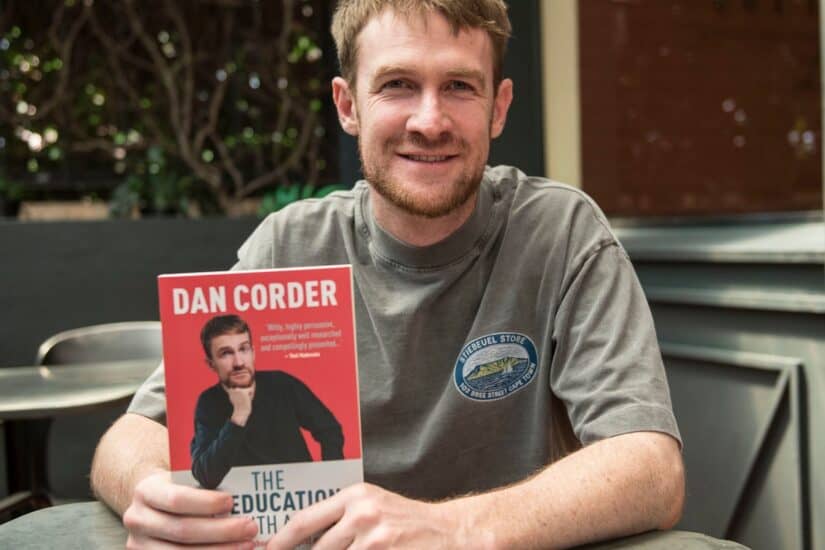
Dan Corder’s book is a must-read for South Africans. Picture Michel Bega / The Citizen


South Africans are vulnerable to hogwash, misinformation and fake news. Just throw a rock and it may land on a politician, executive or a PR practitioner who’s massaged the truth to suit a narrative. And even though history has taught us to be suspicious, inequality has divided the country and social media has provided the perfect vehicle to turn a nugget of truth into something altogether different.
Once upon a time, a politician shared, at a dinner party, that the truth comprises 50% reality and the balance, well, what is made up for the public.
These days, social media, fake news and AI fakes are making it even easier for people in the spotlight to get away with more, while voters seem relatively meek in collective demands for transparency and governance. Misinformation is everywhere, and disinformation follows hot on its heels.
It is also the stuff that author, journalist, podcaster, comedian and broadcaster Dan Corder tackles in his new book The Miseducation of South Africa.
It’s not a manual about what South Africans should think or a collection of opinions everyone should agree with. Instead, Corder wants people to know more, question more and become better equipped to figure things out for themselves. And it’s a bit of a wake-up call, too.
Question more, said Dan Corder
South Africa’s relationship with misinformation not a-typical gullible people believing nonsense on the internet. There are reasons why fake news, as Trump calls it, is sticky.
“South Africa is one of the most vulnerable countries in the whole world to disinformation and misinformation,” he said. “We are a people divided by history, as well as in the present in terms of class and wealth, employment, education access and language.”
Millions of South Africans also predominantly speak languages which, he said, don’t have built-out media ecosystems with lots of publications that can be relied upon to tell the truth.
“South Africans are prone to conspiracy theories. We are built to think, ‘Oh no, but there’s something going on here.’ Because our history has been dominated by that being true,” he said.
It is fertile ground for anyone wanting to sell a story, particularly when the best lies are not necessarily complete fabrications, like the politician once said. Corder added that because they’ve offered an initial small truth, citizens swallow the entire tale as truth.
Misinformation can also be effectively weaponised in politics.
“The more that South Africans are vulnerable to disinformation and misinformation, the easier they are to mislead about political opponents or whoever is trying to appeal to them to vote for them,” Corder said.
But it goes beyond electioneering, slogans and convincing someone that the other guy is the devil incarnate. It can also shape what voters expect from politicians once they have their bums in government seats.
Not demanding enough of our politicians
Corder said South Africans don’t demand enough from the people they elect.
“I think South Africa has a culture of not being demanding enough of our politicians. Our politicians work for us; this is literally their job, and we do not hold them accountable enough.”
While the country’s keyboard warriors may be noisy, angry and permanently arguing with one another on social media, noise does not necessarily translate into collective pressure.
“One of the effects of misinformation is to divide a populace so they can less effectively unite to demand political change,” he said.
People can become so consumed with fighting one another over competing narratives that the bloke who was supposed to fix the road, keep the lights on or make sure public money wasn’t stolen can almost become a sideshow.
The Miseducation of South Africa is not Corder’s attempt to replace everyone else’s version of reality with his own. In fact, he doesn’t particularly care whether readers agree with him.
“I don’t want somebody reading the book to just agree with everything I said,” he said. “I want someone who has read the book to think, ‘now I need to put into practice a more informed life.'”
And that, rather than telling South Africans what to think, is the point.
“The takeout is, I should read more. I should inquire more. I should be more curious,” Corder said. “It’ll lead to me having a more fulfilled and satisfying life. And allow me to be a more effective participant in South Africa as a social project.”