

Chaka’s Rock adventurer survives Nepal snow storm
Graeme Duane and two friends narrowly escaped with their lives from blizzards and avalanches that claimed the lives of 43 people in the mountains of Nepal two weeks ago.
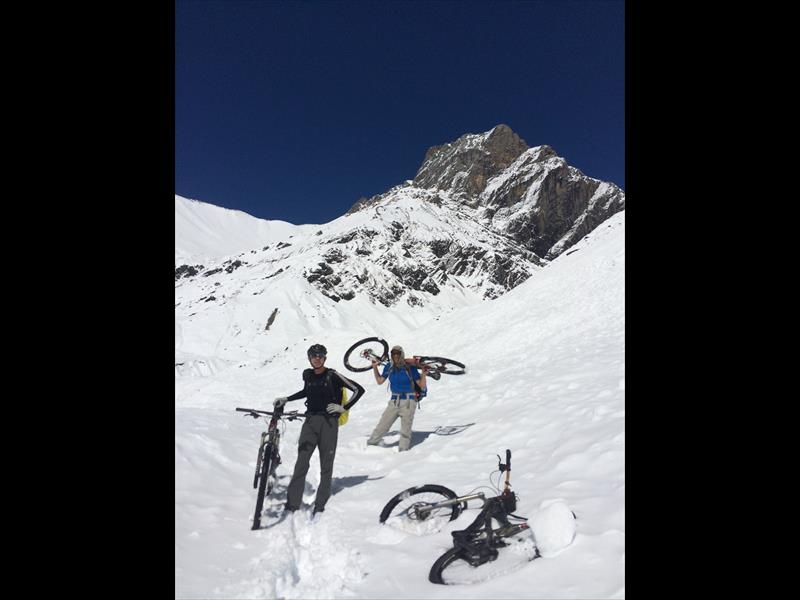
Imagine yourself stranded in hip-deep snow, soaking wet, freezing at -5 deg C, no food, and having to stop every couple of paces to suck in freezing air. Oh, and you’re carrying a mountain bike and you’re so far from safety you might as well be on the moon. Chaka’s Rock cinematographer Graeme Duane and two friends narrowly escaped with their lives from blizzards and avalanches that claimed the lives of 43 people in the mountains of Nepal two weeks ago.
Graeme tells his story to Editor Bruce Stephenson.
It started out as a great adventure. Graeme and fellow adventure junkies Cuan Cronje and Dean Burscough set off to conquer the challenging Annapurna circuit, a 250km trek through the Himalayas that circumnavigates Mt Annapurna, the 10th highest peak in the world. It’s normally about a 21-day hike, but some hardy souls have conquered it on mountain bikes, so the trio felt no twinges about loading up their bikes and flying off to Katmandu. They were fit, had done altitude training at Sani Pass and felt ready.
Graeme takes up the story: “We entered the Manang valley at 3600m above sea level – feeling strong and blasting the single-track reward of pushing up to Nawal village. The track was firm and dusty, the weather was perfect. The scenery totally breath-taking. The only snow was on the high peaks above 6000m – Annapurna III and IV loomed above us.
“Just before Nawal we took a tea stop at Upper Pisang, prayer flags ripping in the wind, with plenty of tourists milling around the Gompa. Among them, only revealed in photos, was Matt Adams, a big Canadian on a lone mission on the trail. Our paths would cross in a big way over the next few days. We had no idea how this awesome trip would change.”
Unlike the masses that plod up towards Thorung La pass at 5400m, they decided to tackle a lesser used pass – Mesokanto La, which lies a few miles north west, around Tilicho Lake, one of the highest tarns on earth. It was looking good, no snow up at 5500m, and they were feeling strong.

The last two thirds of the way involves traversing steep scree slopes left by glacial deposits – a 45-degree wall of loose rock and dust with a one-foot bevel on which to walk. They could ride most of it, but steep switchbacks involved tiptoeing along rock ledges that plunged 200m into the river valley below.
Overnighting at Tilicho base camp with 80 other hikers, it started snowing heavily. A teahouse is a basic stone barrack with uninsulated rooms and a communal kitchen/eating area. At this altitude there are no trees, so there is little to burn for warmth. Food is prepared on fires fuelled by burning Yak droppings, and there is not that much around.
“We had cold weather gear and down sleeping bags, and we spent most of the day wrapped in everything we had. We considered leaving right then and there – back to Manang, but it’s a good thing we didn’t.
“We heard later that over at Thorung Pedi, the base camp for the Thorung La pass, a group of hikers were coaxed out of the teahouse by their host, in return for money. He was to guide them back down in return for 1000 rupees each. As we lay in our bags on Tuesday morning, they lost the trail, became disorientated; hypothermia set in and some were already dead by midday.”
The South Africans had a timetable: they had to fly to the UK on Saturday. Food was running out and the Nepalese advised them to head down for the river in the valley bottom and follow it to a bridge, from where they would be able to cycle back to safety. They decided to head out, accompanied by Canadian Matt, who would break trail for them through the snow. They struggled through deep snow down to the river where they hoped conditions would improve, but it got worse.
At 4:45pm they were faced with a river crossing.
“From 100 metres off we could see that there was no other way down. Sheer cliff on the left, broad flat bank on the other side. The water was freezing, but we made it across. Cuan and Matt almost fell in.

“As we reached the opposite slope, darkness was setting in. It was a terrible feeling. The battle to survive had begun. We’d eaten two boiled eggs each that morning, but we had little food. A bag of nuts and some energy bars. But it was warmth that we needed.”
They found shelter under a pine tree and started a fire with pages from a novel, then collected wet twigs and slowly built a fire that warmed them up. A Nepalese porter appeared out of the dark, warmed himself at their fire and said the bridge was only an hour ahead, so Matt decided to go with him. The others realised it was decision time.
“We said ‘If we sleep here, we’re all going to die’. There was little doubt in my mind. Greeting the sub-zero dawn in a wet sleeping bag is a recipe for disaster and we knew it,” says Graeme.

They taped torches to their helmets and set off through the freezing night. Every step was an effort, but they knew they had to keep moving. At 2am they found a dry spot at the base of a cliff and huddled down to wait for dawn. Inside their sleeping bags they were still freezing and did sit-ups to keep warm.
When they woke, their socks, trousers and boots were frozen solid. They had to thaw them out by dipping them in the glacier-fed river!
“I was worried and I began to realize that we hadn’t been in contact with our wives – Tessa, Noleen and Lucy. The plan was to check in when we crossed the pass, but that was two days ago. Now I worried that my family was worried, but we had no idea that this snowstorm had hit the international news.”
By that stage 24 were missing, and bodies were being found around Thorung La and Thorung Pedi, another base camp. The deaths were going out on the news and their families were understandably in a state of panic.
“Even without this knowledge, lying exposed in the Himalayas not knowing what’s going to happen next, and thinking of your wife and family back home is a terrible feeling. You feel so far away, and you realize that you’re in a situation like you’ve seen in the movies, but that this is real, and that’s not a comforting thought.”

On day three they finally struggled to a teahouse where they wolfed down soup, and slept. The next day they cycled about 90km back to the start point at Manang. Graeme said they never considered leaving their bikes behind. They came to ride, and what a ride they got!
Safely back in Chaka’s Rock this week, Graeme hasn’t come to terms with, on the one hand, being elated at having survived, but on the other, having twinges of unease that so many died.
He believes a lot of the tourists were ill-prepared for such an arduous hike, let alone a freak blizzard.
“Perhaps because of our exposure to outdoor life, South Africans are better equipped to make practical decisions. We’re better at problem-solving. I don’t know how we did what we did, physically, but we just knew that we had to push on, whatever, and we kept doing it for 36 hours.”

Back home, a wave of relief spread amongst his family and friends in the community. His wife, Tessa, and parents, Keith and Anne Duane of Simbithi, are used to his sometimes hair-raising job of swimming with and filming sharks and crocodiles, but the tension while news of a mounting death toll came in was unbearable.
Says Tessa: “Deep down I believed he would be okay, but it was hard to keep my anxiety under control. There were so many people praying and the support from the community was amazing while we waited to hear if he was safe.”

And would he do it again?
Graeme only hesitates for a second. “Right now my wife doesn’t want me to do anything more than the Midlands Meander, but yes, we want to do it again. In better weather next time.”
* Graeme will tell his story, with photographs and video, at All Souls church, Salt Rock, on Friday, November 7. Tickets R150 in aid of Summerhill House. Book through Lisa at 083 763 6864.
Stay in the loop with The North Coast Courier on Facebook, X, Instagram & YouTube for the latest news.
Mobile users can join our WhatsApp Broadcast Service here, or if you’re on desktop, scan the QR code below.