Army worm infiltration being closely monitored in Dundee district
According to Gerhard Verdoorn, director at the Griffon Poison Information Centre, the worm moves with passages of winds and weather fronts and also through host plants.
Incidents of the fall army worm (Spodoptera Frugiperda) infestation on maize farms in the district are being closely monitored.
The KZN Department of Agriculture and Rural Development confirmed that there had been reports of fall army worms in maize crops in the northwestern districts of Northern KZN and in the northeast.
The first appearance in this area was in the Fort Mistake area and was identified by Cameron Fogg of Farmers Agri-Care, a local company that specialises in crop protection for agriculture.
Fritz Botes, on whose farm, Nkunzi, the worm was found, told the Courier that the worms have been identified attacking young maize plants but can also cause damage to the cobs in older plants. It can be effectively controlled if identified at a young age and pesticide for the control of the army worm is available.
‘We need to learn as much as we can about this invader as it is a totally new pest to us’
Brian du Toit of Farmers Agri Care said farmers had to be vigilant to ensure that the intrusive worm was not present on their lands. “We are closely monitoring the presence of the moths in the area that lay the eggs that hatch into the army worms that then do the damage. We have imported pheromone moth traps from the USA which attract the male moths so we can monitor the presence of the moths in the area.
“There is no need for panic. We need to learn as much as we can about this invader as it is a totally new pest to us. It can be easily confused between the stalk borer (Busseola Fusca) and the African Bollworm (Helicoverpa Armigera) yet the army worm is a more aggressive feeder. In future, we will have to strategise our spray programs as we are dealing with a totally new pest”.
Description
Fall army worms are similar in size and shape to other moths in the cutworm family. They are greyish in colour with a wingspan of about 1.5 inches.
The front wings of the male are a mottled greyish colour with white markings near the wing tips. The front wings of the female are similar, but the markings are less distinct.
Fall army worm eggs are laid in clusters of 50 or more in a single layer attached to foliage. Eggs are dome-shaped and dirty white to grey in colour. After egg deposition, the female deposits greyish scales over the egg mass, giving it a hairy or mouldy appearance.
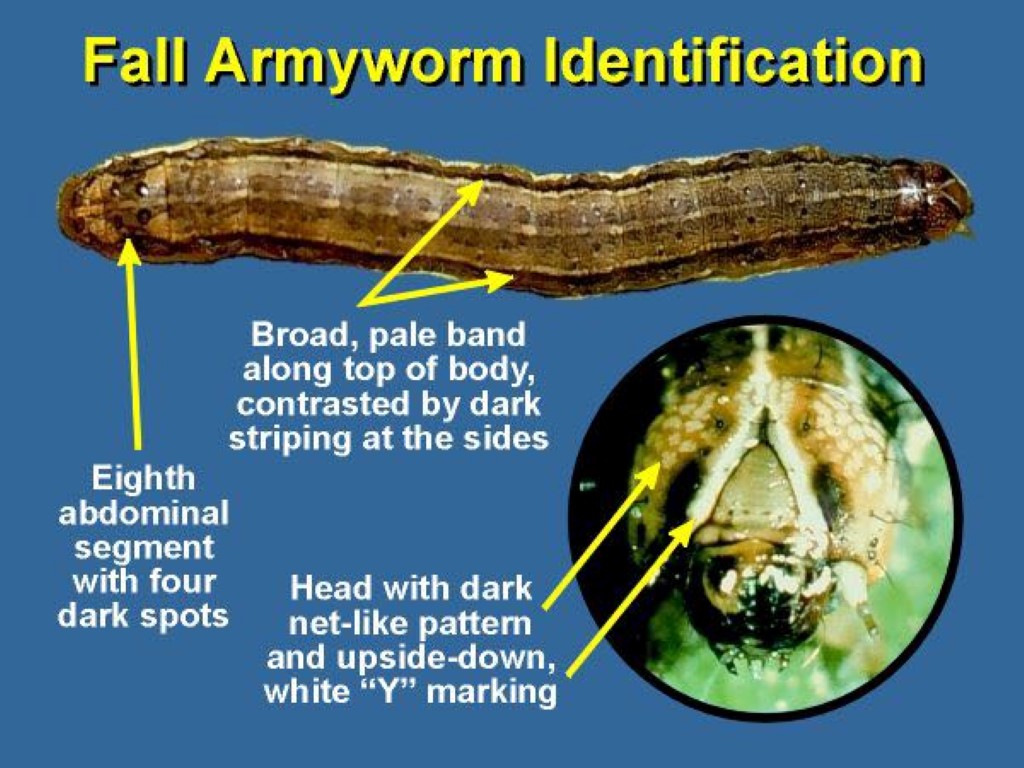
Below are definitive identifying characteristics of the Fall Army Worm
1. White inverted ‘Y’ shape on the head.
2. Head is normally black and the same size as the thorax (not smaller).
3. Body is not hairy but there may be bristles on it.
4. Body colour is normally dark, with many black dots, on the tail section, there is a square shape of four dots (forms a perfect square outline).
5. The last section of false legs emerges directly under the body and not at an angle like a bollworm.
Fall army worm pupates in the soil, and pupae can be identified by their smooth, leathery skin that is reddish-brown to dark brown.
According to Gerhard Verdoorn, director at the Griffon Poison Information Centre, the worm moves with passages of winds and weather fronts and also through host plants.
“They can move thousands of kilometres a week and anyone growing maize, sugar cane, sorghum, soybeans, groundnuts and potatoes is warned to be on the lookout and to contact a pesticide supplier should they suspect an infestation.” The moths originate from central and South America but last year were spotted in Nigeria and have moved south.