Newcastle the ‘Cannabis destination of the world’
The hardest battle in the ‘cannabis war’, according to Dr Jamalodeen and those who support his efforts, is overcoming the stigma that surrounds the plant, and educating the public to understand the decriminalisation of cannabis and the farming of industrial hemp is not ‘an excuse to get high’.

Dr Ahmed Jamalodeen is one step closer to realising his dream, of turning Newcastle into the ‘Cannabis Destination of the World’.
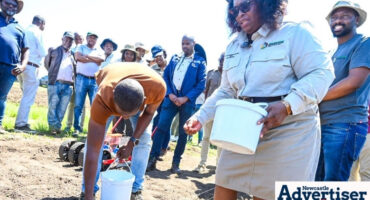
South Africa’s first crop of legally grown industrial hemp has just been harvested on his Normandien farm, Leeds Boerdery.
Dr Jamalodeen, a general medical practitioner, businessman and seasoned farmer, began planting hemp (cannabis sativa) in December last year, when he became the first commercial farmer in the private sector to receive a government issued permit to do so.
The rest of the family-owned 5 000 hectare farms are used for cattle farming, as well as the planting and cultivation of timber, pecan nuts, soya, maize, barley and other crops.
“This is the future,” says Dr Jamalodeen about his decision to farm cannabis.
“Making this project a success requires mass collaboration between community safety groups, SAPS, medical societies, trucking groups, banks, insurance companies, government, agricultural institutions, regulatory bodies, etc. There is huge excitement among all the role players. It will bring global markets to our doorstep and foreign currency into KZN. It will increase the value of farms, recondition the land and create the opportunity for farm labourers to be paid bigger salaries… But are the people in Newcastle ready for it?”
The hardest battle in the ‘cannabis war’, according to Dr Jamalodeen and those who support his efforts, is overcoming the stigma that surrounds the plant, and educating the public to understand the decriminalisation of cannabis and the farming of industrial hemp is not ‘an excuse to get high’.
“It’s not that kind of crop,” he explains.
“There are two types of cannabis. There is cannabis sativa and cannabis indica. Sativa is CBD (cannabidiol) based, which is non-psychoactive and used for medicinal purposes and for pro-active disease control. It has very little THC (tetrahydrocannabinol), which the psychoactive component that makes people feel high. Indica is much higher in the THC. We are planting industrial hemp. You can’t get high with this.”
Internet sites tout more than 60 000 uses for the hemp plant, including applications in medicine, pharmaceuticals, science and technology, clothing, plastics, biofuels, and even construction.
“We are just the pilot project and we are still learning, but now that the first harvest is out we have begun exploring possible uses, looking into which companies have an interest in working with hemp or adding it as a product line, and investigating who has the expertise to drive the industry forward. For example, we know the roots of the plant can be used for tea, stems can be used to make hempcrete, which is used to make environmentally friendly building material, the flowers can be used to make oil, and the seeds can be cold pressed to extract omega rich hemp oil. The waste product is high in protein and can go into livestock feed. We can also give out seeds to other farmers, so they won’t have to bear that cost.
With more than 60 000 uses identified for the hemp plant, no part of the plant is wasted. It is massive and it is just the beginning, but we do what we do in love and friendship with each other, so we are actually having a good time,” explained Dr Jamalodeen.
Hemp offers the opportunity to develop numerous innovative and sustainable alternatives to everyday products.
“Levi’s is now making hemp jeans. Local clothing manufacturers need not miss out on this opportunity. Brand named clothing may be too expensive for most people, but South African clothing manufacturers, who are confident in their design, style and quality, can now explore this option,” continued Dr Jamalodeen.
“When we say 60 000 uses of hemp, we are just getting started. When it was illegal, research could not be done. Now that it is becoming legal, people are starting to use it to make faux wooden flooring, blinds, plywood, chip board and even cosmetics.”
Dr Jamalodeen urges local business and farmers not to look at hemp as a product that will compromise or replace their current initiatives, but to look at including it in additional product lines that will complement their current activities.
“It is a new product, that’s all. In farming, it is just a new crop,” he said.
“It offers better crop rotation and it rejuvenates the soil. It doesn’t require pesticides or herbicides and I was able to show that you can plant hemp, here, in winter, which makes it a two-season farm. Other places in the world do not have the benefit of our latitude.
“If we all try to be the best in our fields of industry, hopefully that will attract foreign interest and tourism. I will just try to be the best farmer, and then the next person takes over from there. Everybody down the line benefits and it create more employment and opportunities to plough back into charities that support the vulnerable in our communities.”
Dr Jamalodeen has been instrumental in introducing an IKS (Indigenous Knowledge Systems) Tax applicable to South Africa’s cannabis trade, which will fund the research, practices and cultural preservation of the nation’s traditional healers, alternative medical practitioners, Amakhosi, Khoisan, and Rastafarians.
“The idea is the sustainability of charity,” he stated. “We can only move forward if we support each other.”
“Hemp has become a catalyst for unifying common minded people all over the world who are looking for sustainable, environmentally friendly, cost-effective solutions.
“We want to bring the world to South Africa and to KZN and Newcastle in particular, and say, ‘We are open for business!’ It is time to do away with the stigma.
“This is an onward battle… But, the truth will flow out like a river,” concluded Dr Jamalodeen, quoting Bob Marley.
“There is nothing to hide. See it like it is. For everyone a place and a place for everyone.”
ALSO READ: How legal is dagga really? What you should know before you light that joint
Contact us
WhatsApp: 082 874 5550
Email: Reveshni Douglas (Editor) at reveshni@caxton.co.za
Make sure you follow us for regular updates: